Sunday, January 29, 2006

Nanny McPhee

How It Rates: ***
Starring: Emma Thompson, Colin Firth, Angela Lansbury
Rated: PG
Red Flags: Some mild references to gas and some comic grossness

Harry Potter And The Sorcerer's Stone kicked open the door to a new genre of family film: the comic-fantasy costume drama -- refined for the adults and yet visually dazzling and accessible for the kids. Nanny McPhee would have never existed had it not been for Potter's success. It is mannered yet naughty, proper yet gross, and very, very British. Credit Emma Thompson, who adapted the screenplay from the "Nurse Matilda" books of Christianna Brand. The film has an easily deduced Francis Movie Equation: Mary Poppins + Harry Potter + Lemony Snicket's A Series Of Unfortunate Events / Sense & Sensiblity.

The film plunges us into early 19th-Century England and a beautiful countryside estate, where the seven obnoxious children of widower mortician Cedric Brown (Firth) have managed to drive out all 17 nannies sent to care for them. The nanny agency is fresh out. Their father -- who spends more time with the dead than his children and talks to his dead wife's empty chair -- needs to find someone else fast. He also needs a new wife, or his uptight great aunt (Lansbury) will cut him off from the money he and the children need to maintain their standard of living it up. A scullery maid, Evangeline (Kelly Macdonald), observes all this with sympathy. She seems to be the only person who really connects with the children.

Cedric keeps hearing about a "Nanny McPhee." Hiring her is right difficult, mind you. She doesn't seem to work for any agency, and the kids cut her address out of the paper. But one night, McPhee (Thompson) mysteriously shows up at the door, an ugly Mary Poppins, warts and all. Maybe she works for the Wicked Witch of the West. Is she a good witch or a bad witch? Both, actually. All it takes is a tap of her magic staff to start the kids on the road to mending her ways. McPhee says she has five lessons to teach, and as the kids learn, it's not just their behavior that will start looking better... hint, hint.

Thompson gives her character dark and laconic charm, doing little more than grunting at times as she observes the family she is minding. It's fun just to watch McPhee disappear and reappear at will with the mannered explanation, "I did knock." But also charming is Lansbury, the snooty, snobby aunt who puts the crust in upper crust. Also enjoyable: Celia Imrie as Selma Quickley, the gaudy widow who is about to become the children's new stepmother, something that never amounts to anything good in every fairy tale we've been told.

And that's just what Nanny McPhee is: a fairy tale. It plays out like a bedtime story, full of color, morals, and naughty children who eventually learn the consequences of their actions. Emotionally, it is not deep outside of its happy ending. The film is so busy telling its story it doesn't give its characters much depth. Maybe it rips too much style from Mary Poppins.

Oh come now. You didn't worry about character development when you were snuggled up in bed, did you?

Friday, January 27, 2006

Truth, Lies, and Oprah Winfrey

Oprah did a big thing for a big media star. She admitted she was wrong. On Thursday's show, she apologized to her viewers for supporting recovering drug addict James Frey's so-called "memoir" A Million Little Pieces after he admitted several of those pieces were made up. She said she was sorry for calling Larry King to defend him. And as Winfrey grilled Frey over the course of an hour, more of his story went up in smoke.

But she didn't stop with Frey. She went after his boss, publisher Nan Talese, who explained the book was vetted, not fact-checked. For those of you outside the book business, that means the text wasn't scoured for accuracy but merely scanned to make sure it wouldn't get the publisher sued.

"Well, that needs to change," Oprah said.

Maybe it does. But I still pity Talese. She took a man at his word and got hung out to dry. Then again, how much trust can you put in a recovering dopehead? They've hurt their family, their friends, their co-workers and everybody within a reasonable radius. Trust must be earned. Taking his story at face value -- especially the now infamous bit about the no-novacaine root canal -- seems naive.

What should've happened and didn't was this: Talese should've sat Frey down, face to face, and said something along the lines of, "Mr. Frey, you have written a highly compelling and amazing work of non-fiction. And for all that's holy, it better be non-fiction. My company is devoting quite of bit of money and dead trees to putting your story into readers' hands. We will not be suckered. I want to know right now if there's any facts, scenes or memories you've stretched for the sake of more compelling copy. If there are, you have one chance to redeem yourself and rewrite them. If you tell us no and we find out otherwise, you will be dropped from our shelves like two-week old milk."

And as usual, we find warning signs were brushed aside. A drug counselor who worked at Frey's treatment center said parts of the book weren't true. But Random House backed Frey to the max, and that was good enough for Winfrey. It would have been good enough for a lot of us, if you're of the reasonable impression that a publishing giant wouldn't risk its reputation by hawking a made-up memoir. Then The Smoking Gun dug up more discrepencies. That should've been enough.

Yet Winfrey called into Larry King and called the allegations "much ado about nothing" -- even after Frey admitted moments earlier he'd made things up.

Oprah is a big-picture person. I'm sure she believed the totality of Frey's anti-drug message mattered more than some factual pockmarks. But what she forgot is how much honesty has been watered down as a virtue. Arizona Daily Star cartoonist David Fitzsimmons pointed out "The New Standard": "I agree with Oprah. He lied. Big deal. No troops died."

I don't want our kids -- or anybody else -- learning it's okay to make things up and call it the truth if you're serving some greater good. Substance abuse is ravaging enough without the need for hyperbole, so Frey didn't even need to spice things up. I don't want our media giants backing these people who think they can cheat and win. Oprah did the right thing, but a touch late. That call to Larry King should've put some heat on Frye's behind instead of lipstick.

What I want to see now is Frey get his story right on paper. Random House should recall all copies of "Pieces" that haven't sold and force Frey to rewrite the book, excising his excesses and presenting what really happened. When that revision hits shelves, the millions of people who bought the original text should have the opportunity to exchange it for the true story. They paid good money for what they thought was the truth. They deserve to get it.

And Oprah, I accept your apology, even if it is late. You've done too much good for others and owned up to your faults. But what took you so long?

Wednesday, January 25, 2006

New Name, Old Stations, New Troubles

The UPN and WB television networks are merging to create the CW network this fall. Couldn't they have come up with a better name? "CW" flashes me back to my ham radio days. Maybe we should've added just one more letter -- like UWB? WBU?

But put that aside. While the merger is good for the guys at CBS (which owns UPN) and Time-Warner, it's going to be murder on their affiliates.

Here's the rub: WB and UPN both spent years building their affiliate bases. WB even created a cable-only network called the "WeB" to get into markets where they didn't have a broadcast outlet. A deal with Tribune put it on Chicago superstation WGN in the early years, giving it national coverage. UPN managed to scrape by with a hodge-podge of full-power affiliates, owned-and-operated stations, and several low-power affiliates that existed mainly to feed cable systems.

So after years of trying to get national coverage, we have numerous TV markets with both WB and UPN affilates. The question now is, who gets the new network?

Here in Tucson, we have UPN affilate KTTU and WB affiliate KWBA. I have no idea where CW is going, but this is what I see:

Scenario 1: KTTU gets CW. I'm putting my money on this one, mainly because of ownership. KTTU is owned by Belo, a powerful media company which also owns KMSB (Fox) in Tucson. Belo also runs the WB affiliate in Phoenix. I'm betting Belo will have enough corporate muscle to make deals in Tucson, Phoenix and maybe a few other markets. Never mind KTTU is mainly the second-run station for a lot of KMSB syndicated material along with more than a few informercials.

Scenario 2: KWBA gets CW. This could happen if Cascade Broadcasting argues KWBA has a higher profile in the community. It certainly can, even though it just ended its newscast partnership with KOLD. It has a recognizable personality in weather anchor/"Buzz" hostess Joan Lee. At one point, it was the WB's Station Of The Year. However, Cascade Broadcasting is not a major player. It's now only a two-station group, with outlets in Tucson and Louisville. It just sold a station in Oklahoma City.

Depending on where CW goes, that raises the question of what happens to the station left out in the cold. If KTTU were shunned, I'm thinking Belo would hold onto it as a true independent and use it as a re-run station. If KWBA is shunned, it might well cover the gaps with more syndicated programming or movies.

However, here's another possibilty. Maybe the losing station decides to flip to Spanish-language programming. It's certainly doable: Azteca America is on the air here, but on a puny low-power station nobody can see without cable. Univision and sister network Telefutura are both doing well here, and they have stations with the wattage to get them into homes. Telemundo is also doing all right. Azteca would love to have some of that pie.

Yet another possibility: a religious broadcaster like Daystar or TBN moves in, buys a station and flips to all God, all the time.

We shall see what happens in Tucson, but elsewhere, I wouldn't be surprised to see some UPN or WB affilates flip to Spanish, flip to religion, or flip off the transmitter entirely.

Sunday, January 22, 2006

The New World

How It Rates: ***
Starring: Colin Farrell, Christian Bale, Q'Orianka Kilcher
Rated: PG-13
Red Flags: Ye Olde Violence

Francis' Theory of Movie Equations states any new movie can be expressed as an equation of older ones. So take Dances With Wolves, add Titanic, multiply by Pocahontas, and divide by Memoirs Of A Geisha and the result is The New World, a trippy, skippy adventure short on dialogue and long on ambience. The title might lead you to think it's another period-piece adventure, focusing on the settlement of Jamestown and the romance between the formentioned Indian princess and Captain John Smith. It is, and it isn't.

Director Terrence Malick explores uncharted territory of the soul as his characters explore the vast wildnerness and danger of early America. The New World is more about love than land, which explains why so much of the story of Jamestown is glossed over: the population of the settlement with too many gentlemen and not enough laborers, the disasterous first winter where dozens died, and efforts to make glass. Wait, that last one isn't mentioned at all. If you want authenticity on the English side, go somewhere else -- like Jamestown Settlement in Virginia.

The story revolves around Smith's (Farrell) romance with Pocahontas (Kilcher), who as we know, saved Smith from execution by Powhatan tribal members. But this is no Disney movie. The natives -- or "naturals" as the film refers to them -- are portrayed exceptionally well down to them not speaking a word of English. The awkward first encounters between the settlers and the natives are filled with authentic tension and dread. Pocahontas, though loved deeply by her tribal king father, eventually falls out of favor for giving too much comfort and aid to the settlers. Smith, likewise, gets into trouble over fancying a natural.

The film is filled with grandeur, hyphenated by flashes of thought and snapshots of joy. At times it plays like a rock video. At times it plays like a memoir, with characters narrating the story as if they were writing letters back home to England. We see several takes of Pocahontas skipping through the fields, dancing among the natives, doing cartwheels on the lawn. And yet an early sequence of the colonists discovering the land that would be their home holds long without dialogue, underscored by a musical cresendo from James Horner, conveying to us the awesome wonder the settlers must have felt upon seeing the greenery of colonial Virginia.

To call The New World an historical epic doesn't fit, for it is neither completely historical nor epic. It is more of a scrapbook with pieces stiched together. Films with historic themes can easily drift into tedium when filmmakers feel obligated to stick to the textbook. Malick does not, and while you may not care for that approach, you certainly won't be bored.

Sunday, January 15, 2006

If You Can Walk...

Making History, Making Merry, Making Up For The Past
Oh no. Not now.

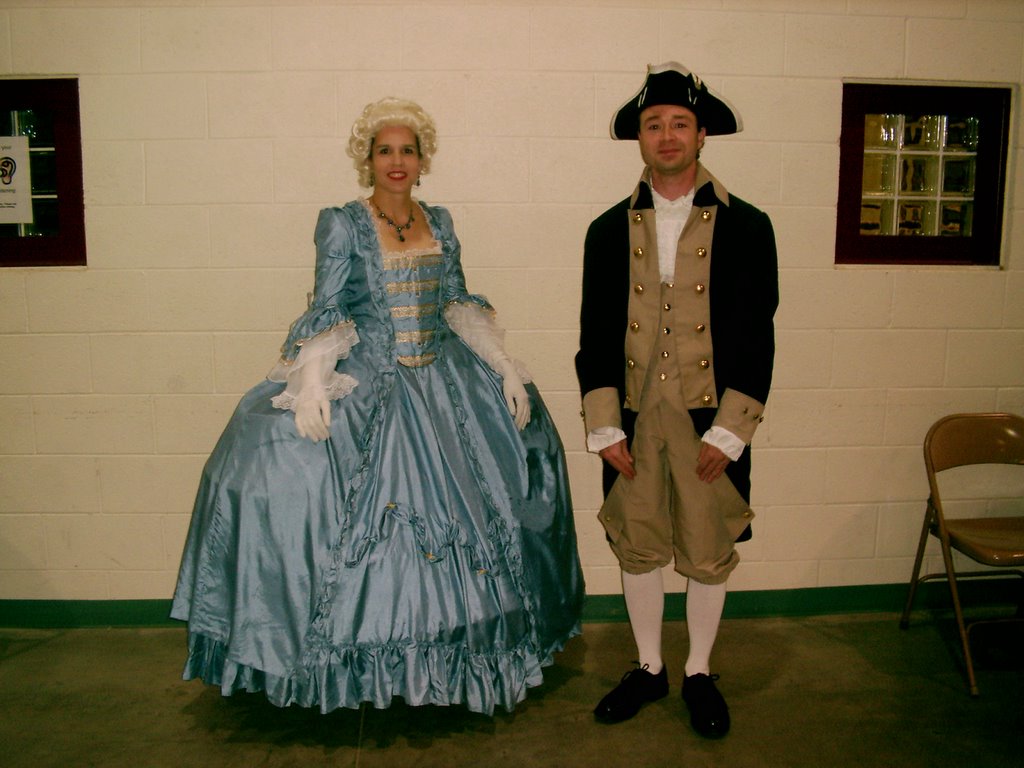
My eyes locked on the barren patch of brown fabric where a gold button used to be. How did I not see that on the coat before I walked out of the costume shop? This beautiful brown and blue colonial outfit with the matching breeches, waistcoat and shirt now had a gap as obvious as a missing piece from a jigsaw puzzle, one high up near the collar where others would surely notice it.

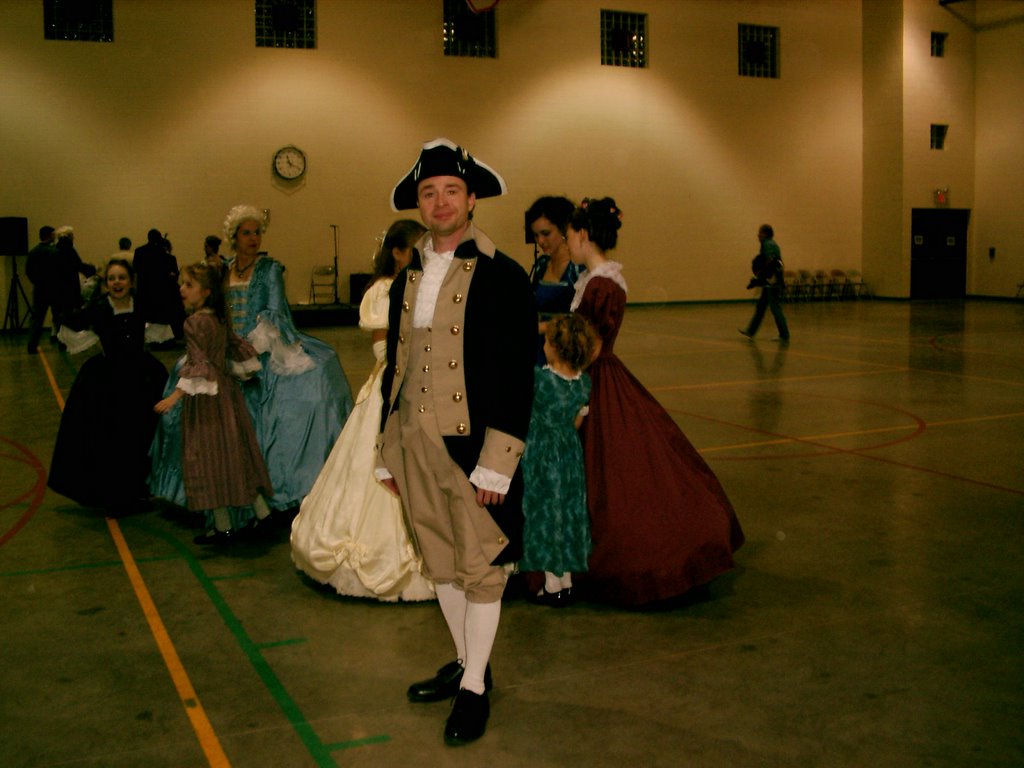
I searched for the precious button all over the motel room floor. I dashed back out to the car and felt through the trunk. Dejected, I returned to the room. Sigh. Just another thing to worry about as I prepared for Her Majesty’s Royal Court Ball, an event in Mesa 100 miles away from home and 200 years in the past -- a night of 18th Century fashion, courtly manners, bows and curtsies, and lots of period dancing as organized by the Phoenix-area re-enactment organization “We Make History.”

In the shower I worked on a way to fit it into my character. The night before, an e-mail newsletter suggested we might all want to adopt a noble title. Knowing almost nothing of royal rank, I crammed information into my head from a furious Google search. I adopted the title of Viscount Francis -- below an Earl, above a Baron. I’d hashed out a backstory for my historical character: a nobleman who had returned to Europe after traveling in the colonies.

My chosen outfit would make me appear more soldier than gentleman, but I hadn’t worked out that discrepancy. I still had to figure out the button part… a-ha. I had traveled long and far by carriage, and because of delays in my transportation and the hurry to arrive in time for the festivities, a button fell loose and disappeared with no time for a fix. That wasn’t far from the truth: traffic outside Phoenix had mysteriously slowed to a crawl in some stretches.

But then came a miracle. The errant button had landed in the cuff of the coat, and it fell out as I slipped into costume. I dug out an emergency sewing kit from my travel bag and quickly re-attached it with a safety pin. The puzzle was solved!

Now came the first long walk of the night: from the motel room to the car in the full regalia, topped with my white-trimmed tricorn. I had parked as close as possible to the room to avoid awkward encounters, but I might still run into a few wide-eyed guests.

“Do not be alarmed if you see a man in colonial attire walking down the steps,” I advised the desk clerk upon check-in.

I made the walk quickly. Only one person spotted me: a man walking from the pool. But he slowed not a step. I saluted him. He saluted back.

My ride rolled up to the Fitch Center’s gym -- the ballroom for this occasion -- a quarter before six… fifteen minutes before the official arrival time. I sat in the car and peered through the open door, not wanting to walk in too early.

I got out after a few minutes of nervous anticipation.

This is it, I thought. No going back now. You said you couldn't have a do-over, but you could have a do-right.

* * *

Through four years of high school, I had a lot on my agenda: grades, getting into college, competing with the speech and debate team, and moving with my family from Kansas City to St. Louis between my junior and senior years.

Prom did not make the list. That landmark of the high school experience meant as much to me as a class ring at a time when I didn’t even wear a watch. Acquiring a date seemed an insurmountable task. I had learned to live without a girlfriend back in middle school, when puberty, cliques and open hostility towards nerds conspired to shove me into the outer circle.

I took the blame for that -- too out of touch, too nerdy, too smart, too shy. And although my friends on the debate team admired me, the desirable girls there were taken.

I couldn’t dance, either.

Maybe in another age, somebody would have insisted I learn the social graces of movement, but those days were gone. Even dancing at a couple of weddings in the family with some guidance from a relative felt awkward.

Square dancing in middle-school gym class filled me with dread. Girls hated me. They only joined their hands to mine because a teacher made them. Other boys would snicker at my unlucky partner, forced to cavort with some virus on legs.

By high school, the square dances ceased. But the damage was done, shadowing any thought of more frolicking in sets and figures. And here I had come, two decades later, to do exactly that same thing again.

* * *

“Greetings!” chimed Lord Scott in his light-blue colonial outfit as I entered through what I thought was the front door.

“Christopher Francis of Tucson,” I replied, slipping into my clipped British accent, removing my hat, and doing my best 18th Century bow before the master of ceremonies.

“So glad you could make it,” he welcomed and directed me to the front desk where I could check in.
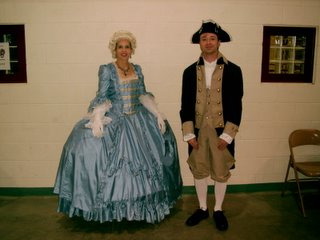
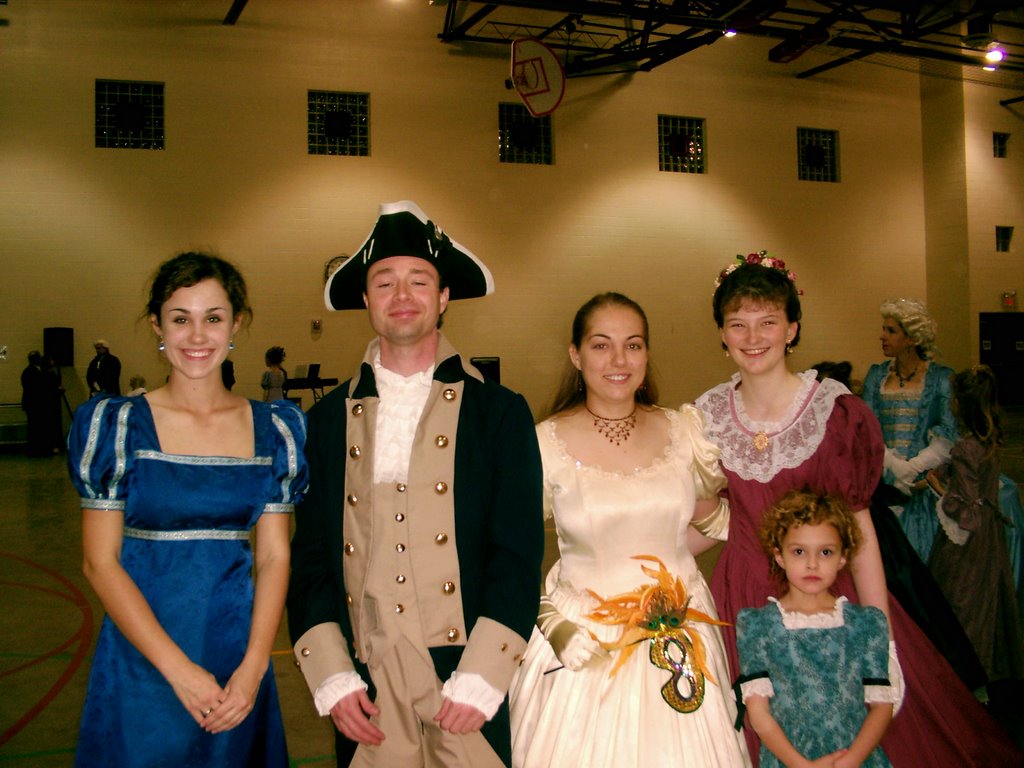
I spent the next hour acquainting myself with people who strolled in. A kind gentleman had nothing but encouragement for me upon hearing this was my first ball, advising me not to be shy in asking a lady for a dance. I met a couple and their son from Prescott, also newcomers, and mingled with a group involved in Arizona student government. Topping things off, the lady of honor for this ball, Her Majesty, gladly offered to pose with me for a picture (at left).

“We don’t usually start slipping into character until 7:00,” Lord Scott advised. “But you may start early, if you wish.” I was already into my accent full throttle.

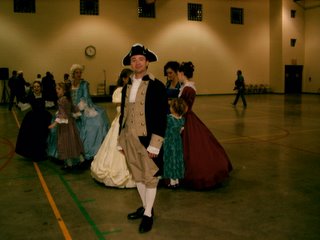
The musicians -- a piano player and a flutist -- tuned up as various people dressed from various points on the timeline strolled in. Eighteenth-century nobility in wigs and tricorns mixed with a Renaissance maiden or two. Fine ladies in floral ball gowns stood by musketeers. Revolutionary War patriot soldiers made it in, and fortunately for them, no redcoats were after them. A Spanish swordsman kept his weapon in check as a few characters from the Victorian era entered, along with some modern-day folks in tuxes. A Confederate Soldier emerged. So did a lone representative of WWII, and though neither were officially in the ball’s time frame, nobody minded. Children of all ages milled about the crowd, including the young princesses, eager to get started.

At 7:00, Lord Scott called us together for the Pledge of Allegiance and the National Anthem, a nod to the country whose heritage we were celebrating. And then the hands of time turned.

“Going back in time, one century, two centuries…”

Lord Scott introduced himself and Her Majesty, and the dancing began with an elegant promenade.

“Line yourselves up according to rank!”

Rank? Where does a viscount fit in this line? Nobody had told me any titles. People were forming in front of me. I had no partner. I couldn’t walk alone. In the nick of time, I spotted a young lady standing alone and bowed to her. She happily accepted my invitation.

We stepped hand in hand about the gym into various figures snaking about and around like a maze, ending in a full circle, but nothing fancy. My fears about colonial dancing evaporated.

Then the country dances began, the ones like square dances with the sets and figures and fancy moves led by a caller who would walk us through a dance slowly and then let us get to it.

The first dance, "Haste To The Wedding," seemed familiar. And as I went through the motions, I realized I’d done it before…

* * *

My education in English country dance began two years ago at Colonial Williamsburg with a simple guideline.

"If you can walk, you can dance," said the historical interpreter, dressed in period costume. "And if you move quickly, I can prove it to you.”

He lined us up in the ballroom of the Governor’s Palace midway through a tour. The rows of men and women faced each other. I stood near the end of my row, eyes trained on my camcorder’s viewfinder.

"A one couple, a two couple," he counted us off, his hands spread apart, marking the sets. "The evening starts and you all have been dancing forever, so you know what to do."

Our costumed guide explained to us that if somebody called out a dance we didn’t know, an explanation would kindly follow upon request.

"Oh it’s simple. Right hands across, left hands back, circle left, circle right, do-si-do, clap twice, two-hand turn your partner, turn to your neighbor, do-si-do, clap twice, start all over again. And you’re like, 'Is that all?' And you would do it."

And we were about to.

"Right hands across, which means across!"

I flicked off the camera and he led us through it, calling out the steps and humming in place of an orchestra. And unlike the square dances of my youth, I enjoyed it –- no vibes of animosity or hints of snickering.

I had wanted to try it earlier in the day, while watching a costumed group of women perform outside on a mild, sunny day. I didn’t get a chance, but I did learn my 18th Century honors: a bow over my strong leg, as coached to the audience by a Colonial Williamsburg dancing interpreter.

"It’s important for all of us to learn and practice our honors," she said.

* * *

The dances grew more complex, even with the help of a wonderful and patient caller. New steps were introduced and new figures thrown into the mix. I changed partners after every number, easily finding willing ladies.

Some dances deteriorated into confusion. “The Doubtful Shephard” threw us all through a loop with serpentine moves we couldn’t quite nail down after repeated attempts. We laughed it off, improvising simpler steps. No wonder that shepherd was doubtful.

Moments of levity worked their way in. At one point, the ladies cast one shoe into the middle of the floor as the gentlemen looked away. And then, on command, we scrambled for the footwear, grabbing the first shoe we could and searching out our Cinderella for a new partner.

That next dance, “Christchurch's Bells,” marked the high point: simpler figures done over and over again. All of us quickly mastered it and soon the caller stopped calling, leaving us to enjoy the piano and flute and prance merrily about one another, having the moves down by heart, just as it was in colonial times.

"Now you're dancing!" the caller exclaimed.

In those joyous moments, as I skipped among the dancers, the notion I was in a gym fell away. No basketball nets, no lines on the floor, no fluorescent lights, no PA system. I might have been dancing in 1700’s Williamsburg or London or Paris. I threw a few flourishing moves in -- a twirl here and there.

Although my heart wanted more, my lungs wanted a break, and my costume didn’t allow much ventilation. When the dance concluded, sweat trickled down my forehead. I only sat out one number while some gracious ladies lent me their fans as they spotted me cooling down.

Several breaks with an offering of punch and cookies gave us more time to relax and mingle. I managed to stay in my British accent through every conversation I had. Speaking was the easy part. Finding stylish and elevated words befitting a nobleman required much brainpower.

I forgot all about my self-appointed title of Viscount. I was simply “Mr. Francis,” to His Lordship and all others. I found it more than fitting. I had trouble imagining myself as both noble and newcomer whilst surrounded by many other newcomers, all learning steps more than two centuries old, all eager to smile through our mistakes.

“At this point, the spirit of the dance is more important than the steps of the dance,” I said to comfort a lady who felt a tad embarrassed at the mistakes she had made.

Not one lady refused me for a dance when I sought one out.

Not one.

Not one even used the perfectly acceptable excuse of sitting a dance out. I honestly felt they enjoyed my partnership, and I was quick to bow to each one of them after every dance with words of compliment:
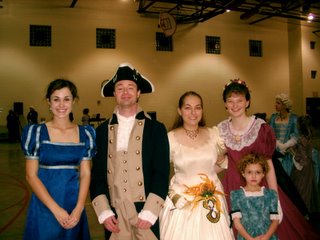
“Thank you for a most enjoyable dance.”

“You are a wonderful dancer!”

“Your enthusiasm is most kind!”

They would smile and graciously return the honors.

Her Majesty’s Royal Court Ball ended just as it should have, with a slow waltz with “your favorite partner.” I again sought out a lone lady.

“I have to warn you,” I advised, “you may have to lead me a little.”

It turned out we were both a little fuzzy on the steps. But it didn’t matter. We waltzed around the floor as best we could, enjoying each others conversation and company, myself admiring her exquisite purple ball gown and doing my best not to step on it.

I once again thanked Lord Scott before I left, and he returned it with more gratitude for my long trip from Tucson.

“Was the evening everything you anticipated?”

“Much more,” I replied.

Five hours after I had slipped into the 18th Century, the moment had come to return to my “own place and time.” With more goodbyes to newfound friends, I walked back to my car and made the drive back to the hotel in silence, reflecting upon the evening and its significance in my life so far. I felt like a better person, someone more well-mannered and wiser, and I didn't want to let go of it.

I had taken the next step, gone beyond dressing for Halloween as a Patriot. A lot of people could willingly play Rebels and Redcoats. But could they pull off “Strip The Willow?”

In the late hour, I didn’t run into anybody else between the car door and my room door. I slipped out of my colonial attire and began sewing up the button temporarily secured by the safety pin. The needle didn’t want to go where I needed, and I had to settle for a couple of loose stitches. I bagged everything up as instructed by the costume shop and took one more look.

Oh no.

Shouldn’t there be another button on that coat pocket?

* * *

The afterglow of the evening hindered my sleep. Joy still flowed through every part of me, hours after the fact. The piano and flute echoed through my head. I tossed and flopped on the loose sheets of the motel room bed. At least it was my own. At a colonial inn, I probably would have ended up sharing a bed with somebody, having paid for a discount room.

Seven A.M. came and I rousted myself after a restless night. I dressed quickly, checked out, and made the two-hour drive back to Tucson on the power of two glasses of orange juice. My own bed in my own time stood waiting, a place to crash and find true rest.

My feet ached to be left alone. My right calf throbbed, forcing me to limp for two days afterward. It must have been that jig we did. But next time, my legs will be stronger.

And there will be a next time. George Washington's Birthday Ball is just weeks away.

Wednesday, January 11, 2006

Tucson's News Queen?

David Hatfield's latest column in Inside Tucson Business raised my eyebrows. Here's the first few grafs:

Crown KOLD 13 and Kris Pickel the ratings victors

The race is over. The results have been tabulated. Now the victor can be crowned. In the battle among the big three local TV stations for news ratings supremacy, Kris Pickel and the News 13 team won, according to the latest ratings taken by Nielsen Media Research Nov. 3 through 30 and just recently released.

Since its breakthrough in February 2004, KOLD appears to be on a hot ratings streak.

Ahh, but ... coming up fast is Jennifer Waddell. In her debut as the lead female anchor on KGUN 9, the station's 10 p.m. newscast registered a 50 percent increase in viewers ages 25-54 year-old over a year ago. That age group is the primary target stations and, more importantly, the lion's share of advertising dollars.

There are a lot of variables that contribute to winning ratings. Some of KGUN's increases might be attributable to higher numbers locally for ABC's primetime programs but probably Waddell can rightfully be given some credit.

Meanwhile, declining fortunes continue to plague once-dominant KVOA 4's Eyewitness News. Nobody can blame Kristi Tedesco for the station's losses. Among 25-54 year-olds viewing was off in every weekday newscast, including those she doesn't anchor. KVOA is down 17 percent at 10 p.m., down 39 percent at 6 p.m., down 6 percent at 5 p.m., down 30 percent at noon and down 9 percent in the 5 a.m. to 7 a.m. slot.


Thanks, David! Kris and I both emphasize we can't do it all, not without our (heaping praise alert) wonderful staff. Pass those crowns around.

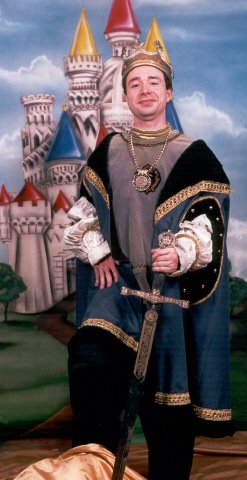
Actually, I don't look too bad in a crown. But I'll stick to my tricorn.

Monday, January 9, 2006

Fashionably Late

Here's a missing sock story that beats anything from the laundry room: The knee-length socks I ordered as part of a colonial outfit for Halloween have arrived -- three months later. The official explanation was they were back-ordered. (The outfit you see in the masthead was a rental from a couple of years back and I needed something new and different.) Amazingly, I found some suitable stockings at Wal-Mart to cover my legs. But I didn't forget. Neither did CelebrateAmerica Costumes. Thanks for coming through, folks! Those socks got here just in time for an event this coming weekend (stay tuned).

Day-O(h My Word)

UNICEF says Harry Belafonte was speaking for himself, not for us as a goodwill ambassador when he called President Bush "the greatest terrorist in the world" in front of Venezuelan leader Hugo Chavez. No comment from them about those other comments, like: "we're here to tell you: Not hundreds, not thousands, but millions of the American people ... support your (Chavez') revolution."

Does Belafonte have their names and addresses? Did he get them from the NSA's secret wiretapping program?

Goodwill ambassador... ha.

Saturday, January 7, 2006

The Producers

How It Rates: ***
Starring: Nathan Lane, Matthew Broderick, Uma Thurman
Rated: PG-13
Red Flags: Sex Jokes, Mild Language

The Producers is a remake of a remake -- a Mel Brooks movie turned smash Broadway musical turned Broadway movie musical. In the translation from screen to stage to screen again, we see again why many stage musicals are great movie musicals and many aren't.

This film yearns to have fun, and it largely succeeds, but it's out of its element. On stage, over-the-top elements are what musical comedies thrive on. On screen, they just look over the top. Case in point: a number where several little 'ol ladies fall over in their walkers like a line of dominoes. I'm sure that was a sidesplitter in a live performance. On film it's just trippy.

For those who have seen neither the 1968 original nor the Broadway reincarnation featuring both Lane and Broderick in the title roles: Max Bialystock (Lane) is a washed-up 1940's Broadway producer one footlight away from bankrupcy. His new show, "Funny Boy" -- a musical version of Hamlet -- has just tanked. In steps accountant Leo Bloom (Broderick) to help with his books. Leo, wondering out loud, notices that it's possible for a theatrical producer to make more money off a flop show than a hit, if the show closes quickly and costs less than what investors have put into it. Aha! Max and Leo hatch a scheme to wildly oversell investments in a show so awful, so offensive, it has to close in one night.

They find what appears to be a sure-fire flop in "Springtime For Hitler," poised as a "gay romp" with Der Fuhrer. Will Ferrell is the play's author -- a goose-stepping, leiderhosen-wearing, pigeon-raising neo-Nazi "kraut." Now to find a rotten director. A gay romp deserves nothing less than a flagrantly flaming Roger De Bris (Gary Beach). And for the straight folks, we have Ulla (Thurman), a Swedish bombshell hired as a production secretary who can shake it all over the office (a part not in the original film). Alas, the opening night disaster so carefully plotted fails to materialize as a stunned audience finds more satire than shock value in a singing and dancing Hitler and chorus line of Nazi stormtroopers.

Lane, a stage pro, clearly owns this film. Broderick is a capable singer but lacks his co-star's comic flair and polish. I kept thinking back to how well Gene Wilder pulled off Leo's character in the original film. Thurman is surprisingly good in her role, almost enough for me to forget it's a needless tack-on. Beach and Ferrell are simply hilarious. All these preformances amplify Broderick's weaknesses, and I think the film could have gotten away with trimming a sequence with Ulla and Leo late in the film. The two of them -- and Lane's charater -- both have one musical number too many which adds a lot of dead weight to the third act of the picture.

Mel Brooks (who wrote the book, music and lyrics but didn't direct) buries some inside jokes -- or recycled ones -- for his fans in the film. I counted at least four gags borrowed from Blazing Saddles. Well, if you're going to rip, at least rip from your best material. But Brooks shouldn't have to rip. He is one of the comic masters of the 20th Century and I hate to think he's running out of gas.

Friday, January 6, 2006

Add This To The Mix

I'm absolutely loving the iPod Nano I got for Christmas. But could somebody add a crossfade feature, just like in iTunes and Windows Media Player? (Or have I just not found it yet?)

On To The Next Target

I posted the following on BuzzMachine in response to the uproar over NBC's "The Book Of Daniel."

Sigh.

Only yesterday the extreme religious right complained about people taking Christ out of Christmas.

Now that the holidays are over, they’re moving on to the next target. Helluva way to start the new year.

What ARE these people afraid of? That the whole of America will suddenly hold devout Christians up to mockery and ridicule because of a little ‘ol TV show? That suddenly our collective image of Christ will warp into some tripped-out caricature? It’s gonna take a lot more than that…

If the show is a chunk of fertilizer, it will collapse under the weight of its own vileness. We shouldn’t have to hear anybody tell us that, and especially before the first showing. It’s certainly all right to have worries and concerns, but give the show a fair shot. Thank goodness the bosses at Mormon-owned KSL have enough tolerance.

And let us not forget this: not one but TWO TV movies recently aired on the late great Pope John Paul II. Christianity is certainly no cheap laugh for the networks… especially when so many of the stars of said religion do it so well themselves:

Oral Roberts (lost many stations after the infamous “God will call me home” speech, claimed to see a gigantic Jesus behind his City Of Faith in Tulsa)
Pat Robertson (not on Hugo Chavez’ Christmas card list this year, by any means… and hey, did you hear what he said about Sharon’s stroke?)
Jim and Tammy Faye Bakker (you know the story)
Jimmy Swaggart (his episode with a hooker in a motel room brought new meaning to the term “lay ministry”)

Thankfully, all of this is countered by the dedicated TV ministries of Dr. Robert Schuller (who recently stepped down, bless him) and Billy Graham. And let us not forget the late great Mr. (Fred) Rodgers — how many of us knew he was a Presbyterian minister? — or Bishop Fulton J. Sheen, whose oratory trancended denominations.

Yeah, TV’s full of saints and sinners. Shouldn’t we be used to figuring out who’s who by now?

We'll Try This Again

A new year, an old blog. A new attitude, same old slacky habits. A new resolution to blog more, an old suspicion about the follow-through. Start your watches. Mark your calendars. We'll see how long this one lasts.

Wednesday, January 4, 2006

Memoirs Of A Geisha

How It Rates: ***1/2
Starring: Ziyi Zhang, Ken Watanabe, Gong Li
Rated: PG-13
Red Flags: Two Sex Scenes

A geisha does not sell her body, we are told, only her art: providing entertainment and conversation for Japanese men, many of whom are stuck in arranged marriages. And yet it's the geisha's life that is also arranged, with its rules and expectations. Affection is superficial and serves only the requirements of the job. They are prostitutes who do not dispense sex and yet are denied the chance to seek true love.

This is the story of Chiyo, sold into slavery as a 9-year-old girl in pre-World War II Japan. Her new mistress runs a geisha house, and Chiyo is soon introduced to the mysterious trade, while seeking out a sister who was taken from her at the time she was sold. So much of Memoirs is better if I dispense with plot details, although I will tell you Chiyo faces a rival geisha who lives under the same roof. As Chiyo hones her skills, she is seeking out the man who offered her the equivalent of a popsicle, the one man she longs for out of love.

Rob Marshall (Chicago) directs with efficiency and beauty. So many shots in this film are wonderfully lit and composed, making the picture a shoo-in for Oscar nods in cinematography and art direction. If I have one quarrel with the film, it's that a little too much mystery surrounds the life of a geisha and its expectations, and I would've liked a little more set up.

But it's hard not to get absorbed in this film with its awesome visuals and John Williams score, featuring cellist Yo-Yo Ma. The geisha is a moving work of art, one scene explains. So is this film.

Sunday, December 25, 2005

Munich

How It Rates: ****
Starring: Eric Bana, Daniel Craig, Marie-Josee Croze
Rated: R
Red Flags: Graphic Violence, Nudity (both male & female), Strong Brief Sex, Language

"You are going to kill them, one by one."

The assignment is deceptively simple: hunt down 11 Palestinian terrorists connected to the 1972 Munich massacre. Israeli Mossad agent Avner (Bana) accepts it for love of country and duty. And yet he finds the more he kills, the more others get killed... and others require killing.

Munich is a microcosm of the cycle of violence enveloping Israelis and Palestinians. It raises many questions from both the Palestinian and Israeli perspectives and forces you to think about them. But Steven Spielberg's newest film is not out to preach. The film will let you draw your own conclusions as you're drawn into Avner's world of revenge killings, collateral damage, suspicious loyalties, and love intertwined with hate. It will also remind you Spielberg is one of film's master storytellers.

The film opens with the massacre itself, told largely through the incredible ABC broadcasts of Jim McKay and the late, great Peter Jennings (who snuck into the Olympic village to get a better view). We even see the erroneous first reports of the hostages surviving. Then comes McKay's heartbreaking words: "They're all gone." Prime Minister Golda Mier makes the secret decision to go after the leaders of Black September, the Palestinian organization who carried out the killings. The scene where she orders the hits is grippingly solemn as she tries to rationalize shedding more blood.

Avner is recruited to head a team of four, including a bombmaker, officially operating off the books. They soon find an informant who leads them to the men they're after. Each hit grows more complicated and dangerous as the assassins devise new ways to rig bombs. And there's also the expense. Killing terrorists ain't cheap. A shadowy bookkeeper scolds, "I want receipts!" Avner must also deal with questions about the informant's organization, a group that doesn't seem to have loyalty to anyone except themselves and the bottom line: "You pay promptly and well."

Tony Kushner co-wrote the script, based upon true events recounted in the book Vengeance by George Jonas. The book, though disputed by many, was also the basis of the HBO Movie Sword Of Gideon. Spielberg's film goes out of its way to avoid propagandizing the Israel-Palestinian conflict. A few scenes feature characters talking about the conflict, but in a way born of the plot and not stapled onto the script for some political purpose.

Munich seems the odd film to open two days before Christmas, the time when we all wish for peace on earth and good will to all. But in its own violent way, this film wishes for it too, demonstrating by example the escalating danger of revenge killing and how nobody benefits -- not the victims, not the killers, not their countries, not their religions. Nobody.

Saturday, December 17, 2005

King Kong

How It Rates: ***
Starring: Naomi Watts, Jack Black, Adrien Brody
Rated: PG-13
Red Flags: Adventure Violence and Mild Language

Remaking King Kong is like remaking Gone With The Wind or Citizen Kane, but if you're going to redo an epic, at least put it in the hands of an epic director. Peter Jackson's a fine choice. And he's made a fine film... a very long fine film. At three hours, the new Kong is a director's cut DVD version unleashed into theaters. It's big, bad, and bloated. It wants to be so many things -- art-house romance, period piece, CGI adventure, monster movie -- and by ramming it all in, it nearly forgets its one redeeming thread: the doomed romance of a beauty and the beast.

We don't see Kong himself until more than a half hour into the film. That gives more than plenty of time for set-up: Naomi Watts slips into the Fay Wray role as Ann Darrow, a struggling vaudeville actress looking for work in Great Depression-era New York City. She runs across madman movie director Carl Denham (Black), who's looking for a lead in an adventure picture, if he can ever get it finished. The studio threatens to kill the picture and its runaway budget, so Denham quickly signs up Darrow, grabs his crew, and ships out of New York. They set sail aboard the filthy steamer of an animal hunter bound for Singapore. But really, Denham is heading everybody for Skull Island, an uncharted, unknown land mass filled with restless natives, bloodthirsty dinosaurs and the aformentioned ape.

A romance blossoms between Darrow and playwright Jack Driscoll (Brody), who's writing the picture's screenplay. He gets trapped on board the boat before he can get off and get back to more artistic pursuits. One wonders how the heck a cultured writer hooked up with a snake like Denham, but shh, shh; this movie doesn't need to be any longer.

After the genesis of a romance-at-sea movie, we finally hit the action track. The ship runs aground along the rocky shores of Skull Island. Denham is just too eager to get out and shoot film. Everything goes downhill when the film crew disembarks and runs into one of the natives, who then turn around and kidnap Darrow as a sacrifice to you-know-who.

The new Kong is not your father's Kong and not even your grandfather's Kong, and thankfully, not even Donkey Kong. He's an ape with scars, matted fur and serious anger control issues. He looks like he's had a life, and it becomes all too clear it's a sad and lonely one. Beating up dinosaurs and chewing up human sacrifices doesn't even approach therapy. But then Darrow comes along, and this big lug of a gorilla softens up. So much of this film's value lies in the scenes of Darrow and Kong, whose CGI expressions were molded from actor Andy Serkis (who you will recall set the mold for Gollum in Lord Of The Rings). Kong roars and growls and beats his chest, but he has depth, emotion and a scary charm. Woman and beast read each other like two long-lost souls looking for true love. It's all in the eyes, and Jackson gives us plenty of nuance.

But things get cluttered up. While the ship's crew is trying to rescue Darrow, they run into the dinosaurs, which briefly turns the film into Jurassic Park. Then they end up at the bottom of a cliff infested with huge spiders and snakelike creatures who've probably crawled over from Aliens. Although they're fun to watch, way too much time is spent on them. Eventually Kong is captured and shipped back to New York, things get out of hand again, and we come to the landmark sequence on top of the Empire State Building, where more emotion is milked until Kong meets his demise.

Peter Jackson can handle long films. The Lord Of The Rings trilogy was long because it was a long story. King Kong is long because it wants a lot of depth and a lot of action. Thirty minutes shorter and this film would still have it. Cut the filler scenes detailing the friendship between two shipmates. Toss one of the dinosaur scenes. All of this can go on a DVD. The name of the film is King Kong, not Long Kong.

Sunday, December 11, 2005

The Chronicles Of Narnia: The Lion, The Witch & The Wardrobe

How It Rates: ***1/2
Starring: Georgie Henley, Skandar Keynes, William Moseley, Anna Popplewell, Tilda Swinton
Rated: PG
Red Flags: Scary Sequences and Ye Olde Swordplay

The opening picture in what could become another Harry Potter-esque series is the stuff of bedtime stories: innocent children, a mystical land, a wicked witch, talking animals and a friendly lion who's anything but cowardly. You have likely heard much about Wardrobe's religious symmetry, but Disney has not made The Lion King Of Kings.

For those unfamiliar with C.S. Lewis' classic novel, four children are evacuated to the country in WWII England to escape bombing in London: the inquisitive and adventurous young Lucie (Henley), the belittled Edmund (Keynes), his big brother Peter (Moseley) and practical big sister Susan (Popplewell). They wind up in the mansion of reclusive Professor Kirke (Jim Broadbent), a man not used to children or even walking about his sprawling estate, it seems.

The children, bored silly, turn to amusing themselves with a game of hide-and-seek, which leads Lucy to hide in a musty, dusty wardrobe in a spare room. But this wardrobe turns out to be the ultimate walk-in closet: a portal into a the world of Narnia, a land in perpetual winter ruled by the evil White Witch (icily and slickly played by Tilda Swinton). Lucy eventually leads the others into the new world, where they learn about a prophecy: they -- four humans -- are destined to defeat the witch and bring peace to the land, if she doesn't kill them first... with the unknowing help of Edmund. He betrays the others, albeit unknowingly, with the witch's promise of power and a few tasty Turkish Delights.

As for the good guys, you have a couple of beavers, a sly fox, an army of half-human, half-beasts and the aformentioned lion, Aslan. He's so warm and furry and friendly, it's hard to believe he can lead an army, much less save his people. Here's where we get to the religious symbolism. I'm not giving anything away by saying Aslan agrees to give his life in place of Edmund's to satisfy a murky law of the land concerning the execution of traitors -- at least it's murky as applied to Edmund. So Aslan is executed by the witch, although the scene surely doesn't have half the power of The Last Temptation Of Christ. You can probably figure out what happens next -- Aslan returns to life the next day, ready to do battle.

But as the film explains it, Aslan's return isn't about messianic power, but rather a knowledge of "deep magic" and some cunning. Watch the film with this in mind, or go back and read it in Lewis' book and think about it. Yes, you can certainly draw parallels, but those wanting a pure Aslan-as-Jesus comparison will be disappointed.

C.S. Lewis strongly objected to a movie of his novel because he thought filmmakers wouldn't be able to pull off all the talking animals without resorting to silly puppetronics. He died in 1963, years before anybody had an inkling of what was to come in CGI. The animals in Wardrobe talk and act with a CGI fluidity that is about as natural as you can get for fantasy beasts. No doubt the digital artists spent painstaking hours studying the movements of creatures to synthesize human and animal instincts.

Like C.S. Lewis' classic novel, Wardrobe is tightly paced. Little needs to go on the cutting room floor, and little does, leaving a film clocking in at a comfortable two hours. If box office results are strong, we could see the six other Narnia books filmed.

Sunday, November 27, 2005

Reel To Reel:
Harry Potter And The Goblet Of Fire

How It Rates: ***
Starring: Daniel Radcliffe, Rupert Grint, Emma Watson
Rated: PG-13
Red Flags: Scary Sequences and Fantasy Violence

Seeing a new Harry Potter movie is like going to a high-school class reunion every couple of years. You know these people, you love these people, and you see how their lives are changing -- both for the better and worse. Unfortunately for Harry, it's always for the worse. Fortunately for his best girl friend Hermoine (Watson), it's always for the better, as she's picking up teenage beauty to go along with all those smarts. A few snarky Muggles (non-magic folk) might argue you can change anything with a wand, including acne.

For the fourth installment of the series, director Mike Newell picks up the baton from Alfonso Cuaron and continues into deeper, darker territory while still preserving the magic touches Potter fans demand and expect.

The film opens with what could be the wizarding world's equivalent of 9/11 -- the Quiddich World Cup is firebombed by Death Eaters, followers of the evil Lord Voldemort (don't say his name), right before Harry's eyes. But life goes on, and Harry goes back to school at Hogwarts with yet another new Defense Against The Dark Arts teacher, "Mad Eye" Moody (Brendan Gleeson), a nutty exterminator of evil. Harry's dreams reveal something's about to go down involving him and you-know-who, but he can't put the pieces together.

The film contains no Quiddich matches -- even with the World Cup scenes -- but it does host the Triwizard tournament, which I guess you could call Merlinian Gladiators. (Can you imagine Larry Czonka doing color commentary on a battle with a dragon?). Students from two other wizarding schools are being hosted at Hogwarts: the girls of France's Beauxbatons and the boys of Bugaria's Durmstrang. The latter is home to Viktor Krum, a star Quiddich player and chick magnet. Only one wizard from each school is chosen to compete by a magical cup which holds names of those desiring to enter. But for some mystical reason, the cup chooses two from Hogwards: Cedric Diggory, the captain of the Quidditch team, and Harry.

We've got a problem. Not only is the competition too dangerous for underage wizards, somebody else put Harry's name in the cup. But who? However, the rules are absolute. Cedric, Harry, a girl from Beauxbatons and Krum are the challengers. One of them will emerge as champion -- if they survive.

Harry and his pals are growing up. The teenage angst of the last picture is remixed into the frustrations and angst of getting a date as Potter and his best friend Ron look to ask somebody to the school dance. But who? Hermione, she's got Krum. It always seems easier for the girls, doesn't it? Not quite, as you will see.

The latest Potter film stays true to the notion that it's the reality, not the fantasy, that draws people into this continuing story. The Harry Potter saga is really a coming-of-age story spread out over seven (or maybe more) books that just so happen to have magical appeal. The film adaptation of Goblet Of Fire has been distilled down as much as possible without breaking it, but like every other picture in the series, it never matches up to the book in depth, although Prisoner of Azkaban came the closest with its emotional legs. A plan to break this book into two pictures was thankfully scotched, as the filmmakers have been able to slowly drift away from a slavish loyality to the text. The film is still long, at two hours plus, but it's as good as you're going to get.

Reel To Reel:
Walk The Line

How It Rates: ***1/2
Starring: Joaquin Phoenix, Reese Witherspoon
Rated: PG-13
Red Flags: Mild Language, Drug Abuse, Mild Sexuality

Johnny Cash would have ended up another washed-up singer, downtrodden like those he sang about, if he hadn't risen to the challenge of Sun Records executive Sam Phillips, who demanded more than the washed-up gospel act Cash offered him. That music already sold. That music wouldn't sell any more. What did Cash have of his own?

Cash offers him a song he'd written in the Air Force, "Folsom Prison Blues," and instantly, we see a musical metamorphasis as Cash becomes the gritty voice that would influence country and rock music forever. It is Walk The Line's best moment, and it is played perfectly.

Joaquin Phoenix embodies Cash effectively, right down to the guitar, which he learned to play for the role. His performance here isn't as mesmorizing as Jaime Foxx's embodiment of Ray Charles last year, but it's darned close enough. Equally compelling and almost overshadowing is Witherspoon, who is irresistable as the twangy June Carter, a country legend in her own right and Cash's obscession. And yes, both Phoenix and Witherspoon do their own singing.

Cash's pursuit of Carter is the picture's framework, as we follow the Man In Black up the charts and down the spiral of drug addiction. His first marriage to Vivian Cash produces children but little love. Cash is always on the road, apart from family but closer to the woman he pines for, who conveniently is part of the Sun Records tour. June Carter goes through one marriage and then another in an atmosphere where divorce is abhorrent and sinful and, unfortunately for her, public. Cash hurts from the scorn of his father, who still blames him for a saw accident which killed his brother. Carter refuses to have anything to do with Cash off the stage, but she is slowly reeled to him in a tug-of-war romance spanning years. Here are two people who know they need each other but yet can't take it all the way for fear of mutually assured destruction.

Walk The Line is a drawn-out love story more than a musical biopic, and it works like that. Cash's music is given its due, but his performance at Folsom Prison, the live recording which many consider his masterpiece, is almost an afterthought. Chances are you won't mind.

Saturday, October 29, 2005

Reel To Reel:
Good Night, And Good Luck

How It Rates: ****
Starring: George Clooney, David Strathairn, Robert Downey Jr.
Rated: PG
Red Flags: Mild Language, heavy smoking

I remember reading Edward R. Murrow's "Wires And Lights In A Box" speech in jouralism school, his address to the Radio And Television News Directors Association where he noted, "if there are any historians about fifty or a hundred years from now, and there should be preserved the kinescopes for one week of all three networks, they will there find recorded in black and white, or color, evidence of decadence, escapism and insulation from the realities of the world in which we live." He spoke those words in 1958. About fifty years later we can reach those conclusions without the need for any kinescopes.

Murrow's words on the state of television open Good Night, And Good Luck, a compelling black-and-white drama recounting, in tightly wound tension, one of broadcast journalism's defining moments: Murrow's unmasking of Wisconsin Sen. Joe McCarthy as a demogague in red-scared America. I watched the landmark 1954 broadcast a couple of years ago at the Museum Of Radio And Television in Beverly Hills. For somebody who grew up on 60 Minutes,20/20 and Eyewitness News, it's hard at first to understand the ground Murrow broke. But television news, remember, was a medium in its infancy, where techniques of interviewing, storytelling and presentation were still in development. Murrow's approach placed film of the junior senator's own words against him and against the facts. That alone might have been enough. But the legendary newsman capped it with a commentary at the end, saying "we will not walk in fear," and "we must not confuse dissent with disloyalty." Those cable news commentary shows can only wish they had Murrow's power and pull.

David Strathairn mezmerized me as Murrow, right down to his four-pack-a-day chain smoking. Strathairn nails the cadence of the CBS newsman's words on and off the air. Even in everyday conversation, Murrow wastes no language. He talks little compared to his writers and producers, but every phrase rings with authority, honesty, and intelligence. Clooney is Fred Friendly, producer of Murrow's program See It Now and the middleman between the newscaster and CBS chief William Paley (Frank Langella). Paley backs Murrow but only as much as the network's bottom line will allow. Paley's payback inflicted on Murrow is Person To Person, a softball celebrity interview program Murrow looks ashamed to be involved with.

Murrow's collission course with Sen. McCarthy begins with a story everybody else is overlooking: a soldier with eastern European heritage is suspected of Communist sympathies without any public evidence to back it up. Murrow looks at the story and realizes this isn't a time to be fair and balanced -- this is a time to expose what appears to be injustice. Give this story to O'Reilly and Nancy (Dis)grace and they'd shout about it for 30 minutes. Murrow let his facts do the talking. Friendly and Murrow soon find they must confront the axis of airbags -- McCarthy himself. The senator appears only through televison and film footage, which is more than enough to underscore his volatility and relentless disregard for the truth.

Good Night, And Good Luck does not try to present the personal side of Murrow, nor does it need to. We get some hints he is a man filled with anxieties, someone more adept at stringing together words than managing relationships. As a sidebar, the film cuts us in on the lives of Joe and Shirley Wershba, married producers who keep their vows secret to avoid CBS regulations. It's hard to tell what they're more afraid of -- being accused of treason or matrimony. Their scenes provide some lightening moments but thankfully don't dull the film's focus.

This is one of the few films, besides The China Syndrome and Broadcast News to treat television reporters with some modicum of respect, a refreshing alternative to the stock characters with stick mics and one-minute standups. It's sure to become required viewing for j-school classes, and when the DVD version hits shelves, please let it include Murrow's orginal McCarthy broadcast.

Not suprisingly, this sure-fire Oscar candidate on many fronts nearly didn't get made. George Clooney pitched it to Warner Brothers, who passed. Clooney and partner Steven Soderbergh got the $7 million in financing themselves and sold it back to Warner Independent Pictures. Shame on the studio head who didn't see the parallels between today and Murrow's time. Good Night, and Good Luck evokes deep thoughts about a nation challenged by the War On Terror, different from the Cold War of the 1950's, but all the same a tool of politicians. It is tempting to brush those parallels aside by saying it's a different kind of war, but really, how different is it on the battlefield of politics?

Saturday, October 22, 2005

Reel To Reel:
North Country

How It Rates: ***1/2
Starring: Charlize Theron, Frances McDormand, Sissy Spacek
Rated: R
Red Flags: Intense depiction of sexual harrasment, rape, and language

If it weren't for a melodramatic, over-the-top courtroom sequence in the final moments of the picture, North Country would be a 4 out of 4. So feel free to snip that scene out of your head when you see it coming -- maybe get up and take a potty break. Believe me, you won't miss anything powerful or climactic.

I can safely tell you Josey Aimes, the miner mother played by Charlize Theron, is triumphant in a landmark sexual harassment lawsuit against a northern Minnesota taconite operation in the late 1980's. That real-life suit, settled out of court, forced companies to institute sexual harassment policies. The outcome of the picture is no mystery. The journey there is the picture's emotional core, and it is more riveting than any courtroom drama thrown in as devices to move the story forward.

As the film opens, Josey escapes a physically abusive boyfriend by coming home to an emotionally abusive father (Richard Jenkins) and her stand-by-your-man mother (Sissy Spacek). Her life to this point could be its own picture, with two children by two different men. Her daughter seems to be doing all right, but her teenage son has never met his father and hates his mother's guts relentlessly. Josey's father still hasn't forgiven her for fathering that son as a teenager out of wedlock.

An old friend and union rep Glory (McDormand) talks Jess into a fresh start by working at the mine, which hires women only because the Supreme Court said it had to. Some fresh start. Taconite is a low-grade iron ore, and the outnumbered women are treated lower than the grade of the ore. The place is oinking with so many male chauvenist pigs the lunch room should be filled with troughs. They are 40 and 50-year-old schoolyard bullies.

I won't detail the cruelties Josey and the other women suffer, only to say that they would never be tolerated in any workplace today. The men see it as fun. The women learn not to see it, to shut up, and take it. Only Josey won't. She is dumbfounded her union, the one that collects from her paycheck, the one supposed to be protecting workers, allows the abuse to continue. A plant supervisor is unforgettable as the farmer tending the swine. His northern-Minnesota accented "it's like this, dont-yer-know" mentality masks his own deep realization he is a victim too, powerless to stop the harassment. Eventually Josey enlists the help of a former hockey player turned lawyer Bill White (Woody Harrelson), who warns her own tawdry past will be put on trial.

The picture is a psychological horror film with one indignity piled on top of another, a sort of Passion Of The Christ for blue-collar women. Theron remixes the grittiness she won an Oscar for in Monster, and I don't buy USA Today's swipe she's too pretty to play this role. I think an Oscar more than qualifies. A lot of you will wonder how men can be so cruel to others and laugh at it. Believe me, they can. As this picture rolled into theaters, advertising guru Neil French resigned after telling an industry group women did not make it to the top because "they're crap." Wonder no more.