Tuesday, April 18, 2006

The NYC Diaries- Day 4: Life, Liberty, And The Pursuit Of A Tour Group

Click any picture for a larger view.

My thighs and feet ache for a bed. This comes after a comprehensive tour of Manhattan followed by a visit to the Empire State building.

The Manhattan tour covered a lot of the same ground as the ones I did on Sunday and I wonder whether I wasted money on those "loop" tours. But this one had two stops the other didn't -- the Statue of Liberty and the United Nations. It's that first stop that nearly got me lost. Our guide -- who we will refer to as "Z" to protect her identity -- led us on a Circle Line ferry trip to Liberty Island and Ellis Island. The problem was, she made an announcement I either didn't hear or she never made at all. The key words, unheard: Get off at the second stop, meaning Ellis Island.


We journeyed out there and I got a great look at Lady Liberty from the Hudson River. I rolled video, I snapped pictures. I got off at Liberty Island when the ferry stopped. This is where I walked right past Z, but did she notice? No. Did she say something to me in her Dr. Ruth-ish German accent? No. Did she stop me? No.

I got off and looked for where the rest of the group was gathering... only I couldn't find them. Where were they? I gotta catch up with them! I ran all over Liberty Island looking for them... around the perimeter where people snapped photos of Lady Liberty from up close.

So busy was I, trying to get back with the tour, I didn't even stop to look up at her. Not once did I marvel at her. I had time. I could have taken it. But I panicked, and I was thinking about my next move. Should I wait or should I jump on the next ferry out? I decided the latter.

How could this happen? Obviously noboby else got off at this stop. Why would anybody not get off here? The beauty and patriotism of this island say it all. Were we just supposed to stay on the boat? I don't recall hearing that.

I caught the next boat out and rode it to Ellis. Gray Line's gonna hear from me, I fumed. I had my plan. If I can't catch up with the group, I'll get back to Battery Park on the boat and then either try to find the tour bus or go back to Gray Line and give somebody a talking-to, which is putting it mildly.

But a familiar face was in the line waiting to get on the boat chugging up to Ellis Island. Turns out it's the guy leading the bus that left on the tour before us, the one I got on and then had to get off of because somebody with Gray Line miscounted and left me no room.

"Sir, can I slip in with your group?" I asked. "I got separated from mine."

He looked mildly surprised.

"We don't have enough room on the bus, but we'll try to get you in. Were you with [Z]?"

"Yeah."

"Oh, I think that's her over there."

He was right. I went over to her, and she was glad I made it back.

"Vhere vere you?"

"Where were you?" I said. "I got off at Liberty and didn't see you."

She said she'd told the group to get off at the second stop instead of the first.

"I didn't hear that," I said.

"I heard it," a man in the group said.

"Speak louder," I said, cupping my hands around my mouth, annoyed at why such a critical piece of information wasn't articulated enough, or at least more than once, especially on that ferry where it's hard to hear anything over the engine noise.

"Vell, vhat's important iz you're here."

I let it go, but I still wasn't happy about it. It didn't make sense to stop at Ellis if you only had one stop. The Statue Of Liberty was the money shot in my mind. And since the boat goes both places, why not take your time?

Our group was waiting for the next boat, having found the one about the leave full. So even though I technically missed the part of the tour on Ellis, I had time to make it up. Fifteen minutes was all I needed for a quick run through the Ellis Island Museum.

"At least you got to see Lady Liberty and we didn't," said the man who spoke up earlier about hearing Z's announcement.

Yeah, I did get to see Lady Liberty. But I still should've looked up, savored the moment, ignored the panic for 60 seconds. I'm supposed to be working on things like this in my life. What a time to forget.

We had a catered lunch in the upstairs room of a Chevy's Mexican restaurant -- only it was warmed up hamburgers, chicken sandwiches, and soda. Z, bless her soul, graciously ordered me a cheeseburger in my absence. All is forgiven.

However, some passengers grumbled about not getting what they ordered, since the sandwiches were delivered exactly to the number of people on the tour bus, about a dozen or so. You'd think they'd throw in an extra just in case. People like me can always take seconds, if nothing else.

The United Nations tour followed, and we saw more artwork than diplomatic work. I guess this is where the term "art of diplomacy" was born. The building sports colorful murals, colorful artwork, a fantastic sculpture made out of jade, and one piece containing the Golden Rule: "Do unto others, as they would do unto you." Not, "He who has the gold makes the rules." But we all know it's the latter more than the former in the real world.

We could walk into the General Assembly room because it was out of session, but we couldn't go into the Security Council chambers because some heavy-duty meeting was taking place on possible sanctions for Sudan.

The gift shop is something peaceniks and policy wonks can drool over. The UNICEF items are cute and serve a purpose, but I saw way too many snoozer UN reports for sale on various diplomatic missions and studies. Here's another curiosity: Both Bill and Hillary Clinton's autobiographies are for sale, but where's Jean Kirkpatrick? Where's Ronald Reagan? Where's George Bush 41? Let's remember, it's the first Bush who built the coalition to go after Iraq, which was authorized by a UN resolution. He did your dirty work. That's at least worthy of a softback.

The ground the UN sits on technically does not belong to New York, the U.S., or any country. It's in a no-country land. But the people here live in Diplomatland -- where people actually believe you can talk your way out of anything, study your way out of anything, and spend money to fix anything. Even the tour guides buy this. You drink enough Kool-aid, the sugar will overtake you. Cynical, yes. But let's be real. Talk's cheap. You wanna fight a terrorist? Bring more than your mouth.

Some uptown sights capped off the afternoon, including a quick stop inside St. John the Divine Cathedral. East Side traffic crawled because of rush hour and a doorman's strike. I nearly fell asleep on the bus through a couple of waits in the gridlock.

But the day wasn't done. I had to scale the Empire State Building, just like in King Kong. Getting there took longer than it should have because I mistook the Chrysler building for it. But when I got to the right place, the line was not too long. It took about an hour and fifteen minutes to make it to the observation deck. The view is spectacular at night, to say the least. I have lots of video of it but few still pictures. The digital camera blurs shots when I crank up the aperature control without putting it on a tripod. And I didn't have a tripod.

I grabbed a bite at the McDonald's in Times Square on the way back to the hotel. They're shooting a movie scene there tonight. I don't know what movie, but this particular scene involved two people dressed in huge white wedding dresses. Or maybe they're fairy godmothers? Or maybe they're ball gowns...

Monday, April 17, 2006

The NYC Diaries- Day 3 (continued): Too Low For Zero

Click any picture for a larger view.

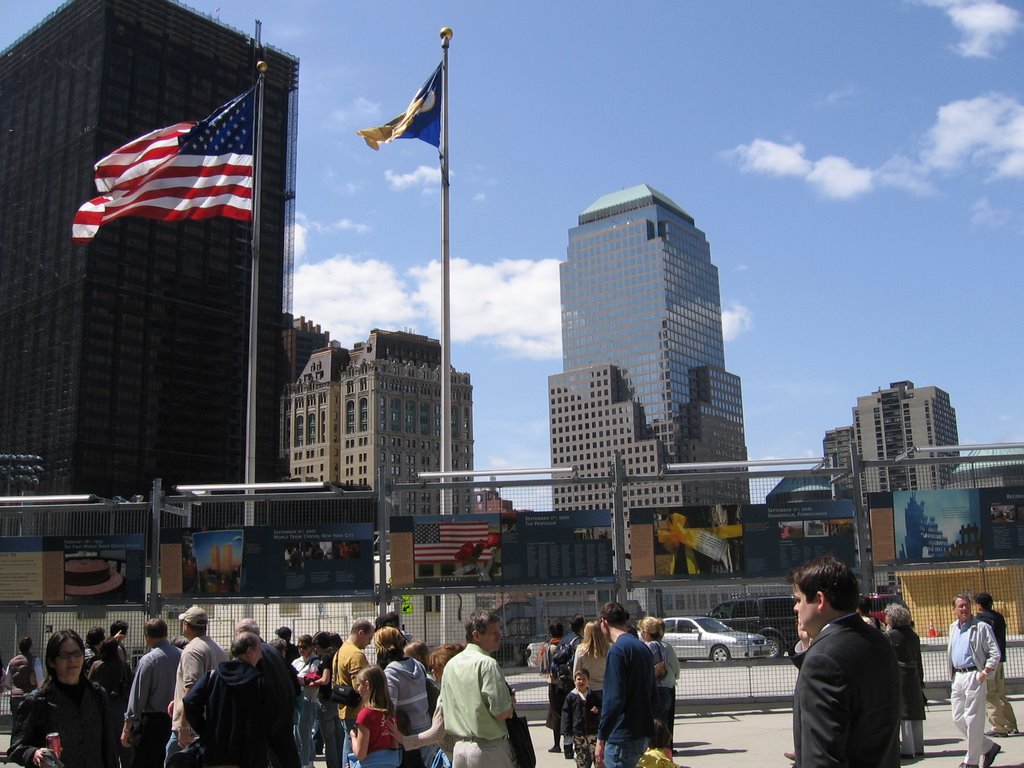
Walk up to the former site of the World Trade Center, and if you don't know the backstory or somehow just beamed down to Earth, it would look like just another construction project in a city teeming with construction -- just another big hole in the ground. The Freedom Tower will rise here someday.

For now, crowds gather along the fence separating construction from curiosity, and as you mill around, pieces of the past come out to meet you.


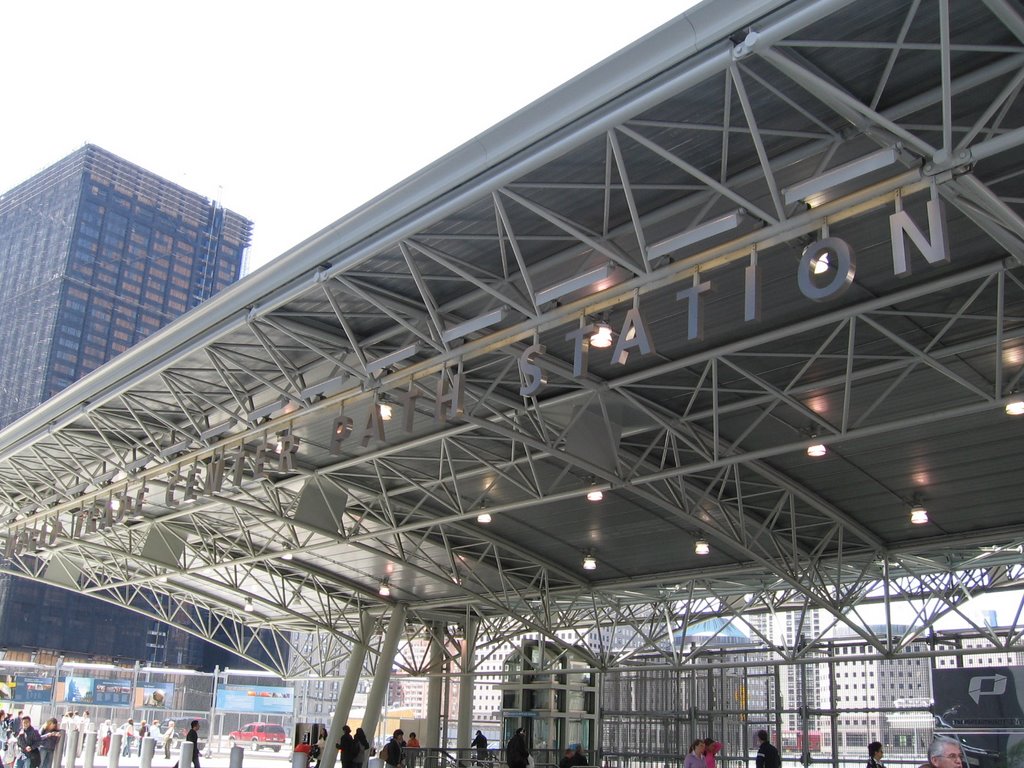
Downstairs, in the WTC subway station, you see an art exhibit from children who lost a relative on 9/11. Colorful images of flags and the twin towers line a wall against a painted backdrop of clouds. One child draws an angel. Another, a firefighter's badge. Another draws a British flag: "Born a Brit, died an American!" I wander back upstairs.


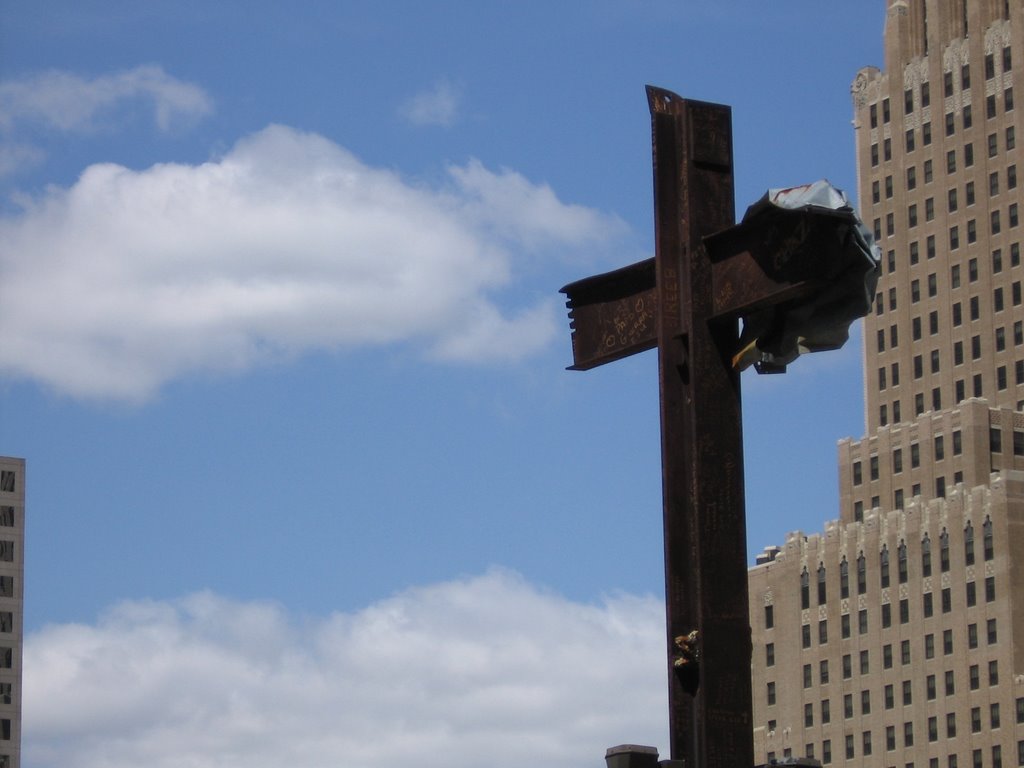
Panels telling the 9/11 story hang on the fence in the odd hybrid of memorial and renewal. Several observation areas have been set up for the masses, who snap pictures and try to get the best view they can through the iron grating. I hardly see any workers. Maybe it's because it's the day after Easter. But I do see a steel cross they've erected.


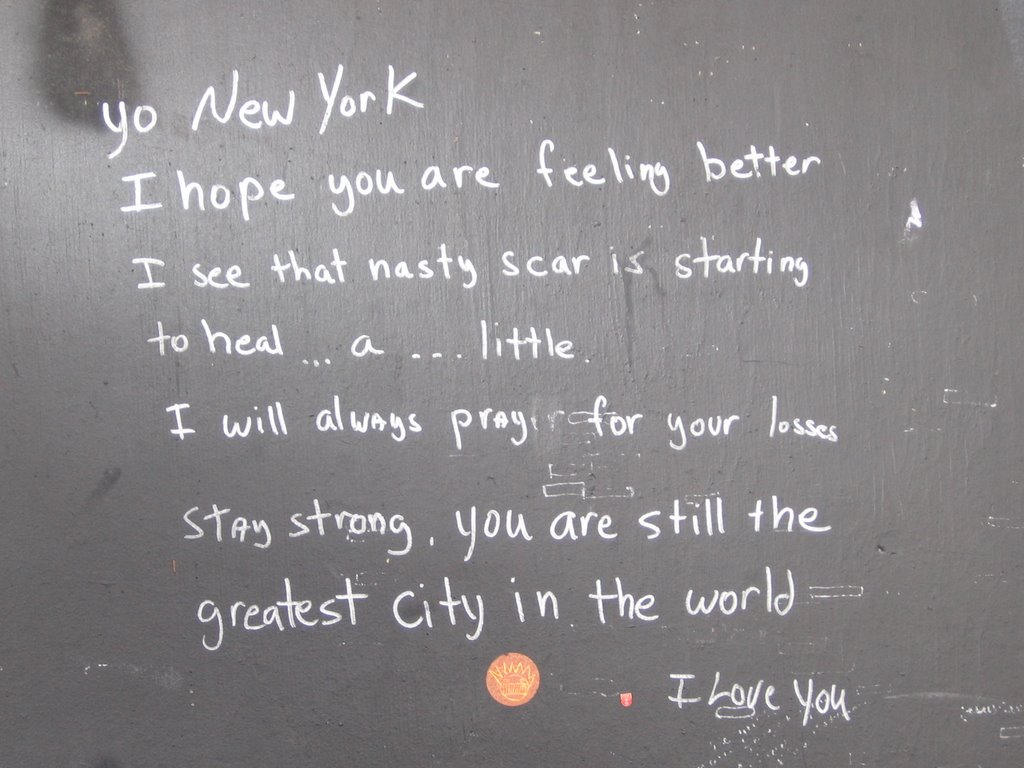
I walk over to another observation deck. Memories of what happened the day the towers fell are creeping back now. I spot an anonymous note scribbled on a wooden pathway: "Yo, New York. I hope you are feeling better. I see that nasty scar is starting to heal... a... little... I will always pray for your losses. Stay strong. You are still the greatest city in the world. I love you."

On another wall, a poem titled "The Road To Heaven."
While traveling along,
It's never too late
Take the road that leads to love
Not the one to hate
Hate is what took these buildings down
With love is how we'll remember those no longer around
Take the right road and you will see
How much sweeter life will be
The road may be uphill and strewn with stones
So get rid of the weight
And lighten the load
At the summit there is
A beautiful view
All of God's peace
Open to you
--A police officer, NYPD
I can't take this any more. I'm heading for heartbreak, just like the week of 9/11 when the emotion finally caught up with me several days after the terrorist attacks, all at once, like pouring out a bucket filled with water... or tears. I have to get out of here to preserve my emotions. On the way, I pass by another bit of graffiti wisdom: "The problem is not the problem. Your attitude towards the problem is the problem."

Attitude. Attitudes of others. Attitudes of people who dance in the street when 3,000 people are killed in moments. Attitudes of politicians who co-opt tragedy to settle unconnected scores. Attitudes of zealots who say they are ridding the world of infidels and who will not be satisfied, even in the tremendously unlikely event they are successful.

It's as mad as the words spouting from the mouth of a man who was riding three seats down from me on the subway to the WTC:

"The government dispatches squads if they detect somebody is happy."

"When all primary targets have been destroyed, the squad will move on to the next operational area."

He sings the "Imperial March" from Star Wars: "DAH-duhduh-DAH, duh-de-dah, duh-de-DAH!"


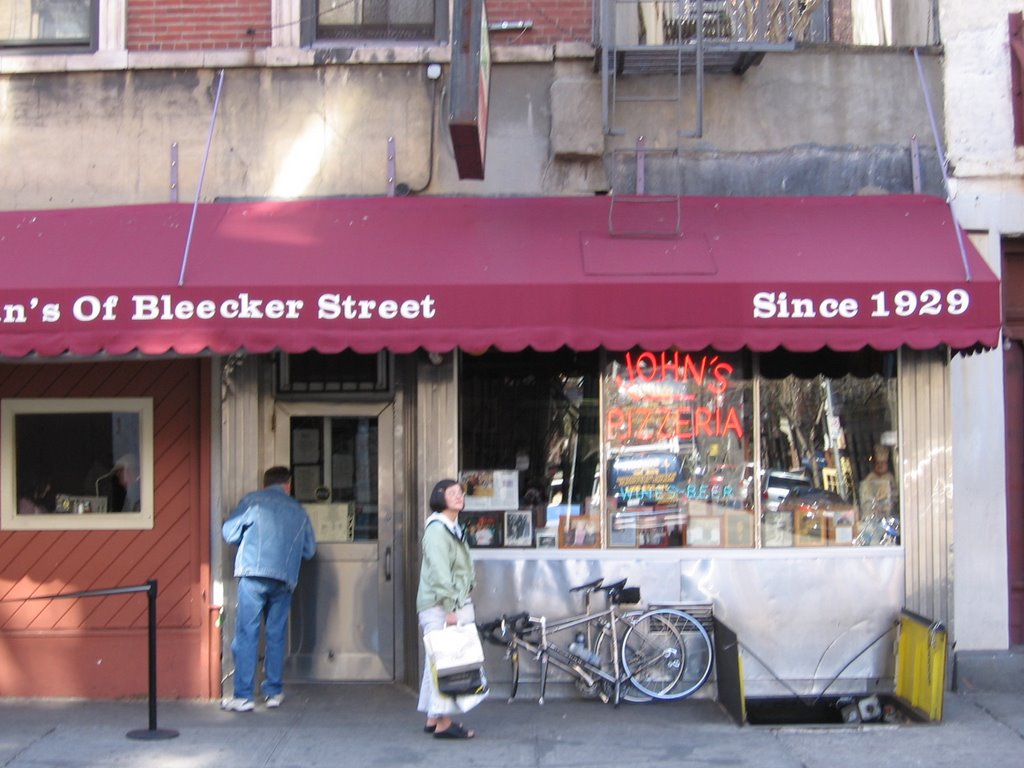
I walk nearly all the way to John's Pizza in Greenwich Village. Thin crusts, cheese and tomato sauce... heavenly... amazing... mmm.

The NYC Diaries- Day 3: The Address Is CBS

The CBS Broadcast Center on West 57th in New York City blends in so well with its neighboring high-rises you can forget it's there. A few satellite dishes on the roof and some banners for WCBS show from the street. I walk inside and inform security who I am, where I'm from, what station I'm with. I'm wearing my KOLD News 13 polo to look more official. The guard makes a call and asks for a photo ID. He points a PC camera at me and after two tries I have a sticker badge with a black-and-white photo worse than any mugshot I've ever seen.

A.J., the CBS employee serving as my guide, shows me upstairs after a short wait. I get a quick tour of the CBS Newspath operation, which provides video news feeds to CBS affiliates for use in local newscasts.

Banks of monitors are everywhere, on every wall, above every desk in the three main workspace clusters of the newsroom. Some TV screens are divided up into four or more screens to jam more incoming video into them. To the side is a dark mini-anchor desk, used for breaking news, health reports and business wraps airing on local stations' morning newscasts. It's also used on "Up To The Minute," CBS' overnight news program.

It's after 5pm, so most of the heavy lifting is done for the producers. The feed coordinators are staying busy, gathering stories from around the country and the world, editing them, and spitting them back out. I'm led over to where video is going out digitally into CBS Newspath Now, which sends video out via computer files to servers at each station instead of via tape.

"Thumbs up means it's ready to go," points out a technician. When the piece is ready, he clicks it and it starts feeding into the system as a stream of bits via satellite. Sometimes three or four stories are going out at a time.

Just feet away, other technicians are doing the same thing the semi-old-fashioned way, pushing video and soundbites onto a private satellite channel one story at a time. But they too have help from digital technology, using a computerized system that stores the video in a long "time line" file -- instead of a tape recorder -- even if it goes out the analog way.

I'm led into one of three control rooms I'll encounter in the course of the visit. This one is handling live shots for CBS affiliates. The Newspath manager showing me around talks about the correspondents who do these shots, how busy they stay, and how they're connected at the electronic hip to the producers in New York.

"So if you've got to change a track on a package" -- news talk for altering some narration on a reporter's report -- "you just do it here and they revoice it out there."

Yes, I'm told. "We can even send scripts to them via Blackberry."

"How much of their own copy do the correspondents write?" I ask. I already know what the answer is.

Not much, or nearly nothing. But as we both understand, it's not by choice.

"They're so busy with all these live shots, they don't get a chance to get out," I'm told. It's the producers who have to run down the latest information and soundbites because the correspondents are cranking out live shots to Erie, PA and Glendive, MT.

I run into a friend of one of the KOLD reporters who's coordinating news feeds. He calls the regional bureaus and they tell him what what stories they're working on. He pulls in the best stories from there, and also from what he can run down.

Now it's time for the big show -- the CBS Evening News with Bob Schieffer. A couple who work at a station in Spartanburg, SC join me as A.J. shows us onto the Evening News set.

As always, it looks smaller in real life. And just like KOLD back home, it's a working newsroom with computers and desks and writers plugging away in the background. A.J. explains how the set has evolved over the years through the Dan Rather era. But my eyes are zooming in on the man of the half-hour: Bob. He sits at a desk off set and to the left of the anchor podium, his back to us, busily tapping out words on the computer screen. A New York Daily News sits to his left, a water bottle to his right.

"Bob writes all his own pitches," A.J. explains to us. Or, he rewrites and tweaks what the CBS writers hand him.

The Executive Producer saunters over for a quick handshake. Rome Hartman is no strange name to me. I recognize it below the "Produced By" line on several 60 Minutes pieces. He's paid his dues much more than I'll ever afford.

We got into the control room. It's 45 minutes before show time, but Bob is busy with teases and pre-productions. Two directors are in the room along with two graphics people and a couple of others. Two people are in the audio booth on the side, surrounded by audio sliders on three sides -- nothing for the claustrophobic. Back in the control room, the graphics folks are loading items into the character generator and a "Thunder" -- a tricked-up electronic slide-store machine that handles animations as well as still frames. It's the one toy I'm envious of.

At least one hundred TV monitors are in the room, mostly by the directors, stacked high and wide. The ones in front show the outputs of the production switcher and the various effects units and character generators. Four monitors directly in front and angled towards them show the tape players. To the side, some thirty black and white monitors show what's coming in on every feed line available to the control room. Mostly, it's test patterns from L.A., Washington, other bureaus, other sources. Behind the directors and to the right of the graphics people sit the producers. A.J. says we can sit down there for now because those folks aren't in yet.

I see four more monitors in front of me at the line producer's position, along with a computer, a phone pad with gooseneck and many more intercom buttons than I would know what to do with.

"Wanna line produce this?" the associate director says to me, playfully.

"I'm game," I reply. I'm not one to step back from a challenge. "But there's too many buttons."

"Just don't touch anything."

"Of course. I know the rules."

I'm silent as the crew carries out the pre-game show. Bob does a bit for the newscast's opening tease, which will be assembled like a jigsaw puzzle from various bits sent in by reporters. The first take goes perfectly... almost.

"There was a video flash in that," somebody points out, referring to some footage playing in a monitor behind Bob. But they don't have time to do it again yet. They have to record another bit for the CBS website. After getting the error fixed, Bob does a "talkback" with a WCBS-TV anchor and another one for WCBS-AM. The lead story is on a drug breakthrough and Bob is excited.

With the teases out of the way, we now have a chance to meet the man who's all legend and little myth.

Bob walks over to us after we return to the set and shakes all our hands. He chats it up with the people from Spartanburg. They point out their Texas roots to the native Texan, talking about where they grew up, where they played baseball, where they went to high school. I feel outmatched.

"So what's going on in Tucson?" Bob asks me.

"Well, your spring is our summer, and our summer is hell," I reply, nearly stumbling over my words. I can't believe I'm talking to him, BOB SCHIEFFER. And thinking back on it, the weather is all that comes to mind -- when somebody just burned a Mexican flag in Tucson a week ago, which made national news? That's the best I can do?

But Bob is exactly the person in real life as on TV. He quickly recalls a story from Arizona.

"I was almost hit by a bus in Nogales."

He tell me it happened in the 1970's, when he was covering President Ford on a trip in Mexico and he almost didn't make the press bus. He had to run to catch it.

He also remembered a botched Spanish good-bye from the President: Hasta "lou-EE-go."

I wished we had more time to talk, but he had a newscast to do.

The 20 minutes before the newscasts is a crescendo of controlled chaos in the control room. Crew members feed graphics into the Thunder. Rundowns get inspected and double-checked. Directors make changes under the supervision of producers.

Nearly all the communication with people outside the booth is done through the panel buttons, including phone calls. Gooseneck microphones link up with phone pads. Mysterious voices float into the room and are answered with a touch. The one phone I hear ringing comes from a black, 70's Princess unit on the back wall. The graphics people use it several times.

"I need an Enron graphic, no cutline," says one woman. "They don't want a cutline!"

"I need a Mexico Bus Crash map," says one director. "We've just added a tell." It's a short story the anchor "tells" from the set.

"What kind of bus is it?"

"We don't know what kind of bus it is."

Ten minutes before the show, Bob is the calmest person in the operation, getting makeup done while the crew and producers hustle to get their acts together.

"How much longer on that Mexico map?"

Chris, the line producer, rushes in and jumps onto the computer at his position on the back bridge. He's mildly nervous.

"Lara Logan's piece is crashing," he says. He means it's still being edited with just minutes before air. "Literally, it's crashing. Her Avid [computer editor] crashed." And the piece has to be fed in from London.

Been there, dealt with that, I think.

"She may move to the top of the B block," Chris says, making contingency plans. But he also has to confront the possibility of the piece not making it in at all. Rome joins him in the booth about a minute later and they go over options, noting at least one other piece isn't ready yet either, and those can't be moved up to fill airtime until Logan's piece is ready.

This isn't Broadcast News, where a network staffer runs down a hall with a tape to get it on the air in the nick of time. Chris draws a line. "If she's not feeding by 6:31, she's not making show," or at least her slot. A link is set up to get Logan's piece in from London "hot," meaning the director would have the tape editor roll it from the edit bay in London instead of a device in New York to make deadline, if needed, instead of recording it first in New York.

Chris has another issue to deal with. I hear only one side of the conversation. "Is is airable? All right, all right." Issue resolved. I'm not sure, but it sounds like a video question.

Five minutes to go. Graphics checks their sequence. The conversations in the control room amplify and speed up, two and three at a time. But, saints be praised, Lara Logan's piece is coming in from London. A hot feed will not be needed. Neither will an alternate version of the headline tease, which makes no mention of the piece.

The newscast begins feeding out to affiliates with a countdown so control rooms across the country are ready. Then the open hits, and Bob begins the broadcast from the desk. A slight glitch hits -- so slight I don't even see it -- during the pitch to the first story. The crew will fix it for later broadcasts.

It becomes obvious who's focused on what with both producers in the room. Chris is focusing on timing. Rome is focusing on content. Chris worries about what "tells" might have to bite the dust if things run long. Rome suggests questions and ad-libs to Bob and talks with the reporters out live in the field.

Bob's ad-libs and questions are challenging Chris. He's 13 seconds over on time -- no sweat for me, but the beginning of a nasty problem in a tightly-timed network program. He kills two tells, giving him about 20 seconds back, but he needs to find more time in a later segment. He asks somebody to help him out with that.

Bob asks if he can ad-lib something after Lara's story, which included video she shot herself alongside troops in Iraq. Rome cautions him that time is tight. Bob ad-libs but keeps it short.

"Some of that video was shot by Laura, who happens to be pretty good with a camera."

Chris sees a story on the wire and phones a writer in the newsroom to do another tell that could make it into a west-coast broadcast.

Another glitch pops up. Bob comes back on camera after a reporter's story, but he doesn't start talking right away. Two seconds of panic later, he's talking. Ten seconds later, when the commercial break rolls, everybody's trying to figure out what went wrong.

"He had prompter, he had script," the director said, ruling out a technical problem.

The seconds tick down and the last report of the newscast airs -- a story of a soccer team made up of Iraqi children -- with precious little time to spare. That precious extra time is consumed by the director holding on the last shot in the story: a child wiping his eyes after a tough loss.

Bob quickly says goodbye and the show is done... for all of two minutes. He hustles back to the anchor desk to do the opening story again, live, for another feed of the newscast going on at 6pm to fix the glitch from earlier. Barring any major breaking news or any major changes in the stories in the first feed, the next program will be stitched together electronically using the live do-over and tape of the first feed. That feed will run again for the west coast, if there's no major updates or breaking news. Many times stories are spliced into the completed first feed.

A.J. led us out and we thanked her. I returned to the streets of West 57th, and about a half-hour later, and several blocks away, I saw two people being shot from a cannon outside the Ed Sullivan Theater for a taping of The Late Show -- something that seemed a lot less challenging than what I'd seen in the CBS News control room.

Sunday, April 16, 2006

The NYC Diaries- Day 2: Give My Regards To Broadway

The Midtown streets are the quietest I've heard yet as I make my way down 8th Avenue to the Gray Line bus. It's 8:30 in the morning -- not too early, not too late.

It's a sunny Easter Sunday in the 60's, perfect for some sightseeing on top of a double-decker bus. We roll out of Midtown to the talking of Dominic, our guide, and into the Garment District. We round Madison Square Garden and head for the Empire State Building. The lines outside are insane. It looks like at least a four-hour wait. Dominic recommends we go at night, and not just for the view.

We come to the Flatiron Building. You probably know it from the Spider-Man flicks as the triangular building housing the Daily Bugle. We go into Greenwich Village, the place Dominic says to get good food cheaper and away from the chain restaurants. He recommends John's Pizza.

On to SoHo -- "South of Houston." That's pronounced HOW-ston for you Texans. It's the it place where loft apartments in cast-iron buildings go for insane rents. Chinatown and Little Italy roll by. City Hall and the Brooklyn Bridge pass. Lots of talking, lots of looking, and a few stops to hop off. But nearly everyone stays on. We come back up the lower East Side past the United Nations. The flags aren't flying in front.

"Cause they get lazy," Dominic says.

The tour ends off 5th Avenue because of the Easter Parade, which is already over. But now, it's more of a street party, and people are just milling about with the costumed characters, wearing their bonnets and bunny ears and wide-brimmed hats.

"Tucson says hello," I say to a couple in their Easter best who graciously pause for my video camera.

I spot a man in a fur-trimmed tricorn. Wonders never cease.

I don't have a lot of time to meet and greet. I have to get back to the Gershwin Theatre some four blocks away and try to score a ticket to Wicked. I'd heard one song on the "Martha" show. Michelle, my boss, also pitched it. I've seen The Producers at the movies and Phantom in London. It's time to go for something new, unusual and different.

I got into the crowd lined up for a shot at the $25 front-row seat lottery. But I didn't make the list of 13 winners. My only hope is the cancellation line. I waited an hour and a half, struck up a conversation with several nice people and finally got my hands on a $110 orchestra-level seat five minutes before showtime.

The show and the seat were worth every dollar.

Wicked tells the story of Oz before Dorothy dropped in. The Wicked Witch of the West wasn't truly wicked, you see -- she was just born a wicked color of green. Snubbed by society and her family, she finally finds a friend in Galinda, her unlikely college roommate, the popular girl who we'll later see as the Good Witch of the North. Wicked spins a colorful and rich tale of rejection and loneliness coupled with a desire to stand for what's right, even if your good deeds go bad. The score is memorable, hummable, and the "No Good Deed" number is the showstopper. The production moves briskly. Kids who like Harry Potter will dig it because it hits on the troubles of growing up with a little magic here and there. My grade: A+.

I grabbed a bite of dinner at a deli off 7th Avenue. I asked for a boiled ham sandwich and the guy stared me cold in the face.

"On?" he challenged in accented English.

"White," I answered, sheepish. Non-New Yorkers like me who deal with Subway aren't used to this level of specificity.

Time for another tour: the nighttime one. Times Square is getting so packed you'd think they were dropping the ball again. But this time we head into Brooklyn after hitting most of the Midtown high points. You cross into Brooklyn over the Manhattan Bridge and you instantly know why many New Yorkers don't live in Manhattan. It's a lot cleaner, a lot more affordable. And there's fewer tourists. Having a bad tough-guy rap doesn't hurt either.

Locals wave at the bus from the street. They take pictures of us taking pictures. They know we're lifting the economy.

"I love New York!" screams a homeless man from a corner. "I love it so much I'm getting the hell out! I've been mugged too many times!"

Saturday, April 15, 2006

The NYC Diaries- Day 1: "If I Can Make It There..."

Click on any picture to see a larger image.

American Airlines flight 712 touched down ahead of schedule at LaGuardia. Now came the trip to the Park Central Hotel on 7th Avenue.

I had a voucher for ground transport, and half an hour after I showed up at the shuttle desk, a man in a bright blue jacket arrived, his scraggly brown hair combed over his balding head and matching his personality.

"You," he said pointing to a couple to my side. "To Washington Square. And you," he said, pointing to me, "Park Central Hotel." I caught a wink in his eye at the end of the sentence.

He tossed our luggage in the back and got things rolling with a growl at his dispatcher.

"You ask these people a question and then ten minutes later they call you back, " he said, merging into the congested LaGuardia traffic. "How long does it take to say yes or no?"

We rolled onto the freeway and into Queens, the driver alternating between pedal and brake with haste enough to sway us forward and back in the stop-and-go traffic. The scenery rolling by us could have been lifted straight from the title sequence of The Sopranos: red brick neighborhoods with flags flying outside doors and people sitting on porches, and other walking everywhere amongst sidewalk delis in the 80-degree April heat. One pedestrian caught me with my camcorder up against my face and waved cheerfully. Really, he did.

On the other side of the iron giant known as the Queensboro Bridge, we were in Manhattan. Thirty minutes later, I was checked into my room overlooking nothing but a central core of four-window lined sidewalls. At least I had an LCD flat-screen TV in the room.

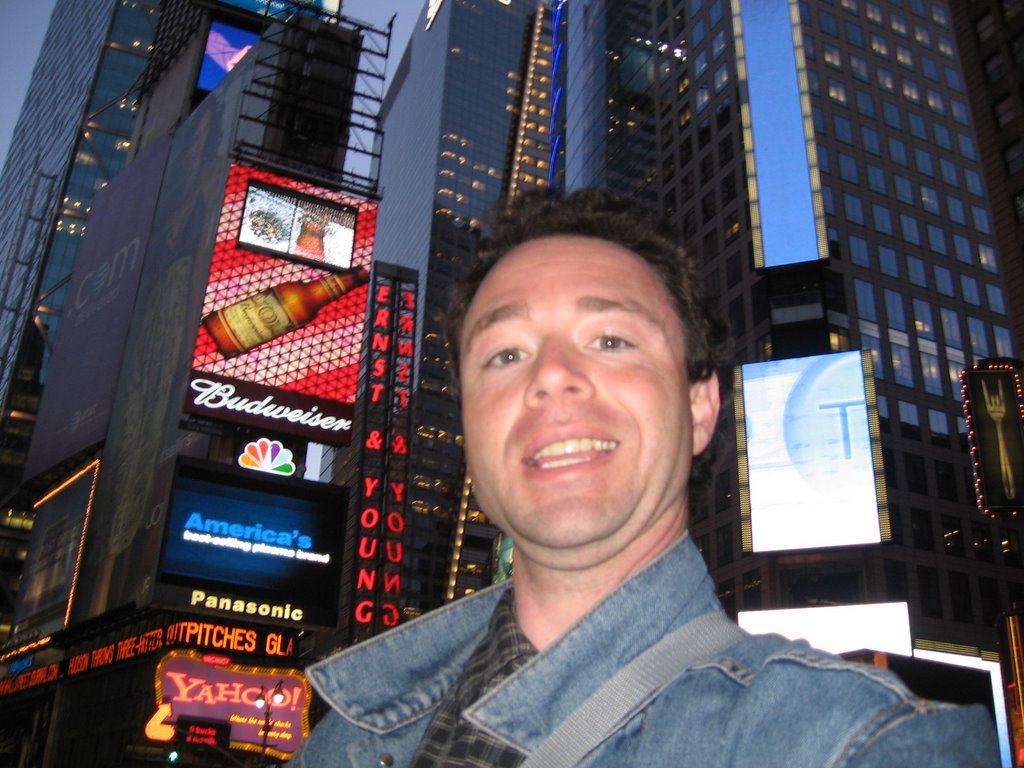
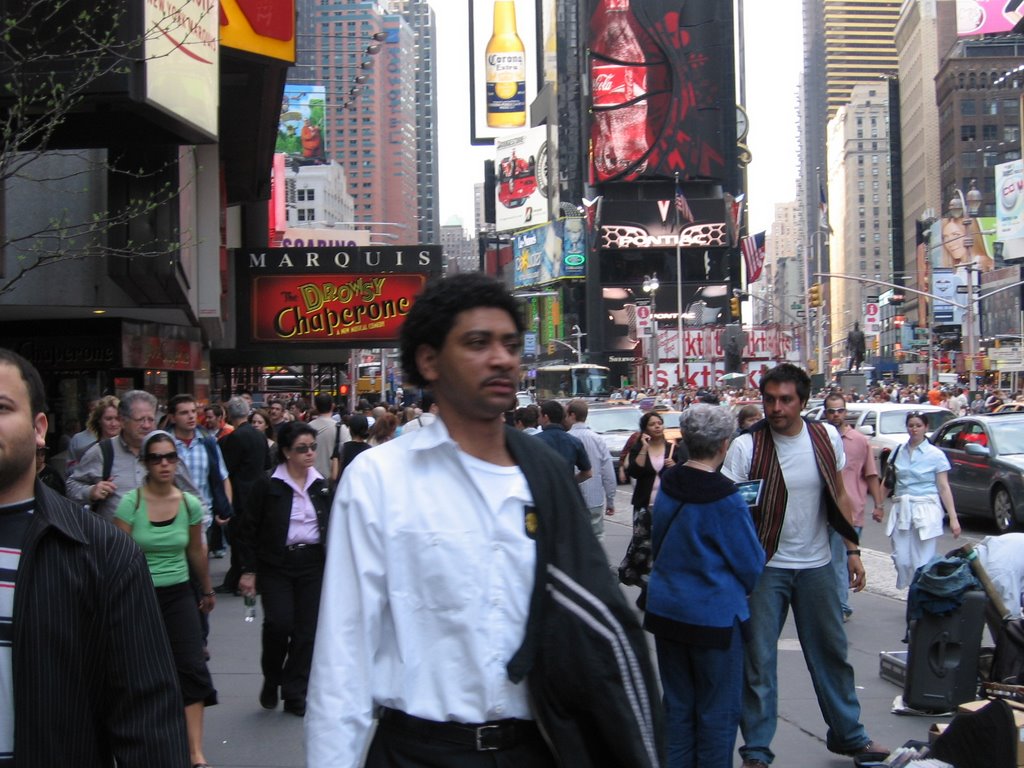
The first stop: Times Square. The electrical heart of Manhattan with its towering billboards and neon signs is Las Vegas without the gambling. Hundreds of people walk every way, any way they can amongst the theaters, restaurants and ubiquitous camera shops. Lines for the TKTS Broadway show outlet stretched for at least two blocks down Broadway. No way was I going to stand in that. Not yet.

Police have a presence here trying to direct traffic and prevent accidents, but they are constantly overpowered by the multitudes who willingly sneak across on red lights whenever they can to the honks of taxis and limos.

"What, are you ignoring the lights now?" one harried traffic cop called out as a crowd walked through a red light on 47th Street.

Street hawkers run their game 24/7, pushing purses, hats, framed Broadway playbills and the iconic I-Heart-NY shirt. Scientologists got into the act today in the Square, offering a "free stress test" alongside copies of Dianetics, which had to be part of the deal.

I walked all over the Square, pausing once to send a video e-mail and shooting pictures while making sure nobody's trying to lift my wallet. I hear Times Square is one of the safest places in New York City, if not the nation. Everybody's probably too busy standing in line for Broadway tickets.

My stomach rumbled. They don't feed you much on planes anymore, and not for free. I'm lucky if I can do it during a layover. Around me are the franchised corporate-restaurant players: Hard Rock Cafe, Planet Hollywood, TGI Friday's, Applebee's, ESPN Zone, and at least three McDonald's. However, I wanted a real taste of New York City.

I found it in a hole-in-the-wall called Bella Napoli off 7th Avenue. I walked in and craved a sausage pizza sitting behind the glass. One slice would not get the job done.

"Can you do this in an 8-inch," I asked the tosser behind the counter.

"Sure, I do that for you," he replied in an accent sounding more eastern European than Italian. "You got time?"

"I got plenty of time."

He invited me to sit down while he rolled up the custom pie.

My feet got a break and my ears got some entertainment, overhearing a regular tease the manager about the place's lone waitress and how he wasn't allowed to flirt with her.

"You want talk to her, you put a dollar in," said the manager, hinting at the tip jar.

"What is this," the regular grinned at me. "A dollar? She not married!"

"Oh come on, man," I said. "One dollar."

The pie came 10 minutes later, delivered to my table by the man who tossed it, and he insisted I eat first and pay later. "No, take you time."

That sausage pizza was loaded thick with sausage -- lumps of it. But it went down good. Now that's worth a dollar tip on top of the $8 I spent.

"I love you guys," the regular called out as I was finishing up. "You make best pizza in New York City."

And I had my first real bite of the Big Apple.


Central Park buzzed with walkers and children this evening, digging in the sand surrounding mazes of climbing equipment and swing sets on the south end. Hopefully nobody had to use the restroom -- it's fenced off.

I made a call to the folks in California as the sun set behind the Manhattan skyline. Thirty-four years old and my mom still shudders at me crossing the street alone. Wish you were here. Wish you could see this. I'm fine. I'm safe. I'll be careful.

A walk through the enormous green of Sheep Meadow required weaving around several simultaneous games of catch and frisbee tossing. Couple laid out in blankets, some in various stages of deep kisses. A swing through Columbus Circle and some more streetbeating and my feet surrendered.

Tomorrow we get formal. Tomorrow we start the tours.

Sunday, April 9, 2006

A Letter From Virginia

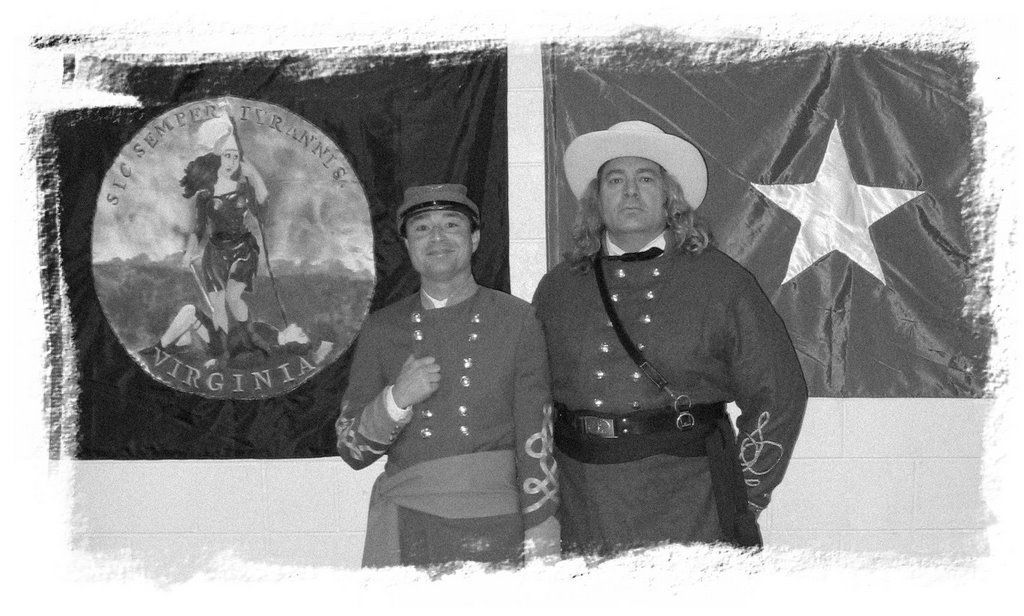
We Make History combines dance and drama in a period ball bringing ladies and gentlemen together as a nation tears itself apart.

Richmond, 1861

My Dearest Family and Friends,

I write you at a time of great uncertainty, tinged with the sadness of what may yet befall us. I will soon leave my home with my fellow Virginians in the defense of our liberties. Though I am proud to serve, I hoped never to see the day when I might have to spill the blood of my own countrymen to protect that which is dear to us.

For many months, I have prayed for an amiable solution. But that hope is no more. My beloved country is tearing asunder as a flag left to flail in the fiercest winds. Yet I write to you on the heels of most joyous ball, sponsored by the 1st Virginia Volunteer Infantry, a night of song and dance with the finest ladies and gentlemen of the state complemented by visitors from both north and south.

I attended in full uniform, the work of a harried seamstress in Williamsburg steeped at the foot of a mountain of work. She did not fail her task of creating a fine garment of yellow and gray with buttons shining brightly in the sun. But I do believe she overdid herself, as my first communications with Captain Scott revealed.

“Colonel Francis!” he greeted.

I ranked higher than I realized. But if I am called to a higher duty, so be it.
When the festivities began, the Belles of Virginia were presented to us, the finest young ladies of the state. One by one, a member of the 1st Virginia escorted them before the crowds. The line of elegance extended beyond my vision. Here, I noticed the gentlemen were most desirably outnumbered.

These charming women had the honor of selecting their first partner. All I could do was smile, hold my breath, and hope for the best while my heart cried out, chose me! Choose me!

A beautiful lady approached. We honored each other and the evening began with a promenade followed by a few ring and line dances.

But as we were enjoying the evening, some disturbing news arrived of deteriorating relations between the states of the north and south. Anger was consuming both sides. Yet my fair state of Virginia had elected to remain in the Union. Perhaps peace would not elude us.

With that hope, the dancing resumed with more sets and circles and a few waltzes here and there. You will forgive me if I cannot remember the grandiosity and yet simplicity of each one, but I am indebted to a young lady who taught me a box step. She led and I followed. “You are a quick learner,” she complimented.

I had many compliments myself for the dozens of ladies I encountered. I felt it my duty to always caution that I was not the greatest waltzer, honesty being something I hold dear, but my partners were all gracious and not put off at all by simple steps from someone who desired above all to be a gentleman.

More bad news arrived. Fort Sumter had been attacked. President Lincoln was demanding troops to quell the Confederacy. We were being asked to attack our brethren, to invade our own lands. The question of secession was inevitable now. We would have to make a choice.

Our host did his best to lift our spirits in the midst of this crisis, noting that even in the dark days of the Revolution, President Washington found time for diversion in dance.

“Enjoy yourselves, enjoy your company,” Captain Scott said.

The highlight of the occasion was upon us now: the Virginia Reel. I had danced it before but still felt uneasy. This could either be delight or disaster. But it was the latter, and I am much obliged to the Virginia Belle who clarified a confusing step for me with one sentence: “You’ll always swing on this side.” Stripping the Willow, as they say, was never easier.

So our musicians began to play and we reeled. And we reeled. And we reeled some more, again and again, around and around, swinging each other, swinging our partners, swinging through the sets, progressing through at least a dozen changes in the head couple before I stopped counting. The band kept at it, and lost in our enjoyment, we could have reeled all night. We could have reeled all the way across Virginia, across the Potomac into Maryland. Then we could reel into Pennsylvania and on to New England, all the way through New York, Massachusetts and Maine. We Virginians will show those Yankees how to dance!

A lady recounted for me the Drop Dead Reel -- one where the musicians keep playing as long as somebody can still stand. The number only ends when everybody’s either off the floor, or lying on it.

“I don’t know whether to call that pleasure or torture,” I responded in shock.

“I think it is a little of both,” she replied.

The talk turned to the fate of our nation and our worries as the hope for an amicable solution faded by the minute. She hoped the people of Virginia would make the right decision.

“I think they already have.

Not long after I uttered those words did we receive more news. The question of secession would be put to a public vote so Virginians could voice what their hearts were telling them. They were, as we were, learning of more animosities, blockades and aggression by the North.

Word of the rising tension was so unsettling I broke rank as I introduced myself to a new partner.

“Captain Francis, uh, Colonel Francis,” I stuttered. “Excuse me. The news has left me quite shaken.”

But as much as we worried, as much as we longed for another way out, we found the time for more merriment, more waltzes and more reels. One dance called “Chase The Squirrel” found me playfully pursuing a lady about the set only to find her chasing me back.

So much beauty surrounded me I did not know what to do when seeking out another partner for a waltz. Two ladies stood a few feet away, beautiful as Heaven would allow. The music began, and without a partner, I began to sway back and forth on my feet, unable to stand still even without a dancing partner. I sauntered toward the pair… whom would I ask?

“Colonel Francis!” Capt. Scott called to me. “Why are you waltzing by yourself when such beautiful ladies are before you?”

My feet halted. “Sir, they are so beautiful, I am filled with indecision.”

“Close your eyes!” he ordered.

He twirled me around a couple of times and directed me to point.

“Open your eyes!”

Before the tip of my finger was my choice: a charming lady and a better dancer than she gave herself credit for.

Our host relayed another dispatch. The votes were tallied. Virginia would secede. In some counties, the vote was unanimous. We had made our choice, but now came the challenge. We learned the first Virginia blood of this conflict had already been shed. Peace had failed, but a new nation may yet thrive, one honored with a song.

“Then here’s to our Confederacy,
Strong we are and brave,
Like patriots of old we’ll fight, our heritage to save.
Rather than submit to shame,
To fight we would prefer
So cheer for the Bonnie Blue flag
That bears a single star.
Hurrah! Hurrah! For Southern rights, hurrah!
Hurrah for the Bonnie Blue Flag
That bears a single star.”


My thoughts return once more to the duty before me. I know not all of you will agree with the choice I have made, but I hope you at least recognize the circumstances. I believe with all my heart we are a nation of undeniable liberty. Those who seek to deny us our rights as citizens, as human beings, do not understand the foundations of this great land. Did not we choose freedom over tyranny one hundred years ago? Did we not resolve to build a nation grounded in justice and guided by those rights given to us by our Creator?

But in the sum of all events, I find the most peculiar irony and a thread of hope. Whatever happens in these next few months, I will never forget the friendship and fellowship of this evening’s celebration, filled with many more memories than I can mention here. A slice of my heart tells me we could patch a great many conflicts with more occasions such as this. Happiness should chase anger away, making room for reason, which if left to blossom shall yield a harvest of reconciliation.

It is an absurd thought, I know, for some of you. But I must keep hope alive. We have passed beyond the crossroads. The road we have chosen will lead us to either redemption or suffering. And I can only pray God will give us the strength to carry out our duties as soldiers and as patriots. My future may be undetermined, but my heart is resolute.

Yours truly,
Col. Christopher Francis

A Postscript From Mesa

We entered in costume, in character, 145 years later, near the stroke of midnight. The scattered patches of diners at the In-N-Out perked up. They may have hesitated to swallow for an instant. One snickered while others smiled.

“Arizona just seceded from the Union,” one person explained to a puzzled stranger on the way out.

“We’re from a Civil War ball,” another said to the young man behind the counter as he stared at all the Confederate uniforms and hoopskirts.

I always love it when present meets past, especially when I’m still submerged in my historic persona. The ball may have ended half an hour ago, but I couldn’t drop my southern accent.

“Could I have a number one, please, sir?” I drawled out.

At one point during a waltz, my partner asked me if that accent was real.

“I’ll leave that to you to decide,” I grinned. Why spoil any illusion? If you want to believe it’s real, by all means believe!

Our conversation put us back in the present day, but in a nation still divided -- this time by illegal immigration. We talked about the upcoming march in Phoenix. We talked about immigrant rights. We talked about solutions.

Should we grant amnesty or deport them all? Should we implement a guest worker program? Should we go after the businesses that hire them? Should we put pressure on Mexico to eliminate the corruption and poverty at the root of the problem?

I don’t think we found a sure cure. Everybody could at least agree on that.

In another time, this talk could have lit the fuse of war. But at our table, you couldn't even light a match as we talked thoughtfully and amiably about the issues.

As I write this, our Arizona Attorney General and a U.S. Attorney are asking the Federal Communications Commission to investigate a comment by a Phoenix radio talk show host. That host suggested one way to solve the illegal immigration problem was to randomly shoot illegal immigrants on one night every week. Such “rabble,” as it might have been called in another time, can only lead to violence, the attorneys say. I fear we’ve been down this road before.

Click here for more photos and reflections of this amazing evening!

Yes, you too can take part! Click here for more about We Make History.

LIFE & TIMELINES -- more of my journeys:
If You Can Walk...
Both Sides Then: Caught In The Middle Of "The Battle Of Winchester"
Come, Let's Be Merry!
"You Look A Little Too Happy To Be Here."

Wednesday, April 5, 2006

Anger Of A Stranger

A month ago, I told you about Elisa, a wonderful 18-year-old girl who died in a car crash. I told you about her outstanding talent as a mariachi singer, something sure to bloom into bigger things for her. I told you about her loving mother and father. I told you about the house full of relatives mourning for her, a number that grew to include myself. I told you of my tears.

And then today, a toxicology report from the Pima County Medical Examiner's office floored me. According to test results, Elisa had cocaine in her system. She also had the legal limit -- 0.08 -- of blood alcohol content.

I wondered if this report could be talking about the same person, the one who practiced her stage technique in front of a mirror in her room, who sang so proudly for millions, who learned Spanish to perfect her craft. It simply didn't fit.

We reported the disheartening follow-up to the tragic story on the 5pm, 6pm, and 10pm news. Between the early shows and the late one, I took a couple of phone calls.

The first caller, identifying himself as a friend of the family asked us how we could report this? How could we do this to the family?

I said I'm sorry, but we can't ignore things like this. We have an obligation to the truth, which is what our viewers expect of us, and sometimes the truth hurts. We can't leave out a part of a story just because it makes somebody look bad.

He says we hadn't done this sort of thing with other people.

"Who?" I asked. Name names. He couldn't.

The guy was beginning to get on my nerves. The more he talked, the more he implied I didn't care about the family.

"Have you ever lost a child?"

He pushed me over the line. I lost a good friend, a reporter, to a train accident, I said.

"I talked with her father. I talked with her mother, sitting on the bed in [Elisa's] room!"

So I bloody well knew about loss!

We went back and forth. He continued to complain about how we could do this to the family. I apologized, but I also got madder as he didn't see my point.

"What do you want from me? Do you want me bleeding on the set on my knees? What do you want?"

Business became personal, because the story became personal. This is the reason you're not supposed to get personally involved with stories, but I already crossed that line two months ago. Now this guy was pushing my buttons, slapping me with the white glove and challenging my professionalism. I wasn't going to let him get away with it.

Fortunately, I was calmer when Elisa's father called. He echoed the same sentiment, in a more civil way. I explained why we made the decision we did, and I offered to run a statement from him. He didn't think it would matter, but I kept asking, and finally I got one to run with the story on the 10pm news. Right after viewers heard about the drugs and alcohol, they heard these words from her father:
"Alisa is with our Lord in Heaven and nobody can harm her now. We are people of faith and the love and support that the community has shown us will never be shaken or watered down."
Anger still smolders inside me.

I'm angry with myself for getting angry.

I'm angry with people who think they know how the TV news business works when they don't know a thing. I'm angry with people who simply assume we care more about a good story than about the people behind them. It's a gutless, stereotypical charge, one easily believed by the masses without any serious thought. It's getting old.

I'm angry with Elisa's parents. According to her father, they heard Elisa had used from the detectives. Maybe they didn't know until after the night I interviewed them, but the least they could've done was own up to the truth. They ignored the opportunity to put a moral on the story: this is what happens to you when you drink and do drugs and drive.

And I'm angry with Elisa. She was blessed with a loving family and a growing talent. She had opportunities. And yet, somewhere in this picture she chose to do coke. She chose to drink and drive. Did she feel invincible? Did she think she was too successful in life to lose?

I will never understand why people who have everything in the world going for them abuse alcohol and drugs.

Both callers tonight said she made a mistake. "Have you ever made mistakes in your life?"

Forgetting your anniversary is a mistake. Smoking dope is a decision made consciously. That alcohol and coke didn't get into her system by accident. She made the choice. Before that deadly night in February she surely heard a variant of the "just say no" message multiple times. And if her parents, her teachers and her friends didn't tell her that, shame on them all.

As I explained to her father, most people will remember Elisa for her gifts to the world. We would all rather remember the way she lived rather than how she died. I'll remember it, too. But I'll also remember her life didn't have to end like it did. She cannot be held blameless for it. And if she were sitting in front of me now like her mother did two months ago, I'd have only one question for her.

Why?

Saturday, April 1, 2006

Reel To Reel: Inside Man

How It Rates: **1/2
Starring: Denzel Washington, Clive Owen, Jodie Foster
Rated: R
Red Flags: Strong Language, Strong Violence

When I heard Spike Lee was directing this bank-heist film, my first reaction was, "He needs to top off his bank account." His last few major films, including 25th Hour, She Hate Me, and Bamboozled won some crix picks but didn't sell tix.

But if you're gonna sell out, do it with some talented company: Denzel and Jodie are good enough excuses. Together, they make a messy action flick work, even though it's still a mess.

Denzel plays New York city detective Keith Frazier, a cop doing his best under that good 'ol worn-out plot device: the cloud of corruption. It's his lucky day as he's called in to work negotiations on a bank robbery hostage situation. Clever-minded thug Dalton Russell (Owen) is demanding the Dog Day Afternoon special: buses and planes to escape. Some food would be nice. How about pizza?

We know almost from the start Dalton isn't after money. We get reassurances it isn't halfway through the picture, largely because of Madeline White (Foster), an icy woman who works part-time in the blackmail and bribery trade when she isn't hawking real estate. Turns out Dalton is after something in a safe deposit box. And that something could be potentially embarassing to the owner if it sees the light of day. White comes in to cut a deal with Dalton.

Inside Man emits a cool, intelligent aura, largely because of Washington's and Foster's performances. Cool and intelligent don't get you everywhere, though. The movie's problem is it telegraphs its moves two and three reels away. By nature of the picture's structuring and flashback sequences, you're constantly on guard for the big plot twist. When it comes, you're not taking a hard left turn but simply merging into traffic.

Maybe Lee knew that when he read the script. And if so, he should be glad he's got Denzel and Jodie working for him.

Friday, March 31, 2006

Feed Your Head -- Rest Your Feet

To the high school students of Tucson demonstrating against harsh immigration reform: Enough marching. It's time to get back to class.

One day of demonstrations, I understand. Two looks suspicious. Three, and I know you're just ditching pre-calc.

I know about the First Amendment, and I know immigrants built this nation. But I also know you all need an education. And a few of you could use some schooling on what you're marching about.

Here's an actual soundbite from an actual student that actually aired at the start of KOLD News 13 at Ten on March 30, 2006:
"I came to protest I guess. I'm just with the Mexican people. A lot of my friends are Mexican."

(Reporter asks a question)

"I don't exactly know what it's for."
"Si se puede!" Yes, we can! Can... uh... what?

Many of you aren't marching in protest. You're wandering in the wilderness, adrift on the waves of others' passion. You know not your purpose nor your politics. Your aim is hanging out with the crowd.

Did you know there's more than one immigration reform bill before Congress? Do you know that not all of them involve making illegal immigration a felony? Did you hear about the guest worker program the president backs -- at substantial risk to his standing among conservative Republicans?

Do your homework. Understand the issues. Understand your position.

Your teachers and principals are trying to help you. They are mercifully -- I say too mercifully -- sparing you from truancy citations and detentions to let you take a hike. They know a teaching moment is before them, and they are offering you classroom time to talk this out. I suggest you take their offer.

From KOLD News 13's report by Teresa Jun:
"We used the approach that we're not going to physically confront kids leaving school," said TUSD Superintendent Roger Pfeuffer. "Given the emotionality of the issue, I think we dealt with it appropriately."
What are you administrators afraid of? Do you have nightmares of the 60's? Are images of Kent State pervading your thoughts when you see the cast of fourth-period Physics parading live on KGUN 9?

"Appropriately," my foot. It's time you put yours down.

A truancy citation is not a death sentence. It is not racist. Asking students to stay in class and march after school is more than reasonable. It's polite, if nothing else. Offer to help rally after the final bell.

Don't let parents get under your skin. They will holler and whine if you lock the school down, but do it anyway. You're paid to educate, not commiserate. Sensible parents will support you.

I cannot deny the satisfaction and emotional rush of publicly expressing your beliefs. But true satisfaction comes from understanding the framework of your convictions and forming your opinions from fact. All this is possible if you don't skip out on History and Civics classes. You can't learn it from the street.

Thursday, March 30, 2006

And The Network Goes To...

My hunch back in January was wrong. KWBA in Tucson is getting the CW network.

It makes sense. KWBA has nabbed higher ratings than KTTU and holds a higher profile. But KTTU will hook up with Fox's new creation: MyNetwork TV.

Let's go deep here. The whole point of merging UPN and WB was to create one strong network out of two weaker ones. Looking at the season-to-date Nielsen averages, WB and UPN are each drawing less than half of Fox's audience (6.0 for Fox, 2.1 each for WB and UPN). Provided CW takes the best of the best, they could stand to close the gap to perhaps 50-75 percent of Fox's number -- say a 4 rating. But that sounds awfully optimistic.

MyNetwork TV is going to get a strong push from Fox, which owns several MyNetwork affiliates. The main offering is English versions of telenovelas, those steamy Mexican soaps. But Why not just call it "Fox 2," as Inside Tucson Business' David Hatfield alluded to? You capitalize on the strong Fox brand. Maybe you also offer a second run of Fox shows a day or two after they run on Fox. Forget to Tivo American Idol? Catch an encore the next night on MyNetwork! As CBS is showing us on Saturday nights, you can make money off repeats of popular shows like CSI.

I also won't be surprised to see a repeat of the present situation: two low-rated nets still in Fox's long shadow. Names may change, affiliates may shift, but you end up with the same problems.

But with my last hunch disproven, what do I know?

Saturday, March 25, 2006

"You Look A Little Too Happy To Be Here."

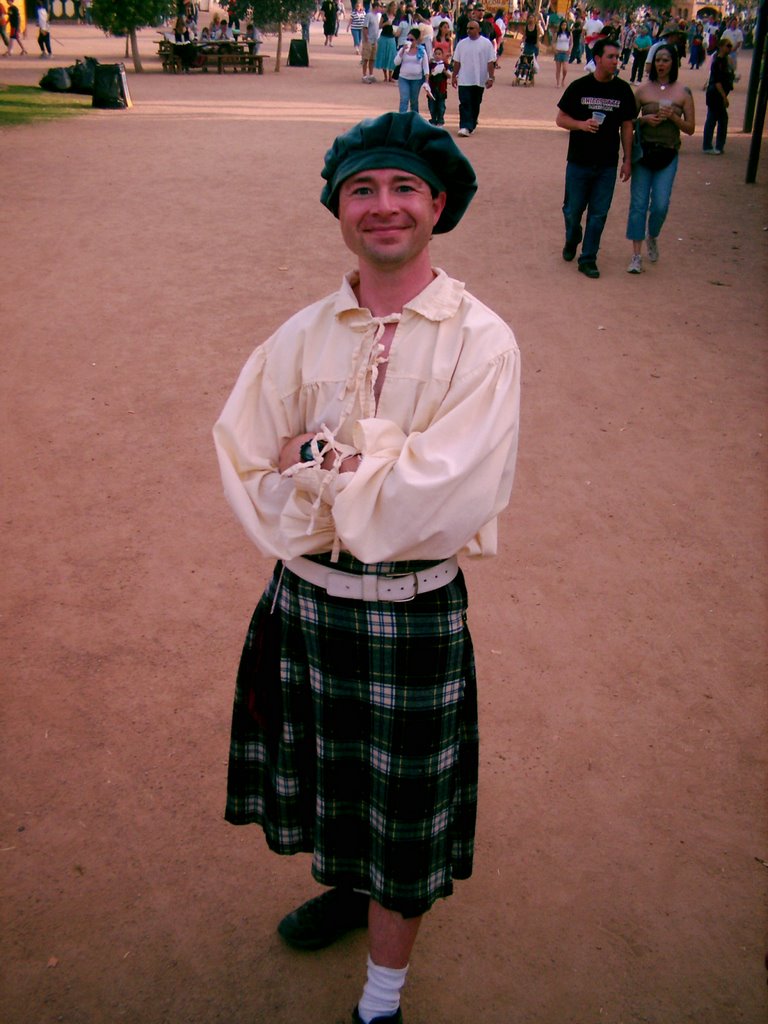
That's yours truly at the Arizona Renaissance Festival, kilted to the hilt and loving every second of it. The title quote comes from the ticket taker at the gate, himself costumed, when he saw the smile on my face as I passed by.

For the uninitiated, you can rent costumes right outside the gate. The fee is not outrageous -- about $30 for me. Yes, it's a little long. And yes, if you have to ask, I was wearing undies. I thought about keeping my dress shorts on in the changing room.

"Take off your shorts," the attendant said.

I thought about it some more. But since the kilt fell below my knee, I decided to risk potential embarassment.

Walking around in a kilt is quite comfortable. I just wish I wore actual kilt hose instead of those socks! Calm wind helps too. Sometimes you have to sit like a girl. I don't care. I have a "brave heart."

I could tell you more about the day, with its shows and jousting and chivalrous revelry. I enjoyed it. But after a few recent timeline travels which involved much more interaction, simply dressing the part isn't cutting it any more. I feel like I have to go further, which in this case probably meant dancing the Highland Fling... something which I didn't have the opportunity to do.

What does this mean? For me, living history means living it. But a time will come, I promise you. Keep your kilts on.

Tuesday, March 21, 2006

Send In The Lions

I thought we got rid of the Taliban in the Afghan government. I guess not:

Christian Charged For Switch From Islam

My favorite contradictory quote:
"We are not against any particular religion in the world. But in Afghanistan, this sort of thing is against the law," the judge said.
And from the prosecutor:
"He would have been forgiven if he changed back. But he said he was a Christian and would always remain one," [Abdul] Wasi said. "We are Muslims, and becoming a Christian is against our laws. He must get the death penalty."
It's getting much harder for me to believe Islam is a religion of peace with characters like these around. I'll say it again: moderate Muslims need to start taking their faith back.

Monday, March 20, 2006

Reel To Reel: V For Vendetta

How It Rates: ***1/2
Starring: Natalie Portman, Hugo Weaving
Rated: R
Red Flags: Intense Graphic Violence and Swordplay, Mild Language

I saw V For Vendetta late in the evening in the middle of a Las Vegas getaway. Out of all the shows in Vegas I could've picked, I picked this one. I emerged from the theater spellbound. This is a film that I watched for two hours and mused upon for many hours afterward. I was still thinking about it when I drifted off to sleep in my hotel room.

V For Vendetta has a complicated Francis Movie Equation: 1984 + Phantom Of The Opera + The Zorro Pictures / The Matrix + the psychology and mindsets surrounding the Third Reich and the War On Terror. The film from the directors of the Matrix triology could be a warning picture -- a prediction of what will happen if we do not guard our liberties, trade freedom for security, and surrender to fear.

The picture takes place in 2020 Great Britain, now a facist state. The motto of the government conjures up images of Nazi Germany and The Wave: "Strength Through Unity. Unity Through Faith." A nationwide curfew is strictly enforced. Works of art and music deemed offensive by the government are confiscated. Television is merely the puppet of the government, censored and bloated with propaganda as news. Vans with listening devices cruise up and down the streets monitoring for dissent. And the public, comfortably numb in their homes and pubs, doesn't care.

One person does: a mysterious vigilante named V (Weaving), who wears the mask of Guy Fawkes, a man who tried to blow up Parliament in the 1600's. V is out to reawaken the public to what they have lost and make them rise up against tyranny. This involves a pirate broadcast, a few big explosions, and lots of killing -- mainly targeted at government officials. He meets and befriends Evey (Portman), a worker for that puppet TV network, who comes to find within herself another person, one with purpose and courage.

That's all you need to know about the plot, which is building up to a big day when something big is supposed to happen. A curiosity: the USA in this film doesn't exist any more as a sovereign nation, although it's not clear why. We hear a couple of references suggesting that somehow, the British took back the former colonies. Lousy redcoats. What is clear is this: the War on Terror has grown and spread, along with a climate of fear. In this climate, a repressive regime rose to power, much the same way the Nazis rose to power in the disillusionment, poverty and hopelessness of post WWI Germany. The film also throws in some other thought-provoking twists, which are better left for you to discover and find the parallels in real life.

In The Matrix, the Wachowski brothers laid some deep questions about our dependence on technology and our perception of reality into a world of CGI. V For Vendetta goes even deeper, though with less action and more political intrigue, all of which works, except for one scene of Weaving's character slicing through people with a pair of swords.

For a vigilante, V speaks with the tongue of a learned man, not some psychopath. He is a voice of reason, even if you do not approve of his methods. "People should not be afraid of their governments," he says. Governments should be afraid of their people." Still, you can call him a terrorist. His actions are violent and designed to incite fear. He kills a lot of people. And even if the ultimate end is eliminating the government's own campaign of repression, he is not a role model for your kids. But as we see all the time, one person's terrorist is another's freedom fighter. And if we suddenly realize one day the freedoms we love have been confiscated, a lot of us are going to want V out there fighting for us.

It's no spoiler to tell you that Parliament is blown up, just as Fawkes intended. This may disturb you. But in the context of the picture, it might not. It is all perception, and the Wachowskis push that question: is terrorism ever justified?

At one point, V lectures the British public on what has happened to their rights and says the blame for it lies with themselves. Twenty years from now, I hope like heck somebody isn't making the same lecture to us in America.

Saturday, March 18, 2006

Drawing The Curtain On Freedom Of Speech

What should have been a teaching moment, an opportunity for a discussion of free speech and what offends us fell victim to a scared administrator in Fulton, Missouri, my home state.

High-school drama teacher Wendy DeVore is resigning after the school superintendent cancelled TWO student plays amid complaints about content.

From the AP report:
But after a handful of Callaway Christian Church members complained about scenes in the fall musical "Grease" that showed teens smoking, drinking and kissing, Superintendent Mark Enderle told DeVore to find a more family-friendly substitute.
Teens smoking. GASP! Drinking. GASP! And kissing. GAAAAAASSSSP! The teenage high-school experience isn't suitable for high-school teenagers anymore. And this is after the script had already been sanitized for high school audiences. The New York Times points out DeVore rated the production PG-13. That should've been enough.

The irony surrounding what was to be the next play speaks for itself:
DeVore's students were to perform Arthur Miller's "The Crucible," a drama set during the 17th Century Salem witch trials.
Note that this play was chosen before the cancellation of Grease.

The irony deepens when you see what play went on instead:
DeVore chose Shakespeare's "A Midsummer Night's Dream," a classic romantic comedy with its own dicey subject matter, including suicide, rape and losing one's virginity.
But I guess because it's written in Old English, nobody will understand it anyway.

According to the Times, Dr. Enderle seems more concerned about tough questions than standing tough for his faculty and students:
Dr. Enderle said he did not base his decision to cancel "The Crucible," which was first reported by The Fulton Sun, a daily, just on the three complaints and the video [of a dress rehearsal]. He also asked 10 people he knew whether the play crossed a line. All but one, he recalled, said yes.

"To me, it's entirely a preventative maintenance issue," Dr. Enderle explained. "I can't do anything about what's already happened, but do I want to spend the spring saying, 'Yeah, we crossed the line again'?"
"Preventative maintenance." Call Roget's. Censorship has a new synonym.
Nevertheless, the superintendent said he was "not 100 percent comfortable" with having canceled "The Crucible."
Not only is he devoid of backbone, he's also wishy-washy. Do you want this person leading a school district?

This could've been an excellent topic for a town-hall meeting with parents. Hopefully, somebody would have stood up for the kids and their teacher.

From AP:
"We have become a laughingstock," teacher Paula Fessler told The Fulton Sun.
Make a ridiculous decision, and you deserve the ridicule. Unfortunately, the ridicule here is obtuse, hitting the citizens of Fulton, Missouri instead of their school superintendent. Fulton is not a backwater bastion of intolerance. You will recall it's where Winston Churchill made his famous "Iron Curtain" speech.

Now, we have the Velvet Curtain. On one side, we have the First Amendment. On the other, we have those who say it doesn't apply to kids, doesn't apply to indecency, doesn't apply to anything we don't "like." They have mentally added another amendment to the Bill Of Rights: The Right Not To Be Offended.

That right does not exist. If something offends you, then use the one that does to state your beliefs as a counterpoint. But also choose to turn away, close your ears and your eyes. The arts and the media feed off of your patronage. Refusing to patronize offensive content will send a much more powerful message than taking a pre-emptive strike. As we have seen time and time again, controversy drives publicity, which drives curiosity.

The student actors at the center of this are concentrating on putting on a fantastic show, Shakespeare or otherwise. Huzzah to them! Unlike their high chancellor in the faculty, they know where they stand.

Saturday, March 11, 2006

Tears Of A Stranger

The following took place a few weeks prior to the date of this entry. I have withheld this story until now to avoid upstaging the mourning of the young woman who lost her life. But I feel ready to tell it, especially after seeing the movie Capote, so that you may know journalists -- including TV news producers -- are not without feeling for the people they encounter, even as others criticize us for having no soul, no shame, no honor in our profession.

I felt powerless. A story didn't roll correctly. A soundbite had no audio. And all I could do was kneel beside a monitor, one earpiece listening to the unfolding program, and keep people in front of the camera from looking silly by warning them when they were on. So much for field producing live shots at the Chrysler Classic of Tucson. Everybody was fine on my end. But gremlins were popping up back at the station during the Sunday 5:30 newscast.

I'd volunteered for the job hoping to help the sports crew avoid a repeat of last year, when the golf tournament went into extra holes. It led to a mad understaffed scramble to get the footage on the air. If anything, I could run tape back and forth should we bump up against a tight deadline, easing the tension. This year, it all ended on time, with plenty of minutes to catch our breaths, edit our tape, and set up our live shots. We were overstaffed.

But then I heard Andrew, one of our photographers, was on his way to another assignment. The family of an 18-year-old girl killed in a car accident just two days ago was going to talk to us. Andrew was to get the soundbites alone, without a reporter accompanying him. I didn't want him to do it by himself, so I dusted off my TV reporting expertise from long ago and hopped in the live truck with him.

We made a call to the assignment desk to get directions and some background. I dug through the back of the van for a pen. My hands waded through camera bags, empty pop bottles, discarded paper, trash, mystery wires, wrappers and filth, but located not a single pen. At work one hangs around my neck. All I had around my neck now was my press credentials. I desperately needed that pen to transcribe the details that were either going to keep me out of trouble or get me into more of it: Who was this girl? How did she live? How did she die? No way was I going into an interview with a grieving mother ignorant of the facts and bereft of a way to take them down in front of me.

Andrew stopped at a 99-cent store while I leaped out and ran for a cheap writing utensil. I snatched a pair of Scriptos and dashed for the checkout.

"Are you in a hurry?" a clerk asked in the middle of an order. She was rolling what looked like two dozen pop cans across the scanner, one at a time.

"Is there an Express Lane?" I queried.

"It's $1.07," she said, seizing the advantage of working at a fixed-price store: an ingrained knowledge of prices plus tax.

She generously took my money in the middle of the other order, and I was back in the truck in a flash, on the phone, and on my way to an interview that would wring my heart like a sponge.

All I knew about Elisa before I met her family was that she was an aspiring mariachi musician, one who had placed fifth in a national contest. I knew she had died in a head-on collision. And that was all.

Our live truck rolled into the dark cul-de-sac around 7:30, delayed by heavy traffic. Rows of parked cars lined the curb outside the family's home, occupying as much space as possible without blocking the center of the road. I worried how we would get our battleship of a vehicle out. The approaching deadline for the 10:00 newscast was working against us. We were to get enough material -- interviews and pictures -- for a "natsound" package, one where the interviewees do all the talking in the finished piece and the reporter does none.

Here I was, the reporter, wearing neither a suit nor tie but the aftermath of a day in the field assisting with golf coverage. A button-down brown-striped shirt hung loose around my waist, with brown shorts as base. Pulling cables left the pant legs marked with black streaks. My press badge with the four-year-old picture still hung around my neck, and a Chrysler Classic media access pin dangled from a pocket.

A relative serving as a liaison for the family met us shortly after we rolled up and graciously thanked us for coming. She led us inside.

Relatives filled the garage and every room of the home's lower floors, some hugging, some eating or sipping beverages, and nearly everyone talking. We made our way to the living room, where a crew from another station was wrapping up amongst the crowds. Their camera sat dismounted, tripod ready for folding. Andrew and I searched out a space for an interview.

"Wherever you want to do it," I said to him and the family. We decided on Elisa's room.

The door swung open and I stepped into a shrine. Pictures of the girl dotted the blue walls: her and her friends, her and her family, her as a mariachi singer, the feature article about her in the paper, all smiles. Ticket stubs for Spanish concerts protruded from the frames. My eyes scanned the room several times as Andrew set up the equipment.

I caught a quote on her bulletin board: "Wait for what you want and you'll get run over."

As the photographer took video of the photos, my eyes fixed on a silver microphone without a wire. It lay on her dresser like a hairbrush, and I asked about it.

Her father laughed. "She used that to practice her stage technique," he said. He didn't think that old mic, dented on the top, worked.

I saw the mirrored closet doors in front of me and knew it did. Every day, Elisa would stand in front of those doors, practicing to become a star, perfecting her voice and her rhythm. My mind flashed back to my high school days when I practiced for speech and debate competitions in front of my mirror-less closet door.

Elisa's mother and I sat down on the girl's bed. I asked her to face the camera and not me as the interview began.

"Tell me about her," I said, keeping my question vague and open-ended so she could proceed with the most striking thought that came to her mind.

"Elisa was a charismatic young lady," her mother said. "She just brought so much joy and happiness to everyone. Everyone she met, she touched in a positive way."

The mother painted me a picture of the daughter she had lost: a loving person, one driven by a love of music, one who brought joy to many others while determined to be the best.

She talked of Elisa placing second -- not fifth as I had been told previously -- at the national mariachi contest last December, second out of 500 contestants.

"She did so well. We were so proud of her, and yet at the same time she was so disappointed that she didn't get first place because she thought she had let us down. And we said, oh no, you never let us down."

She talked of Elisa learning Spanish from scratch to master her craft.

"She had wisdom. She had a lot of wisdom in her age. And I don't know, maybe that's why the Lord took her from us at a young age."

And then came the night Elisa died.

Elisa was on her way to a party, one with traditional Mexican music, and she was to pick up a couple of friends on the way.

"She said, 'I'm on my way, I'll be there in a few minutes,' and then quickly she says, 'Oh no.' She hung up. And and at that time, they didn't hear from her again."

Nobody knew what caused her to veer into oncoming traffic. But her death was instantaneous.

The walls full of pictures, the memories, and the presence of her loving family seeped into me. My insides ached and my eyes watered.

"Excuse me, Chris, this battery's almost dead," my cameraman said. "I need to go get another one."

I needed the moment. I rubbed my eyes nonchalantly, as if my contact lenses were bothering me, composed myself and sat up. While Andrew fetched the battery, I made small talk with a comparison to the late pop star Selena, who also had to learn Spanish on her way to stardom.

I talked to her father, who admitted being hard on his daughter when it came to singing right. But she also made him proud, when she was on stage, performing for millions of people on the Univision TV network.

"I'm sure she's singing right now," I said.

"Yeah," her father smiled. "I guess the Good Lord wanted her in His choir of angels. Maybe they were all sopranos and they needed a mezzo soprano or something."

We needed video of her singing. A family member found the DVD, but it wouldn't play correctly on the DVD player in her room. Someone suggested bringing the DVD player from the living room up to the bedroom.

"It may be easier for us to just go downstairs," I said as Andrew grew nervous about the time slipping away from us.

We returned to the crowds below and Andrew set up the camera in front of the living-room TV while relatives fidgeted with the DVD player. What we were about to get wasn't going to look the best it could. We didn't have the proper equipment and cables to take the video straight from the disc. And worse, Andrew thought he only had 30 seconds of battery power left. But we had to make it work.

The family searched out the moment that brought pride to them. I held the microphone up to the stereo speaker.

Elisa stepped onto the stage, her off-white mariachi outfit glowing in the lights, earrings dangling in front of her tightly-ponytailed dark brown hair. She began to sing, and the passion of the music poured from her corazon as if she had been singing all her life. She missed not a note, flubbed not a phrase. Her beauty penetrated the screen. Again, my eyes watered.

"Muchos gracias!" Elisa called to the audience, taking her bows as the crowd on the disc cheered her.

A few people behind me applauded. I turned around and saw every face in the room staring silently at the screen, the pain evident in their eyes, their hearts longing for another song.

"Thank you," I said softly. "Thank you for talking to us."

Andrew loaded up the gear and I slipped into the front passenger seat of the live truck.

"This is killing me," I said to my colleague, my voice quivering. "I can't listen to somebody talk about this wonderful person who's gone and not be affected by it."

Tears flowed silently now in the privacy of the live truck. I tried to regain my composure, some modicum of professionalism, but my body shook with the chill of grief.

I felt so awkward and out of place. I had entered the home of a family in mourning for their daughter as a stranger, and yet the two people closest to her willingly shared the story of her life with me as they would to a friend, in her own room. Some might call it grief therapy, telling the story over and over again to keep her spirit alive within them.

The rule is you don't let yourself get emotionally involved with a story. You're a journalist, not a grief counselor. And I'd been down this road before, having run the camera a decade ago in college while a fellow reporter talked with the mother of a son who had just been murdered.

I cannot sit in front of somebody, eye to eye, and hear the story of someone like Elisa without it touching my heart, without it making me shed a tear. Perhaps it is because this person is so worthy of my respect, so worthy of honor in a time when many young adults do not make the right decisions. Elisa did not deserve to die. She deserved to live, using her love of music to bring joy and pride to all around her.

We arrived back at the station at 8:30 and quickly pieced together the story. I cut the basic soundbites in the computerized editor and Andrew hurriedly laid down the music and pictures from Elisa's performance to round it out. I was under double the pressure because Andrew had to edit another story and wouldn't be available to help until that task was done.

The finished product deserved five minutes. But we only had time for a minute and a half.

We saw Elisa singing, her mother talking about the "charismatic young lady." Her father talked about his proudest moment, "watching her sing at this competition she was in."

We heard about the night of her death, the "oh no" phone call. But we heard more about the life.

"We're going to miss her dearly," her father said in the final words of the piece, just before Elisa finished her song and said "Muchas Gracias."

I'm glad the piece contained only the words of Elisa's parents. Any words I would've added would have been tainted by emotion. This way, viewers heard the story I heard, although in a lot fewer sentences.

A wonderful young woman, one who had enriched the world around her was gone. The photographs in her room bore abundant proof of the many lives she touched. She was on her way to stardom. She was living a dream. But so many others were taking that journey with her. And now we'll never know how far she would have gone.

To deny my emotion is to deny my own humanity. And I feel no guilt in weeping for this person. She has earned every tear.

Reel To Reel: Capote

How It Rates: ****
Starring: Philip Seymour Hoffman
Rated: R
Red Flags: Brief Graphic Violence, Smattering Of Language

In Cold Blood is on my list of Books I Need To Read Before I Die. But in a way, I already have. Truman Capote's nonfiction novel sparked a new genre and forever changed the way true-crime accounts were written. One of my favorites in the genre, Harry N. MacLean's In Broad Daylight, is one of Blood's many great grandchildren.

But Capote is not the story of a book. It is the story of a man consumed with humanizing the story of a family murdered in 1950's Kansas. Capote's probing of the two killers' lives brings out parallels in his own scattershot life and reveals currents of deep tragedy and longing. Watching Capote unravel the truth is like watching a sand castle blown away by the wind, leaving a foundation in ruins.

Hoffman, who just won an Oscar for his performance, is absolutely mesmerizing as the famed author. His high-pitched effeminate voice leaves no question about his orientation. But at the same time it projects childlike innocence, a harmless disposition that hides deeper scars. Several scenes show us how Capote could be the life of the party as a quirky storyteller. Hoffman embodies the role completely, flawlessly integrating Capote's tics and speech patterns.

The movie focuses on Capote's various journeys to Kansas to gather the raw material that would make him famous. He is aided by fellow author Harper Lee (Catherine Keener), who grew up in Capote's neighborhood and has just penned her own groundbreaking novel, To Kill A Mockingbird. Capote is not one to use a notebook and pen when he's talking to people. He will step into a room and start to absorb his surroundings, as he does in one memorable scene where he meets one of the killers being held in "the women's cell" -- a cage in the Sheriff's kitchen. Capote can recall conversations with amazing accuracy, as he himself boasts, which he will later jot down in notebooks.

The author realizes he can't tell the story without fleshing out the two killers, condemned to death. He bribes a warden to give him unlimited access. He finds another lawyer for them so they will not be executed before he's finished gathering facts. And in the process, a friendship develops -- but maybe it's more of a dependency. The killers want to live. Capote wants to finish his book. The author resorts to small deceptions to keep them talking, saying the book is less finished than it is. But Capote's legal aid works too well, putting the case in front of the Supreme Court, and further denying the author an end to the story which is tearing him up. All through this, he sees his friend Lee rise to fame. Her book is a success. It becomes a movie. Capote knows he has his own success, but it is delayed as long as the killers are alive. Still, he feels for them, he is bonded to them.

Capote reveals why the author never finished another book, just as In Cold Blood revealed what led two men to kill. Both Capote and the killers become victims of their own actions. And as the two criminals lost their lives, Capote loses his own in the contradictions of friendship and his work. He says to Lee, "I couldn't have done anything to save them." Lee replies, "Maybe not, Truman, but the truth is, you didn't want to."

Journalists are not supposed to become emotionally attached to the stories they cover, but Truman Capote was not a journalist. He was a novelist. The attention to detail, the need to create compelling characters, the crafting of a plot all drove him to dig into territory and emotional minefields many reporters don't wander into. Capote became the victim of a job too well done.

Monday, March 6, 2006

And The Oscars Go To...

A few comments on Hollywood's Big Night:

Best Picture: Crash -- You can read this one of two ways. Some of you will say Brokeback Mountain got snubbed because it was about gay cowboys. Nikki Finke of L.A. Weekly says it's because straight Academy members didn't want to see a gay movie. I read it this way: Brokeback had a strong message about love, but Crash had a stronger one about race relations.

Best Director: Ang Lee for Brokeback Mountain -- No gripe here. Lee took charge of a film that could've ended up as porn or laughable love story and steered around the mines. That's what a good director should do.

Best Actor: Philip Seymour Hoffman for Capote -- I haven't seen the picture. But I've seen enough of Hoffman's performance to want to. And now I want to even more.

Best Actress: Reese Witherspoon for Walk The Line -- Hooray! (That only approximates the cheer that went up in the newsroom when she won.) Joaquin Phoenix was great as Johnny Cash. But Witherspoon was even better as his second wife. She dissolved into the role so effectively, doing her own singing, I had to ask myself, "Is this the same person who starred in Legally Blonde?"

Best Supporting Actor: George Clooney for Syriana -- Oh heck, another performance I haven't seen in a film I haven't seen.

Best Supporting Actress: Rachel Weisz in The Constant Gardener -- Ditto.

Best Song: Three 6 Mafia with "It's Hard Out There For A Pimp" from Hustle & Flow -- The lyrics were disinfected for TV, I'm told, but I swear I heard the phrase "talkin' s#!t" instead of "jumpin' ship." Shocking, yes. Surprising, no. Remember, Eminem won for "Lose Yourself" in 2003.

Best Documentary: March Of The Penguins -- A pic about cute flightless waterfowl does more than $100 million in worldwide box office. If that isn't worthy of an award, then the Academy's documentary voters deserve all the scorn they've absorbed over the years.

And about Jon Stewart -- He behaved himself a little too much. Maybe he feared becoming red-state flamebait or becoming the worst host since Dave Letterman. But as the night went on, the jokes got better: "Do you think that if we all got together and pulled this [giant Oscar statue] down that democracy would flourish in Hollywood?" "We're out of clips!" If you tuned in expecting The Daily Oscars, you tuned out disappointed.

In all, we'll probably remember (or forget) this year's Oscars for what wasn't there: no runaway winners, no political barbs. Call it boring, but that's showbiz.

Sunday, March 5, 2006

Reel To Reel: 16 Blocks

How It Rates: ***
Starring: Bruce Willis, Mos Def
Rated: PG-13
Red Flags: Language (medium), Violence (medium)

What saves 16 Blocks from becoming a forgettable police procedural is a barrage of surprises -- not necessarily major plot twists, and not all of them on the level. And all right, Mos Def does steal several scenes as Eddie, a motormouth con with a nasal, Mike Tyson-esque voice. But aside from those two features, it's just another TV cop show.

Bruce Willis stars as Jack Mosley, a run-down alcoholic NYPD detective given a simple chore. Take Eddie from jail to the courthouse for a grand jury appearance. Sixteen blocks -- piece of cake. It's like dropping some shirts off at the cleaners. Eddie, however, is about to testify against some crooked cops who would rather see him dead. When Jack stops off for some booze to stay comfortably soaked, a hit squad moves in on Eddie, who's still in the car. But things go sideways, and Jack and Eddie are on the run, with Eddie's mouth running as fast as his legs.

Willis' character is not drawn for us any deeper than necessary. Maybe it's because Def's Eddie is hogging so much characterization he's not leaving anything on the plate. We know Eddie has a dream of opening a birthday cake bakery, and he's trying to clean up his act. But what do we really know about Jack? Nothing really more so than he's been on the force long enough to have some deep roots and probably a few skeletons, but we don't know the facts, ma'am.

16 Blocks makes good use of several foot chases, dodging the car-chase cliche as much as possible. While that's refreshing, I found a couple of plot twists at the end a little far-fetched. Still, they seemed to work, and the picture has a capable handler under director Richard Donner (Lethal Weapon). The picture is a good run for the money, but it won't leave you breathless.