Sunday, February 19, 2006

Come, Let's Be Merry!

We Make History Presents An Evening In Honor Of The Original "George W."


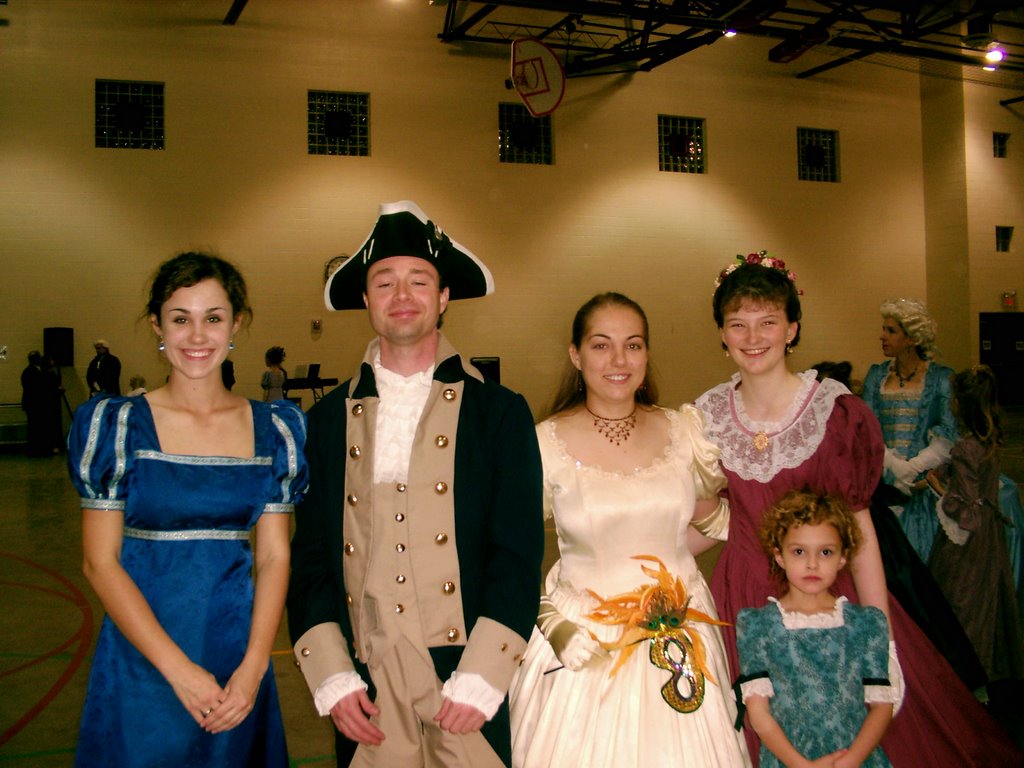
The appointed hour approached and I switched back to my original plan: that lace jabot did indeed look better with the rented coat. I marveled at the comfort of my waistcoat and breeches, the finest handiwork of My Dearest Aunt Susan. She donated her services upon learning of my previous step back in the past. Those gold buttons at the knees -- how fitting and proper!

One hundred and fifty were expected for The George Washington Birthday Ball. His Excellency, hero to a nation, stood at the door greeting the crowds as they entered, including a few members of the Continental Army -- myself among them. Fortunately, my carriage was not delayed by any weather nor Phoen-- uh, Virginia-- traffic.

As generations would pay tribute, the timeline stretched to include them: a Union officer, a Confederate officer, a couple of World War II enlisted men, a 16th Century Englishman... but curiously, no redcoats. Were they plotting a sneak attack? In a setting where the Blue and the Grey danced together, surely a British Regular might fancy a turn or two. Even King George III came to respect His Excellency.

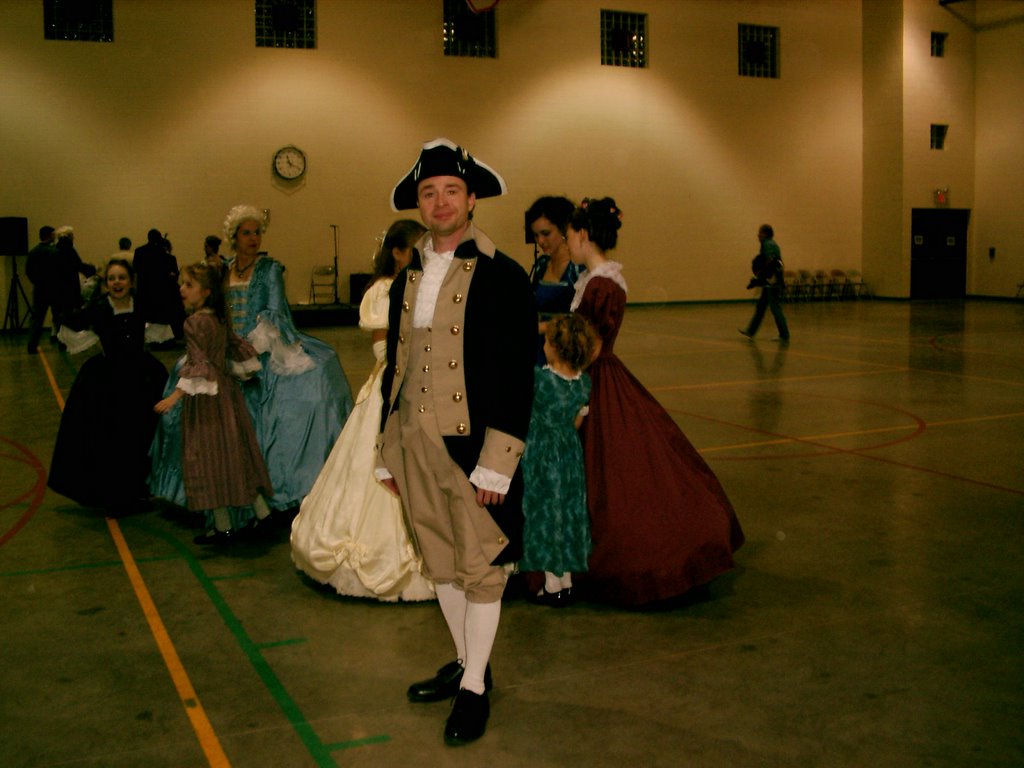
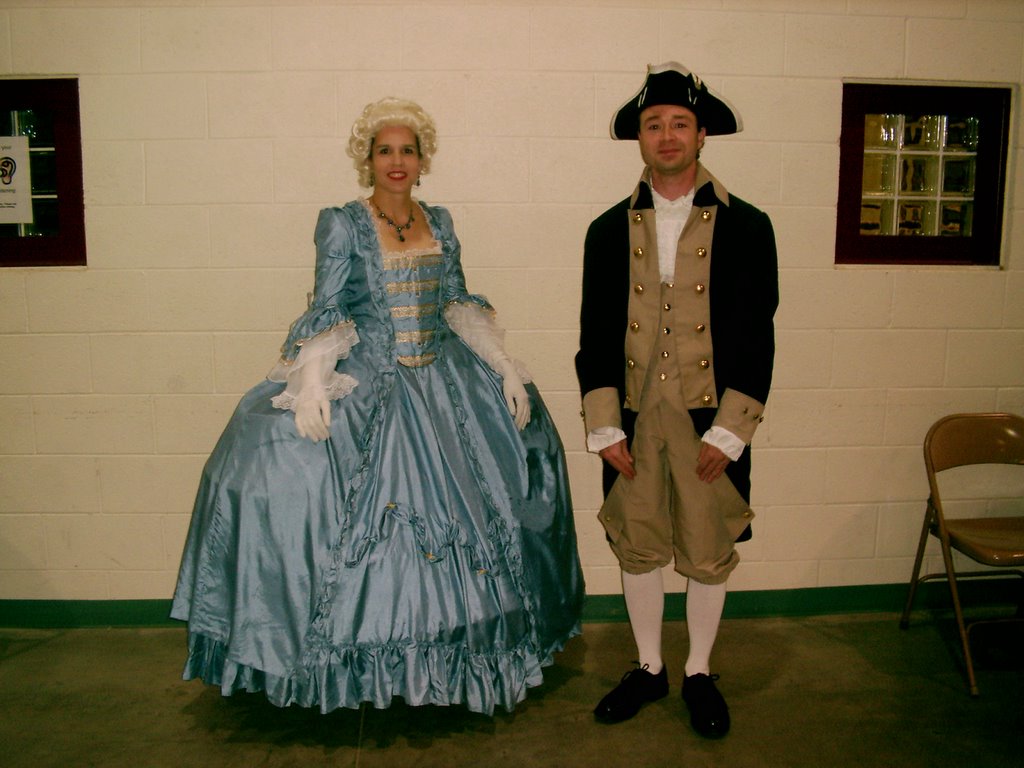
We posed for many pictures. I stood alone for a pair, but Mr. Washington was kind enough to escort a charming young lady over to pose with me. The shutter snapped, and then I bowed to her deeply, my three-cornered hat removed in the utmost respect.

"Wait, wait, that's the pose!" the general cried, and he summoned us back over to resume our honors as flashbulbs went off like rifle shots.

The ladies stood out in their finest ball gowns, accompanied by many young men in modern-day formal attire. They could have all resembled future presidents, a thought not lost on President Washington, who entertained them with many historical facts as they took on the roles of presidents past.

"Let's get this party started."

The Pledge Of Allegiance, The National Anthem, and now, the promenade. As "Hail To The Chief" and "Yankee Doodle" played, I thought I knew this dance. But new steps are always the rule. Picture the long line of couples linking and weaving out of the crowds, the line of partners splitting up and rejoining and joining again in configurations that would challenge the expert at the loom.

I still consider myself a novice to English country dancing, but I know what I like.

"Christ Church's Bells..."

Oh joy! The first set dance of the evening was my favorite of the previous ball. No complicated steps, no serpentine movements.

Then came "Come, Let's Be Merry" -- a three-couple set dance. This could be trouble. I sense some complicated figures ahead. But behold, this dance produced "the moment."

One part of the dance calls for the lead couple to waltz up the line. You can do it one of three ways, each more or less like ballroom dancing, but it's the man who decides. I chose the simplest means. So now I stepped to the three-quarter time with my partner, a beautiful lady in a floral gown, our inside hands joined as if we were performing a minuet. I would turn to face her on alternating beats, my eyes catching hers back and forth. My smile grew wide. Her eyes twinkled.

Ahhhhhh......

Many times it's not nice to tease, but in "Away To The Camp," another three-couple dance, the women and men take turns parading around each other. And it's quite all right, as Mr. Washington demonstrated, to tweak or tickle a lock of a fine lady's hair as you pass behind her. And likewise, they returned the favor!

Several breaks allowed us to cool down and seek refreshment. My costume breathed better this time and I needed little fanning. My feet were stronger. After the throbbing of the last night of dance and revelry, I had sought out the sole comforts of a doctor named Scholl. Already my calves were thanking me.

Eighteenth-century men, as the general pointed out at one point, would sometimes augment their stockinged calves with cork to provide a more attractive form to interest the opposite sex. I wonder though, if it did anything to ease pain.

You can't have a birthday party without cake. And First Lady Martha presented a fine one to her husband with the number 274 atop the white and blue frosting.

"I stopped counting at 200," President Washington quipped.

We also celebrated two other birthdays this night, singing and shouting a hearty "HUZZAH" to some young people. And two women were honored for their service to the community and the greater good: a woman with the staff of the Fitch Center, and an outstanding teacher. Their delight: cherry pies and an outpouring of appreciation.

"This is called 'All Haste To The Wedding.'"

Oh yes, that one I'd learned in Williamsburg and another close to my heart. At such times I skip about in the finest of cheer, my feet aching to do more than walk through the figures. Could I be loving this too much?

"Why is your right hand raised?" one lady asked, jesting at my joyfulness as we performed a "left-hand star."

I am all in the moment, I replied. I think.

Even soldiers were gentlemen, men who had learned to dance respectfully in their youth. Washington himself earned a reputation as a fine dancer. And I could think of no better way to honor that tradition than to add an extra touch of glee... for life, liberty, and the pursuit of happiness, always capped off at the end with a deep bow to my lady partners and a heartfelt sentiment: "Thank you for a most enjoyable dance!"

You know the cliche: careful what you wish for. I wondered if we might try a quadrille or the Virginia Reel. We did.

My little group of four couples agonized through the first few steps of the quadrille. Were we doing this right? Is that partner supposed to end up over there? Are we supposed to switch off or something? Turns out we were doing right all along, and relief washed over us.

Then came the reel, and my set ran into trouble. The reel sent myself and others, well, reeling as the head couple worked the way down the set, left hand turning our partner, right hand down the line, left turn... wait, that was supposed to be a right turn. Fall behind, even for a moment, and you fall out of synch.

"Reels are a lot of fun," I recall a Colonial Williamsburg interpreter saying, "but they can be absolutely painful."

No pain here. We messed up, we continued on and laughed it off. My nightmare scenario did not come to pass, one where a lady or gentleman would turn away in a huff, silently grumbling at the lack of a partner's grace if the other should trip all over the floor.

A slow waltz with "your favorite partner" closed the evening once again. Without a partner, I once again sought out another lady I had not danced with that evening, keeping true to my tradition of trying to dance with as many different women as possible. We stuck to simple steps, her not being that much of a waltzer, but I had to throw in a couple of twirls.

"Your friend dances much better than she knows," I said as I escorted her back to her friends.

Goodbye. Good night. God Bless You All.

* * *

Several people in the motel room parking lot spotted me making the walk back to my room, fully costumed, haversack over my shoulder.

"The British are coming! The British are coming!" shouted one, leaning outside his second-floor room with a buddy. I saluted them, and I gave another one to a woman talking on a cell phone who waved.

The stroke of midnight found me back in my car and re-clothed in my 21st Century attire. My mission was not to roust the militia to arms but find a late-night snack. Still, my three-cornered hat laid in the empty seat beside me.

Perhaps it was hunger, or a touch of fatigue, but a nattering question loosed itself from the back of my mind.

Francis, why do you do this?

Look at yourself. What compels you to dress in a style 200 years prior to your birth and perform dances seven times older than you? You're in your thirties and you're prancing around out there like an overgrown kid.

Maybe. But I'm not a juvenile delinquent, either.

But why?

Because it uplifts me.

Lord Scott, at one point in the evening, talked about "raising the bar" for our culture using the talents and gifts that we have. I am not sure how being a TV news producer in 2006 fits with stepping into the role and accoutrements of an 18th Century gentleman.

But this much I know: If I put on a tricorn and breeches in this day, it's with the intention of being a better person for it. If my joy on the dance floor rubs off on others, if it improves my disposition to life and my family, friends, co-workers and even a stranger or two, that counts as a victory.

So come, let us be merry!

See more pictures -- and more reflections -- from this celebration at this link!

Sunday, February 12, 2006

Drawing Upon Free Speech

Thursday night my station did a story on the controversial Muhammed cartoons which have raised many a riot around the globe. The piece contained three of the cartoons just as they appeared, including the "bomb turban" one. We did not fuzz anything, like CNN.

Here is what we told viewers before the story aired:
Media outlets across the country are debating whether to print the cartoons or broadcast them. Our media partner, the Tucson Citizen is conducting an online poll. And so far, 65 percent of respondents are saying they should run either in the paper or online.

Tonight we talk with an Israeli political cartoonist visiting Tucson and with a spokesman for Tucson's Islamic community. After much debate in our newsroom, we decided to show the cartoons, but only in the context in which they are discussed here. If you think you may be offended, please turn off your television. This is not to incite, but to give Tucsonans and southern Arizonans some insight into what this controversy is all about.
You can read Teresa Jun's excellent story at this link, which also has a video link to the story (and the disclaimer before it) as it aired.

Some honesty: I pitched this story. I believe in free speech. I couldn't honestly call myself a patriot if I didn't. At the same time, I believe rights come with responsibilities -- the old "yelling fire in a crowded theater" exception is one we can all recognize. I also believe it means being respectful of other religions. This story, again, was right on the mark.

But know this also: In Teresa's story, Muhammad As'ad urges the rioting Muslims overseas to "just cool it." I wish Al-Jazerra would broadcast that comment once for every time they've run an Al-Qaida tape. Islam is not a religion of violence. But unfortunately, the moderate, peaceful Muslims have allowed their religion to be co-opted by the radicals. Teresa's story might not have been necessary if more people understood the true nature of Islam.

You wouldn't think of Catholics as abortion-clinic bombers. You wouldn't see Jews as hook-nosed. But mention "Muslim," and I imagine a lot of you are going to have some vision of a person an explosive device. Your better judgment knows it's false, but that's not what you see when you turn on the news.

If we are going to fight a War On Terror against radical Muslims, the moderates cannot sit on the sidelines. It is high time that they started taking their religion back, changing the perception, and getting the truth out there. The Council on American-Islamic Relations (CAIR) is trying, but they have also taken heat for extremists in the ranks. One group is not going to get it done. It's going to take a lot of time, a lot of unity, and likely a lot of TV Public Service Announcements before the message gets out.

Saturday, February 11, 2006

Firewall

How It Rates: ***
Starring: Harrison Ford, Paul Bettany, Virginia Madsen
Rated: PG-13
Red Flags: Violence (high), Language (low)

Harrison Ford has every right to say he's getting too old for this. He's blasted his way out of Mos Eisley as Han Solo, cracked the whip as Indiana Jones, chased replicants in Blade Runner, thrown around some executive power in Air Force One, done the super-spook thing in Patriot Games and Clear And Present Danger, and run for his life in The Fugitive. When he caught a breath, he did the less pulse-pounding Sabrina, Regarding Henry and Working Girl. A lot of people would decide to mellow out. Then came Hollywood Homicide, and the lovable action hero was back, running around with a blaster and trying to ride a kid's bike. Another Indiana Jones picture is in the works.

So I watch Ford in Firewall and see an old friend sucked back into a genre I'm not sure he can handle after all these years. And yet he shows he can. Indiana Jones 4 will not break him in half.

Ford plays Jack Stanfield, a bank security manager who becomes the pawn of slick thief Bill Cox (Bettany), who comes from that large family of British-accented movie thieves. Cox has done his homework. You can spend a lot of time and bandwith breaking into a bank's iron-wall computer system, or you can kidnap the security manager's wife and two kids and force him to do it for you. So Cox and his gang of nerd henchmen strike, and they wire up Stanfield with a hidden camera and microphone to do their bidding. For that extra wrinkle, Jack's bank is in the middle of a merger, one rife with security concerns.

Firewall plays out like a standard hostage-thriller procedural, even though it baits us with possibilties -- an escape, reverse psychology on the henchmen, biological warfare involving a child allergic to peanuts. You'll have to find out for yourself how those scenarios play out, but when they do, they're at least a welcome diversion, if anything. As with all hostage-thrillers, the hostage(s) change(s) the game at some point, and somebody else ends up on the other end of the gun. The only thing to deduce is when this is going to happen, and will it happen in a way that makes sense. Here it seems to, but with some reservations.

Computer technology is at the core of Firewall, which is Silly Putty in the hands of a screenwriter. The means by which Stanfield enables the theft looks like a hardware hack from the pages of Make magazine. Like writing a computer program to solve a complex problem, screenwriters can fall back on a combination of homebrew software and hardware to fulfill their plot device needs. They willfully invent devices and keyboard commands that exist only in the PC landscape of Hollywood. And audiences don't mind any of this phoniness, including the pen camera than can somehow send a clear signal to a van sitting several stories below with not a hint of fuzz.

The Matrix taught us computer systems are designed around rules which can be bent or broken if need be. Morpheus was right, both in our world and his -- but mostly his.

Thursday, February 9, 2006

Hear Ye, And Ye Shall Be Heard

Oops. Comments should be working correctly now -- meaning visible without me having to approve every one of them. I accidentally had more anti-spam protection turned on than I needed. As always, practice your honors.

Wednesday, February 8, 2006

I Love You To Death

From the Speed Of Thought blog comes a new suggestion about how to root out Osama.

Sunday, February 5, 2006

Both Sides Then

Caught In The Middle Of The "Battle Of Winchester"

“We are going to be invaded,” said Miss Kay, putting a dark period on a sentence inside the one-room schoolhouse.

The warning seemed out of place amidst the teacher’s inviting nature. Wooden desks in front of her stood at attention, equipped with fountain pens and writing books stamped with the motto “try, try again.” In one corner lay pocket-sized schoolbooks on arithmetic and grammar. A chess set and marbles sat in another corner. Rays of light pierced holes in the roof, pricking the floor. Facing the blackboard at front, one saw the teacher’s name and a mild admonition: “Please, only kind words!”

“Come, come to school!” the teacher coaxed, and the children outside in the unseasonably warm February morning wandered in. They forgot it was Saturday, forgot it was Arizona, and forgot -- for the time -- the threat beyond their sight.

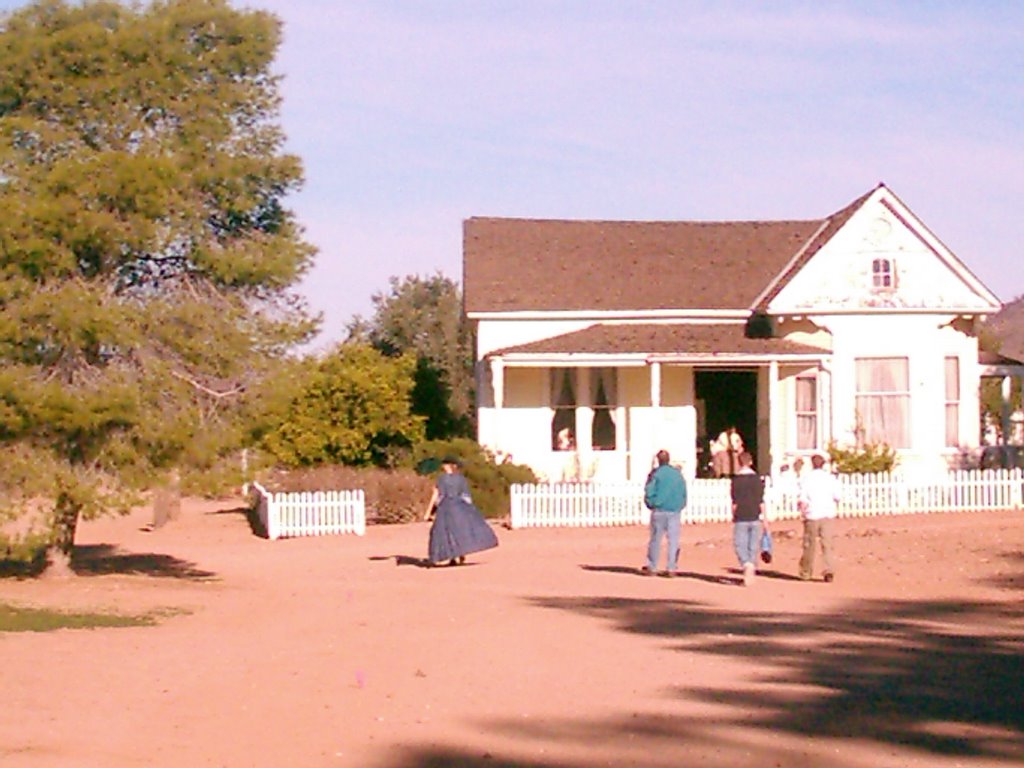
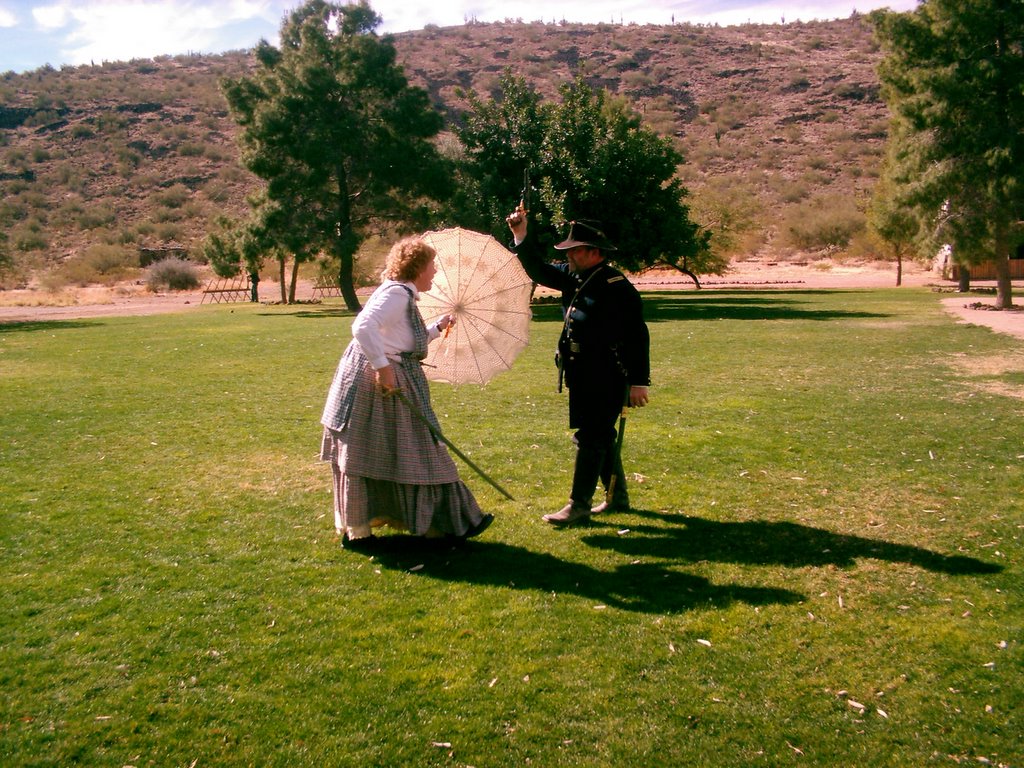
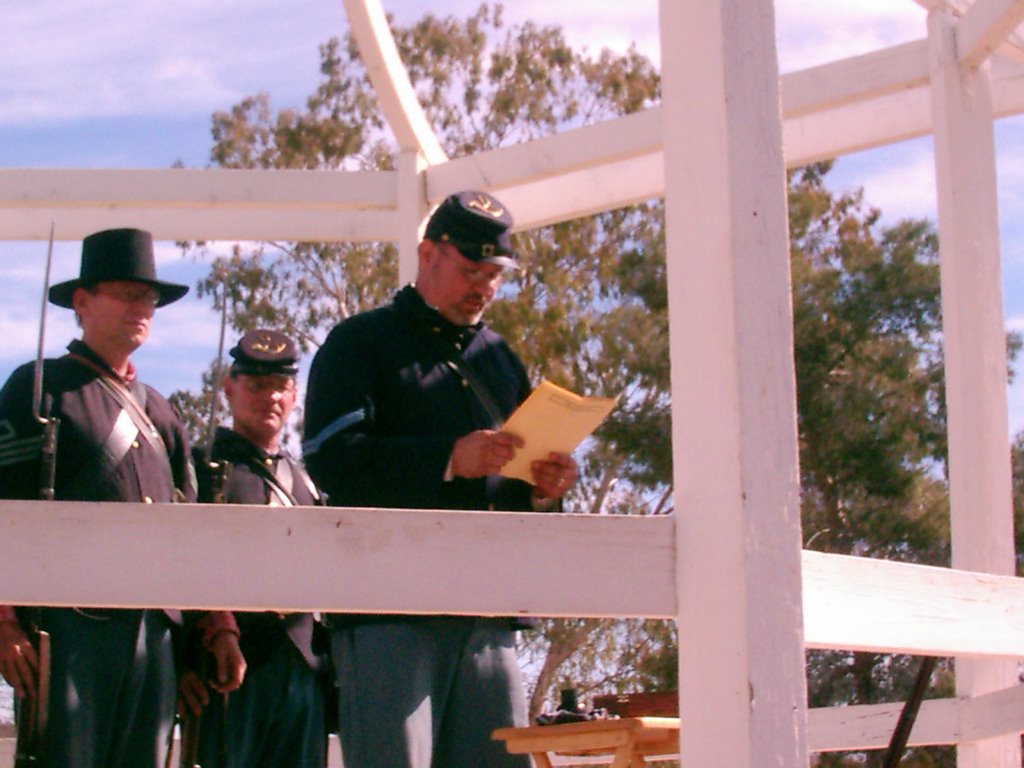
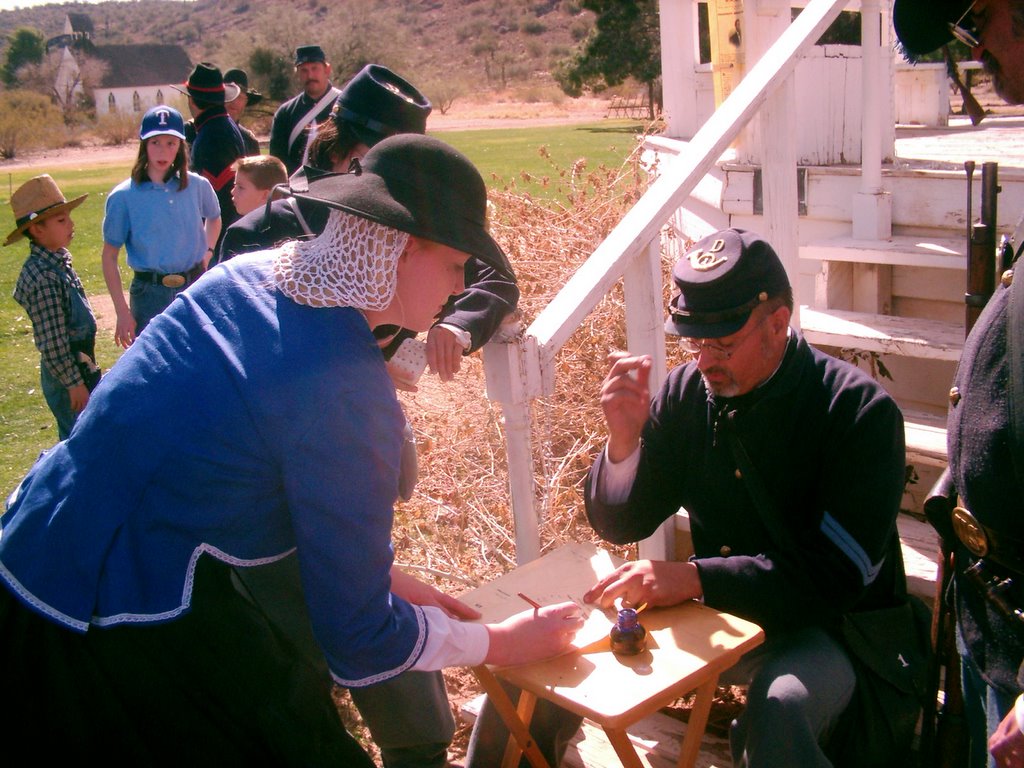
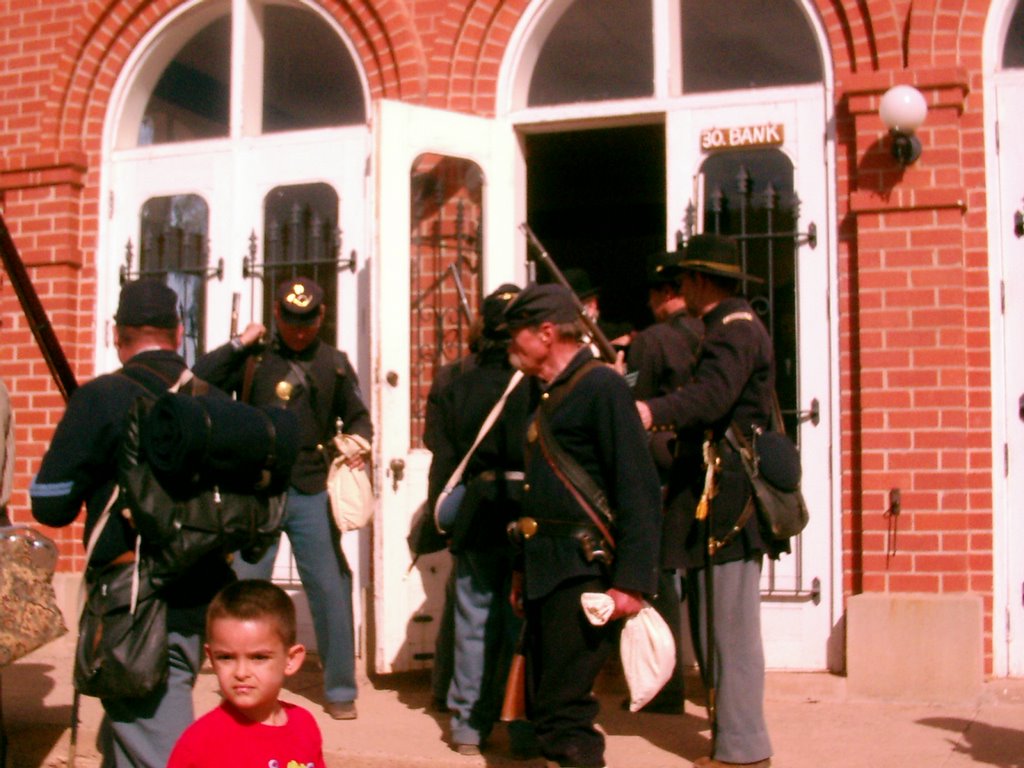
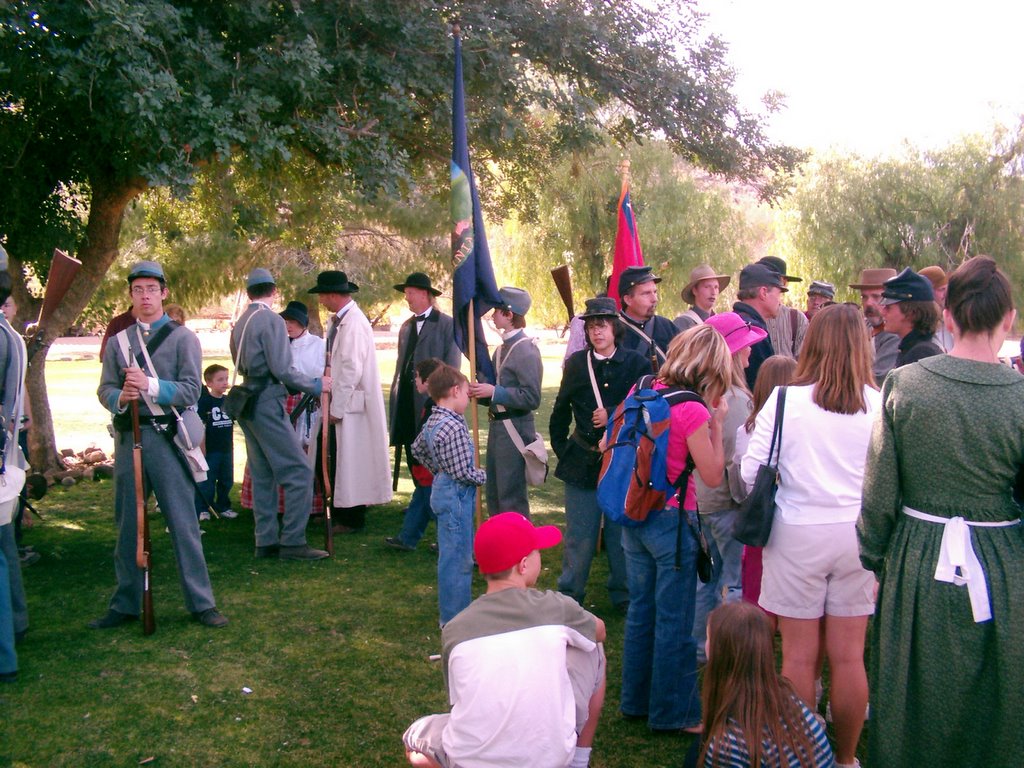
Pioneer Village, a living history museum north of Phoenix, had morphed into town of Winchester, Virginia during the Civil War. The town of loyal, Confederate Virginians was in the sights of Union soldiers. And numerous civilians, myself among them, were about to see a dramatic slice of life during wartime as portrayed by members of We Make History and various re-enactors and actors portraying the Blue and the Grey.

Morning drifted towards afternoon with uncertainty and a sense of trouble ahead. Confederate troops lined up early that morning to hear the yanks were on the move, headed in this direction.

I wandered about the various parts of the town: the Victorian house, the bank, the print shop, the church, the schoolhouse, soaking up history. During this time, the Confederate commander wandered over.

The person, I had met before at a certain ball. His character, I had not.

Yet he seemed to know me and I introduced myself again as before.

“Christopher Francis of Tucson,” I said.

We chatted for a bit, in character, as Captain Scott thanked me for making the journey and introduced me to a member of the 1st Virginia. Without much effort, my voice lapsed into a southern drawl.

“I hear there might be trouble,” I commented, still in something resembling character.

Yes, there was. Capt. Scott was well aware of the movement of the Union forces. “But I am confident we shall hold this town,” he said, unwavering in his convictions.

“Are you here buying or selling on Market Day?” the member of the battalion asked.

“Both,” I said. “Buy here, sell there. I go both ways.”

Our talk turned to the weather and I remarked how warm it was, with the temperature headed towards the 80’s and how winter seemed so unreasonably mild.

“I swear we haven’t even seen any snow on Mt. Lemmon,” I said.

“Mt. Lemmon?” Capt. Scott replied.

Ugggghhh. I’d blown it. That part of my brain still wired to Tucson had cracked out of turn and I’d thrown him for a loop. But a member of his battalion stepped in to make the save, suggesting I was talking about a mountain in Virginia.

“I’m a little geographically challenged right now,” I said sheepishly.

But Capt. Scott took it in stride, asking how the men at Virginia Military Institute were. I didn’t know the answer, but I made up the best one I could.

“They’re doin’ just fine. They’re off and out there,” I said, perhaps trying to draw a parallel in my mind to the reporting staff I supervise.

At eleven in the morning, the rumors proved true. A Confederate lookout ran back into town. “They’re coming!”

A nervous townswoman or two ran to the commander, begging them to hold off the Yankees. Consoled, all they could do was wait.

“Citizens of Winchester,” Capt. Scott announced, “there’s gonna be a fight. I’m sorry this is happening on Market Day, but we need everyone to get to the side of the building here.”

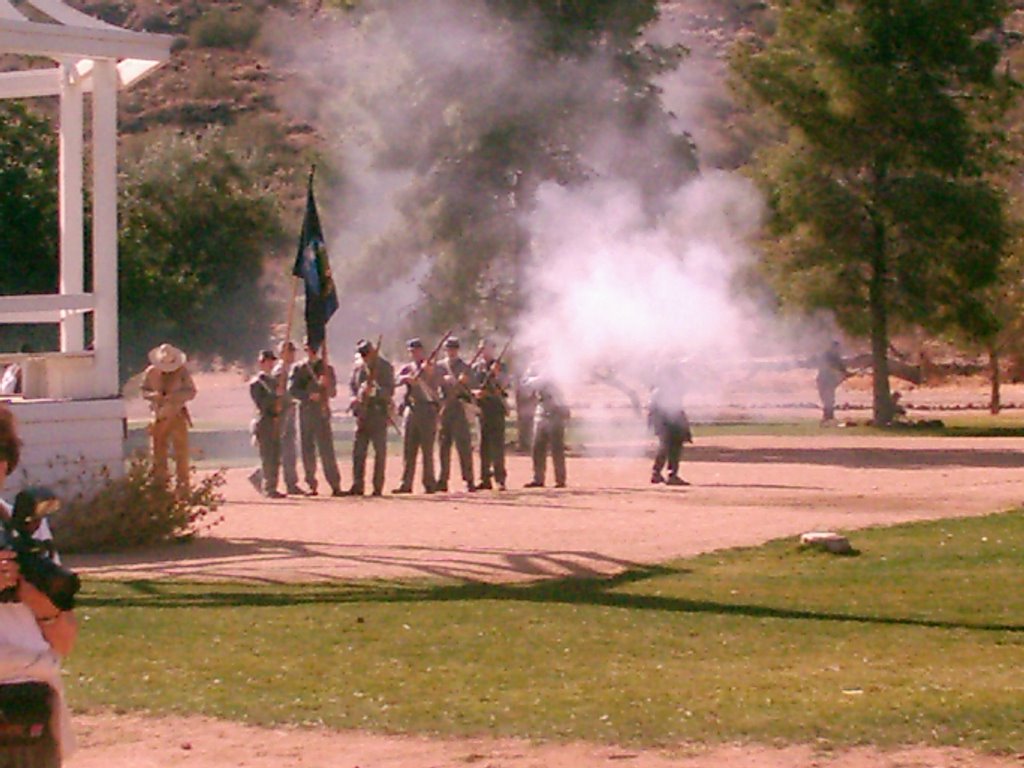
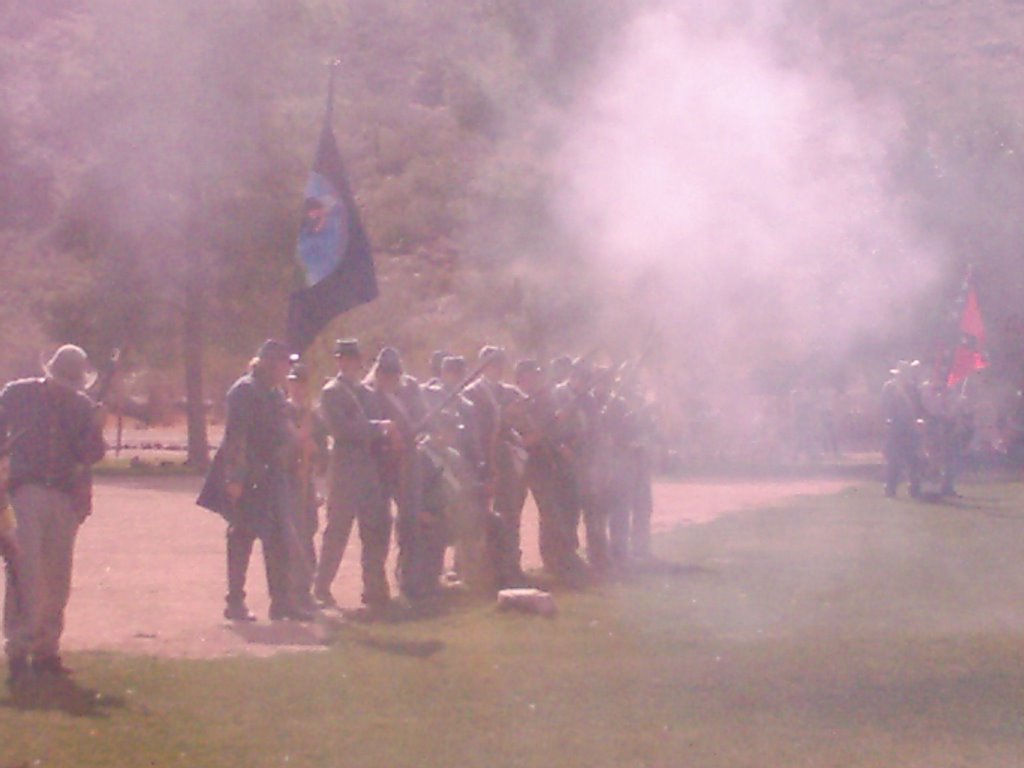
Minutes later, the Union soldiers moved in. Volleys of shots sprayed across the green of the town square, punctuated by cannon fire. When the gun smoke lifted, one Confederate soldier lay dead and two others wounded. The others had retreated. Those Yankees had won this round.


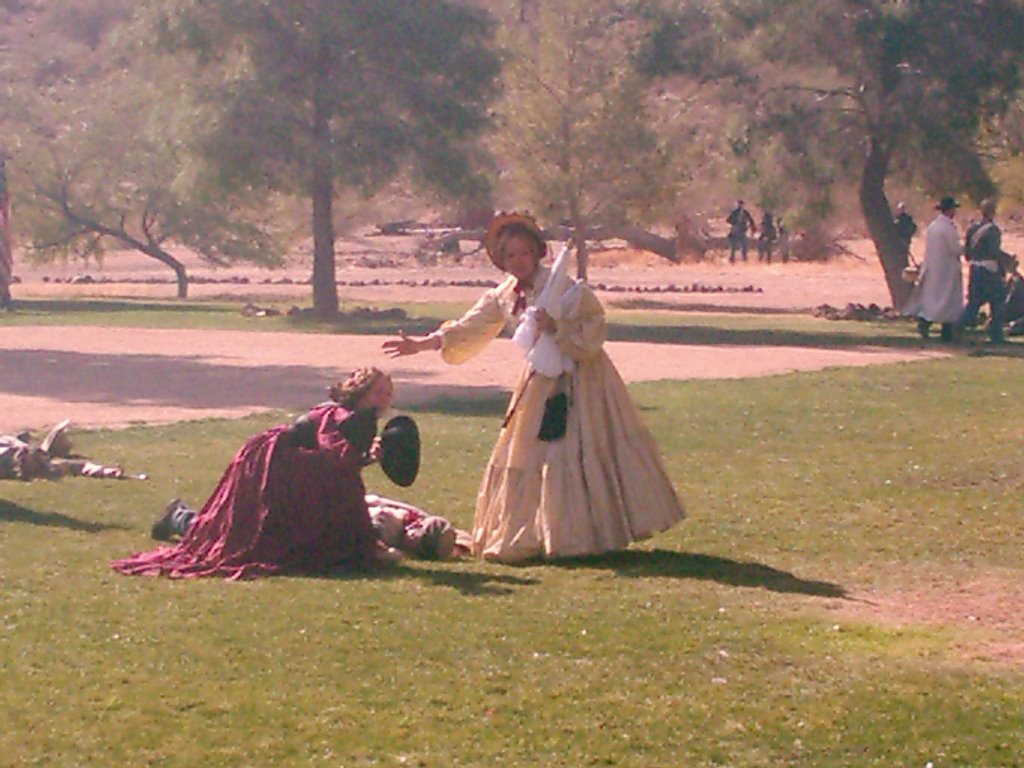
Women and girls in hoopskirts huddled over the casualties as a few stray shots rang out in the distance.


“We must remain strong! We are Virginia women!”

As medics carried the injured off to the medical triage, the ladies of Winchester took their outrage to the Union soldiers.

“Yankee scum!”

“How dare you invade our peaceful town!”

A particularly cunning lady snatched a Union officer’s sword and waved it at him, itching for a fight. He dispatched her with a pistol shot.


“You have no right to call yourself a gentleman!” a woman spat.

“I never called myself a gentleman,” the commander replied, seizing her and laying on a forced sloppy kiss.

The crowds of modern-day townsfolk were choosing a side now. No longer neutral, scattered children and adults took great pleasure in shouting “Yankee scum!” over and over.

“Who said that? Bring him here!” the Union commanders would shout, often in vain.

Back at the triage, more shots rang out. Someone had wounded a Union officer as he argued with a lady, injecting a ray of light into the mournful countenances of the Winchester women.


Half an hour later, a Union commander of Irish stock gathered the townsfolk around the veranda in the center of town.

“Martial law is now in effect!”

The crowd booed.

The Union troops would take money, livestock, and whatever else they needed under authority of President Abraham Lincoln.

Hearing his name left the newly-minted Confederate sympathizers in a quandary. Though hating the troops, they still loved the president. Nobody booed.

“We have our own president!” ladies protested.

The next order of business: a census. All the townspeople -- mainly the ladies for the purpose of this historic exercise -- were to sign a roll. And sign they did, all stating the name of “Sarah Lee.”

The act of defiance frustrated the Union official, so much that he declared the next person to state that name would be taken around back and shot.

“But sir,” one soldier pointed out. “If we shoot these ladies we won’t have enough ammunition left.”

A battle of bullets had progressed into a war of wits. Those filthy, wretched Yankees could take the town, but not the hearts and minds.

The siege grew fiercer.

Union soldiers went door to door taking silverware and whatever else they wanted.

A raid on the bank made their payroll, as they sent the banker to jail with a loud skirmish reminiscent of the Wild West.


The mayor of Winchester narrowly prevented a hanging with his pleas for justice for an accused man.

I found myself confronted by a Union soldier demanding to see inside my backpack as I wandered in a direction he didn’t like. All I could focus on was the sharp point of his bayonet as I fumbled with the zipper.

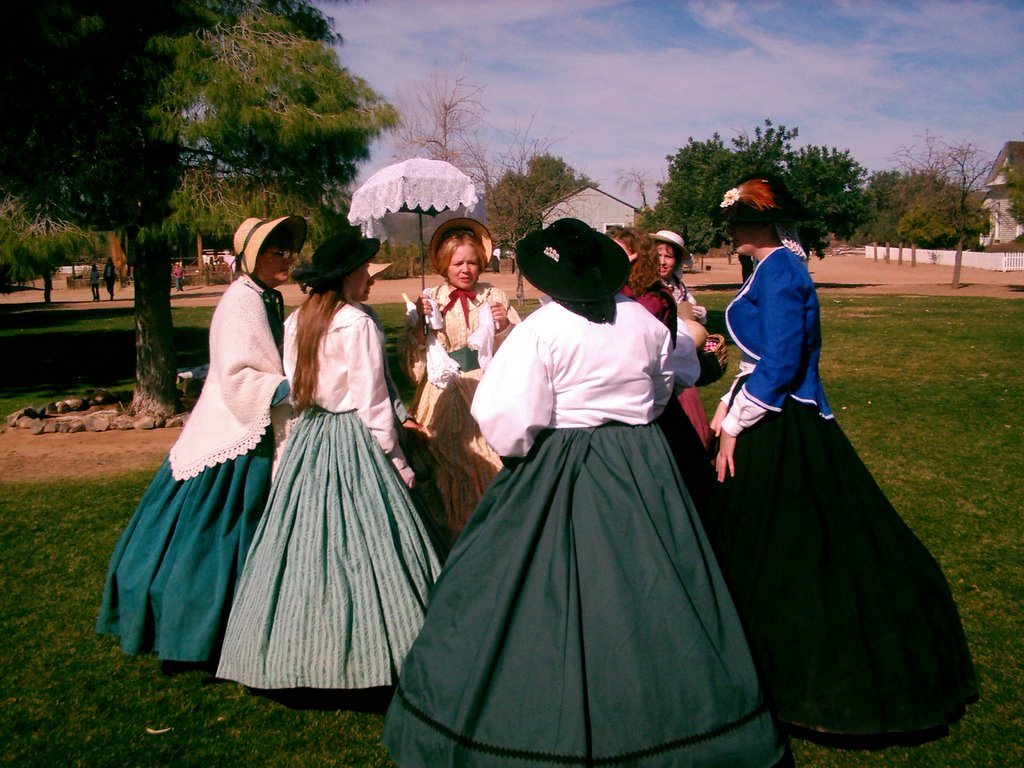
And the taunting continued, as a group of ladies picnicking under a tree sang “The Bonny Blue Flag” within earshot of the enemy.

Three hours after the occupation had begun, help arrived. Stonewall Jackson’s men came in, and with more volleys, smoke and fire, the rebels reclaimed the town.


“Hip hip, huzzah! Hip hip, huzzah! Hip hip, huzzah!”

The spectacle wound down beneath the shade of a tree in the town square, as Capt. Scott called the spectators together with the Union and Confederate Armies filing back in.

“We have compressed about two months of history into a few hours,” he explained with an invitation to meet and ask questions of the various re-enactors. The kids went first, asking about gunpowder. But I still stood in admiration, at a loss for a question.

However, I had one for a lady of Winchester.

“That bit where you all signed in as Sarah Lee. I gather that was an act of defiance. Did it actually happen like that?”

Actually, it was improvised on the spot, she explained. And everybody went with it.

For all the planning, studying, and broad outlining, the magic had come through again. They had become their characters both in words and spirit.

“You do so well at what you do,” I said. “I just find it absolutely amazing.”

My comments heartened her. She was still learning and was glad to hear I enjoyed it so much.

And once again, I prepared for the long trip back across the Shenandoah… back to southern Virginia… southern Arizona… wherever Mt. Lemmon was, anyway.

Wednesday, February 1, 2006

Your Remote, Your Voice

I've been meaning to talk about the speech Aaron Brown gave a little while back on the decline of quality news. But Jeff Jarvis beat me to it, and he gives a better refutation of it than my humble words could muster. The Bottom Line: quality news isn't dying. Audiences are merely getting quality news elsewhere, and televison heavyweights are miffed because it isn't from them.

Sunday, January 29, 2006

Nanny McPhee

How It Rates: ***
Starring: Emma Thompson, Colin Firth, Angela Lansbury
Rated: PG
Red Flags: Some mild references to gas and some comic grossness

Harry Potter And The Sorcerer's Stone kicked open the door to a new genre of family film: the comic-fantasy costume drama -- refined for the adults and yet visually dazzling and accessible for the kids. Nanny McPhee would have never existed had it not been for Potter's success. It is mannered yet naughty, proper yet gross, and very, very British. Credit Emma Thompson, who adapted the screenplay from the "Nurse Matilda" books of Christianna Brand. The film has an easily deduced Francis Movie Equation: Mary Poppins + Harry Potter + Lemony Snicket's A Series Of Unfortunate Events / Sense & Sensiblity.

The film plunges us into early 19th-Century England and a beautiful countryside estate, where the seven obnoxious children of widower mortician Cedric Brown (Firth) have managed to drive out all 17 nannies sent to care for them. The nanny agency is fresh out. Their father -- who spends more time with the dead than his children and talks to his dead wife's empty chair -- needs to find someone else fast. He also needs a new wife, or his uptight great aunt (Lansbury) will cut him off from the money he and the children need to maintain their standard of living it up. A scullery maid, Evangeline (Kelly Macdonald), observes all this with sympathy. She seems to be the only person who really connects with the children.

Cedric keeps hearing about a "Nanny McPhee." Hiring her is right difficult, mind you. She doesn't seem to work for any agency, and the kids cut her address out of the paper. But one night, McPhee (Thompson) mysteriously shows up at the door, an ugly Mary Poppins, warts and all. Maybe she works for the Wicked Witch of the West. Is she a good witch or a bad witch? Both, actually. All it takes is a tap of her magic staff to start the kids on the road to mending her ways. McPhee says she has five lessons to teach, and as the kids learn, it's not just their behavior that will start looking better... hint, hint.

Thompson gives her character dark and laconic charm, doing little more than grunting at times as she observes the family she is minding. It's fun just to watch McPhee disappear and reappear at will with the mannered explanation, "I did knock." But also charming is Lansbury, the snooty, snobby aunt who puts the crust in upper crust. Also enjoyable: Celia Imrie as Selma Quickley, the gaudy widow who is about to become the children's new stepmother, something that never amounts to anything good in every fairy tale we've been told.

And that's just what Nanny McPhee is: a fairy tale. It plays out like a bedtime story, full of color, morals, and naughty children who eventually learn the consequences of their actions. Emotionally, it is not deep outside of its happy ending. The film is so busy telling its story it doesn't give its characters much depth. Maybe it rips too much style from Mary Poppins.

Oh come now. You didn't worry about character development when you were snuggled up in bed, did you?

Friday, January 27, 2006

Truth, Lies, and Oprah Winfrey

Oprah did a big thing for a big media star. She admitted she was wrong. On Thursday's show, she apologized to her viewers for supporting recovering drug addict James Frey's so-called "memoir" A Million Little Pieces after he admitted several of those pieces were made up. She said she was sorry for calling Larry King to defend him. And as Winfrey grilled Frey over the course of an hour, more of his story went up in smoke.

But she didn't stop with Frey. She went after his boss, publisher Nan Talese, who explained the book was vetted, not fact-checked. For those of you outside the book business, that means the text wasn't scoured for accuracy but merely scanned to make sure it wouldn't get the publisher sued.

"Well, that needs to change," Oprah said.

Maybe it does. But I still pity Talese. She took a man at his word and got hung out to dry. Then again, how much trust can you put in a recovering dopehead? They've hurt their family, their friends, their co-workers and everybody within a reasonable radius. Trust must be earned. Taking his story at face value -- especially the now infamous bit about the no-novacaine root canal -- seems naive.

What should've happened and didn't was this: Talese should've sat Frey down, face to face, and said something along the lines of, "Mr. Frey, you have written a highly compelling and amazing work of non-fiction. And for all that's holy, it better be non-fiction. My company is devoting quite of bit of money and dead trees to putting your story into readers' hands. We will not be suckered. I want to know right now if there's any facts, scenes or memories you've stretched for the sake of more compelling copy. If there are, you have one chance to redeem yourself and rewrite them. If you tell us no and we find out otherwise, you will be dropped from our shelves like two-week old milk."

And as usual, we find warning signs were brushed aside. A drug counselor who worked at Frey's treatment center said parts of the book weren't true. But Random House backed Frey to the max, and that was good enough for Winfrey. It would have been good enough for a lot of us, if you're of the reasonable impression that a publishing giant wouldn't risk its reputation by hawking a made-up memoir. Then The Smoking Gun dug up more discrepencies. That should've been enough.

Yet Winfrey called into Larry King and called the allegations "much ado about nothing" -- even after Frey admitted moments earlier he'd made things up.

Oprah is a big-picture person. I'm sure she believed the totality of Frey's anti-drug message mattered more than some factual pockmarks. But what she forgot is how much honesty has been watered down as a virtue. Arizona Daily Star cartoonist David Fitzsimmons pointed out "The New Standard": "I agree with Oprah. He lied. Big deal. No troops died."

I don't want our kids -- or anybody else -- learning it's okay to make things up and call it the truth if you're serving some greater good. Substance abuse is ravaging enough without the need for hyperbole, so Frey didn't even need to spice things up. I don't want our media giants backing these people who think they can cheat and win. Oprah did the right thing, but a touch late. That call to Larry King should've put some heat on Frye's behind instead of lipstick.

What I want to see now is Frey get his story right on paper. Random House should recall all copies of "Pieces" that haven't sold and force Frey to rewrite the book, excising his excesses and presenting what really happened. When that revision hits shelves, the millions of people who bought the original text should have the opportunity to exchange it for the true story. They paid good money for what they thought was the truth. They deserve to get it.

And Oprah, I accept your apology, even if it is late. You've done too much good for others and owned up to your faults. But what took you so long?

Wednesday, January 25, 2006

New Name, Old Stations, New Troubles

The UPN and WB television networks are merging to create the CW network this fall. Couldn't they have come up with a better name? "CW" flashes me back to my ham radio days. Maybe we should've added just one more letter -- like UWB? WBU?

But put that aside. While the merger is good for the guys at CBS (which owns UPN) and Time-Warner, it's going to be murder on their affiliates.

Here's the rub: WB and UPN both spent years building their affiliate bases. WB even created a cable-only network called the "WeB" to get into markets where they didn't have a broadcast outlet. A deal with Tribune put it on Chicago superstation WGN in the early years, giving it national coverage. UPN managed to scrape by with a hodge-podge of full-power affiliates, owned-and-operated stations, and several low-power affiliates that existed mainly to feed cable systems.

So after years of trying to get national coverage, we have numerous TV markets with both WB and UPN affilates. The question now is, who gets the new network?

Here in Tucson, we have UPN affilate KTTU and WB affiliate KWBA. I have no idea where CW is going, but this is what I see:

Scenario 1: KTTU gets CW. I'm putting my money on this one, mainly because of ownership. KTTU is owned by Belo, a powerful media company which also owns KMSB (Fox) in Tucson. Belo also runs the WB affiliate in Phoenix. I'm betting Belo will have enough corporate muscle to make deals in Tucson, Phoenix and maybe a few other markets. Never mind KTTU is mainly the second-run station for a lot of KMSB syndicated material along with more than a few informercials.

Scenario 2: KWBA gets CW. This could happen if Cascade Broadcasting argues KWBA has a higher profile in the community. It certainly can, even though it just ended its newscast partnership with KOLD. It has a recognizable personality in weather anchor/"Buzz" hostess Joan Lee. At one point, it was the WB's Station Of The Year. However, Cascade Broadcasting is not a major player. It's now only a two-station group, with outlets in Tucson and Louisville. It just sold a station in Oklahoma City.

Depending on where CW goes, that raises the question of what happens to the station left out in the cold. If KTTU were shunned, I'm thinking Belo would hold onto it as a true independent and use it as a re-run station. If KWBA is shunned, it might well cover the gaps with more syndicated programming or movies.

However, here's another possibilty. Maybe the losing station decides to flip to Spanish-language programming. It's certainly doable: Azteca America is on the air here, but on a puny low-power station nobody can see without cable. Univision and sister network Telefutura are both doing well here, and they have stations with the wattage to get them into homes. Telemundo is also doing all right. Azteca would love to have some of that pie.

Yet another possibility: a religious broadcaster like Daystar or TBN moves in, buys a station and flips to all God, all the time.

We shall see what happens in Tucson, but elsewhere, I wouldn't be surprised to see some UPN or WB affilates flip to Spanish, flip to religion, or flip off the transmitter entirely.

Sunday, January 22, 2006

The New World

How It Rates: ***
Starring: Colin Farrell, Christian Bale, Q'Orianka Kilcher
Rated: PG-13
Red Flags: Ye Olde Violence

Francis' Theory of Movie Equations states any new movie can be expressed as an equation of older ones. So take Dances With Wolves, add Titanic, multiply by Pocahontas, and divide by Memoirs Of A Geisha and the result is The New World, a trippy, skippy adventure short on dialogue and long on ambience. The title might lead you to think it's another period-piece adventure, focusing on the settlement of Jamestown and the romance between the formentioned Indian princess and Captain John Smith. It is, and it isn't.

Director Terrence Malick explores uncharted territory of the soul as his characters explore the vast wildnerness and danger of early America. The New World is more about love than land, which explains why so much of the story of Jamestown is glossed over: the population of the settlement with too many gentlemen and not enough laborers, the disasterous first winter where dozens died, and efforts to make glass. Wait, that last one isn't mentioned at all. If you want authenticity on the English side, go somewhere else -- like Jamestown Settlement in Virginia.

The story revolves around Smith's (Farrell) romance with Pocahontas (Kilcher), who as we know, saved Smith from execution by Powhatan tribal members. But this is no Disney movie. The natives -- or "naturals" as the film refers to them -- are portrayed exceptionally well down to them not speaking a word of English. The awkward first encounters between the settlers and the natives are filled with authentic tension and dread. Pocahontas, though loved deeply by her tribal king father, eventually falls out of favor for giving too much comfort and aid to the settlers. Smith, likewise, gets into trouble over fancying a natural.

The film is filled with grandeur, hyphenated by flashes of thought and snapshots of joy. At times it plays like a rock video. At times it plays like a memoir, with characters narrating the story as if they were writing letters back home to England. We see several takes of Pocahontas skipping through the fields, dancing among the natives, doing cartwheels on the lawn. And yet an early sequence of the colonists discovering the land that would be their home holds long without dialogue, underscored by a musical cresendo from James Horner, conveying to us the awesome wonder the settlers must have felt upon seeing the greenery of colonial Virginia.

To call The New World an historical epic doesn't fit, for it is neither completely historical nor epic. It is more of a scrapbook with pieces stiched together. Films with historic themes can easily drift into tedium when filmmakers feel obligated to stick to the textbook. Malick does not, and while you may not care for that approach, you certainly won't be bored.

Sunday, January 15, 2006

If You Can Walk...

Making History, Making Merry, Making Up For The Past

Oh no. Not now.

My eyes locked on the barren patch of brown fabric where a gold button used to be. How did I not see that on the coat before I walked out of the costume shop? This beautiful brown and blue colonial outfit with the matching breeches, waistcoat and shirt now had a gap as obvious as a missing piece from a jigsaw puzzle, one high up near the collar where others would surely notice it.

I searched for the precious button all over the motel room floor. I dashed back out to the car and felt through the trunk. Dejected, I returned to the room. Sigh. Just another thing to worry about as I prepared for Her Majesty’s Royal Court Ball, an event in Mesa 100 miles away from home and 200 years in the past -- a night of 18th Century fashion, courtly manners, bows and curtsies, and lots of period dancing as organized by the Phoenix-area re-enactment organization “We Make History.”

In the shower I worked on a way to fit it into my character. The night before, an e-mail newsletter suggested we might all want to adopt a noble title. Knowing almost nothing of royal rank, I crammed information into my head from a furious Google search. I adopted the title of Viscount Francis -- below an Earl, above a Baron. I’d hashed out a backstory for my historical character: a nobleman who had returned to Europe after traveling in the colonies.

My chosen outfit would make me appear more soldier than gentleman, but I hadn’t worked out that discrepancy. I still had to figure out the button part… a-ha. I had traveled long and far by carriage, and because of delays in my transportation and the hurry to arrive in time for the festivities, a button fell loose and disappeared with no time for a fix. That wasn’t far from the truth: traffic outside Phoenix had mysteriously slowed to a crawl in some stretches.

But then came a miracle. The errant button had landed in the cuff of the coat, and it fell out as I slipped into costume. I dug out an emergency sewing kit from my travel bag and quickly re-attached it with a safety pin. The puzzle was solved!

Now came the first long walk of the night: from the motel room to the car in the full regalia, topped with my white-trimmed tricorn. I had parked as close as possible to the room to avoid awkward encounters, but I might still run into a few wide-eyed guests.

“Do not be alarmed if you see a man in colonial attire walking down the steps,” I advised the desk clerk upon check-in.

I made the walk quickly. Only one person spotted me: a man walking from the pool. But he slowed not a step. I saluted him. He saluted back.

My ride rolled up to the Fitch Center’s gym -- the ballroom for this occasion -- a quarter before six… fifteen minutes before the official arrival time. I sat in the car and peered through the open door, not wanting to walk in too early.

I got out after a few minutes of nervous anticipation.

This is it, I thought. No going back now. You said you couldn't have a do-over, but you could have a do-right.

* * *

Through four years of high school, I had a lot on my agenda: grades, getting into college, competing with the speech and debate team, and moving with my family from Kansas City to St. Louis between my junior and senior years.

Prom did not make the list. That landmark of the high school experience meant as much to me as a class ring at a time when I didn’t even wear a watch. Acquiring a date seemed an insurmountable task. I had learned to live without a girlfriend back in middle school, when puberty, cliques and open hostility towards nerds conspired to shove me into the outer circle.

I took the blame for that -- too out of touch, too nerdy, too smart, too shy. And although my friends on the debate team admired me, the desirable girls there were taken.

I couldn’t dance, either.

Maybe in another age, somebody would have insisted I learn the social graces of movement, but those days were gone. Even dancing at a couple of weddings in the family with some guidance from a relative felt awkward.

Square dancing in middle-school gym class filled me with dread. Girls hated me. They only joined their hands to mine because a teacher made them. Other boys would snicker at my unlucky partner, forced to cavort with some virus on legs.

By high school, the square dances ceased. But the damage was done, shadowing any thought of more frolicking in sets and figures. And here I had come, two decades later, to do exactly that same thing again.

* * *

“Greetings!” chimed Lord Scott in his light-blue colonial outfit as I entered through what I thought was the front door.

“Christopher Francis of Tucson,” I replied, slipping into my clipped British accent, removing my hat, and doing my best 18th Century bow before the master of ceremonies.

“So glad you could make it,” he welcomed and directed me to the front desk where I could check in.

I spent the next hour acquainting myself with people who strolled in. A kind gentleman had nothing but encouragement for me upon hearing this was my first ball, advising me not to be shy in asking a lady for a dance. I met a couple and their son from Prescott, also newcomers, and mingled with a group involved in Arizona student government. Topping things off, the lady of honor for this ball, Her Majesty, gladly offered to pose with me for a picture (at left).

“We don’t usually start slipping into character until 7:00,” Lord Scott advised. “But you may start early, if you wish.” I was already into my accent full throttle.

The musicians -- a piano player and a flutist -- tuned up as various people dressed from various points on the timeline strolled in. Eighteenth-century nobility in wigs and tricorns mixed with a Renaissance maiden or two. Fine ladies in floral ball gowns stood by musketeers. Revolutionary War patriot soldiers made it in, and fortunately for them, no redcoats were after them. A Spanish swordsman kept his weapon in check as a few characters from the Victorian era entered, along with some modern-day folks in tuxes. A Confederate Soldier emerged. So did a lone representative of WWII, and though neither were officially in the ball’s time frame, nobody minded. Children of all ages milled about the crowd, including the young princesses, eager to get started.

At 7:00, Lord Scott called us together for the Pledge of Allegiance and the National Anthem, a nod to the country whose heritage we were celebrating. And then the hands of time turned.

“Going back in time, one century, two centuries…”

Lord Scott introduced himself and Her Majesty, and the dancing began with an elegant promenade.

“Line yourselves up according to rank!”

Rank? Where does a viscount fit in this line? Nobody had told me any titles. People were forming in front of me. I had no partner. I couldn’t walk alone. In the nick of time, I spotted a young lady standing alone and bowed to her. She happily accepted my invitation.

We stepped hand in hand about the gym into various figures snaking about and around like a maze, ending in a full circle, but nothing fancy. My fears about colonial dancing evaporated.

Then the country dances began, the ones like square dances with the sets and figures and fancy moves led by a caller who would walk us through a dance slowly and then let us get to it.

The first dance, "Haste To The Wedding," seemed familiar. And as I went through the motions, I realized I’d done it before…

* * *

My education in English country dance began two years ago at Colonial Williamsburg with a simple guideline.

"If you can walk, you can dance," said the historical interpreter, dressed in period costume. "And if you move quickly, I can prove it to you.”

He lined us up in the ballroom of the Governor’s Palace midway through a tour. The rows of men and women faced each other. I stood near the end of my row, eyes trained on my camcorder’s viewfinder.

"A one couple, a two couple," he counted us off, his hands spread apart, marking the sets. "The evening starts and you all have been dancing forever, so you know what to do."

Our costumed guide explained to us that if somebody called out a dance we didn’t know, an explanation would kindly follow upon request.

"Oh it’s simple. Right hands across, left hands back, circle left, circle right, do-si-do, clap twice, two-hand turn your partner, turn to your neighbor, do-si-do, clap twice, start all over again. And you’re like, 'Is that all?' And you would do it."

And we were about to.

"Right hands across, which means across!"

I flicked off the camera and he led us through it, calling out the steps and humming in place of an orchestra. And unlike the square dances of my youth, I enjoyed it –- no vibes of animosity or hints of snickering.

I had wanted to try it earlier in the day, while watching a costumed group of women perform outside on a mild, sunny day. I didn’t get a chance, but I did learn my 18th Century honors: a bow over my strong leg, as coached to the audience by a Colonial Williamsburg dancing interpreter.

"It’s important for all of us to learn and practice our honors," she said.

* * *

The dances grew more complex, even with the help of a wonderful and patient caller. New steps were introduced and new figures thrown into the mix. I changed partners after every number, easily finding willing ladies.

Some dances deteriorated into confusion. “The Doubtful Shephard” threw us all through a loop with serpentine moves we couldn’t quite nail down after repeated attempts. We laughed it off, improvising simpler steps. No wonder that shepherd was doubtful.

Moments of levity worked their way in. At one point, the ladies cast one shoe into the middle of the floor as the gentlemen looked away. And then, on command, we scrambled for the footwear, grabbing the first shoe we could and searching out our Cinderella for a new partner.

That next dance, “Christchurch's Bells,” marked the high point: simpler figures done over and over again. All of us quickly mastered it and soon the caller stopped calling, leaving us to enjoy the piano and flute and prance merrily about one another, having the moves down by heart, just as it was in colonial times.

"Now you're dancing!" the caller exclaimed.

In those joyous moments, as I skipped among the dancers, the notion I was in a gym fell away. No basketball nets, no lines on the floor, no fluorescent lights, no PA system. I might have been dancing in 1700’s Williamsburg or London or Paris. I threw a few flourishing moves in -- a twirl here and there.

Although my heart wanted more, my lungs wanted a break, and my costume didn’t allow much ventilation. When the dance concluded, sweat trickled down my forehead. I only sat out one number while some gracious ladies lent me their fans as they spotted me cooling down.

Several breaks with an offering of punch and cookies gave us more time to relax and mingle. I managed to stay in my British accent through every conversation I had. Speaking was the easy part. Finding stylish and elevated words befitting a nobleman required much brainpower.

I forgot all about my self-appointed title of Viscount. I was simply “Mr. Francis,” to His Lordship and all others. I found it more than fitting. I had trouble imagining myself as both noble and newcomer whilst surrounded by many other newcomers, all learning steps more than two centuries old, all eager to smile through our mistakes.

“At this point, the spirit of the dance is more important than the steps of the dance,” I said to comfort a lady who felt a tad embarrassed at the mistakes she had made.

Not one lady refused me for a dance when I sought one out.

Not one.

Not one even used the perfectly acceptable excuse of sitting a dance out. I honestly felt they enjoyed my partnership, and I was quick to bow to each one of them after every dance with words of compliment:

“Thank you for a most enjoyable dance.”

“You are a wonderful dancer!”

“Your enthusiasm is most kind!”

They would smile and graciously return the honors.

Her Majesty’s Royal Court Ball ended just as it should have, with a slow waltz with “your favorite partner.” I again sought out a lone lady.

“I have to warn you,” I advised, “you may have to lead me a little.”

It turned out we were both a little fuzzy on the steps. But it didn’t matter. We waltzed around the floor as best we could, enjoying each others conversation and company, myself admiring her exquisite purple ball gown and doing my best not to step on it.

I once again thanked Lord Scott before I left, and he returned it with more gratitude for my long trip from Tucson.

“Was the evening everything you anticipated?”

“Much more,” I replied.

Five hours after I had slipped into the 18th Century, the moment had come to return to my “own place and time.” With more goodbyes to newfound friends, I walked back to my car and made the drive back to the hotel in silence, reflecting upon the evening and its significance in my life so far. I felt like a better person, someone more well-mannered and wiser, and I didn't want to let go of it.

I had taken the next step, gone beyond dressing for Halloween as a Patriot. A lot of people could willingly play Rebels and Redcoats. But could they pull off “Strip The Willow?”

In the late hour, I didn’t run into anybody else between the car door and my room door. I slipped out of my colonial attire and began sewing up the button temporarily secured by the safety pin. The needle didn’t want to go where I needed, and I had to settle for a couple of loose stitches. I bagged everything up as instructed by the costume shop and took one more look.

Oh no.

Shouldn’t there be another button on that coat pocket?

* * *

The afterglow of the evening hindered my sleep. Joy still flowed through every part of me, hours after the fact. The piano and flute echoed through my head. I tossed and flopped on the loose sheets of the motel room bed. At least it was my own. At a colonial inn, I probably would have ended up sharing a bed with somebody, having paid for a discount room.

Seven A.M. came and I rousted myself after a restless night. I dressed quickly, checked out, and made the two-hour drive back to Tucson on the power of two glasses of orange juice. My own bed in my own time stood waiting, a place to crash and find true rest.

My feet ached to be left alone. My right calf throbbed, forcing me to limp for two days afterward. It must have been that jig we did. But next time, my legs will be stronger.

And there will be a next time. George Washington's Birthday Ball is just weeks away.

Wednesday, January 11, 2006

Tucson's News Queen?

David Hatfield's latest column in Inside Tucson Business raised my eyebrows. Here's the first few grafs:

Crown KOLD 13 and Kris Pickel the ratings victors

The race is over. The results have been tabulated. Now the victor can be crowned. In the battle among the big three local TV stations for news ratings supremacy, Kris Pickel and the News 13 team won, according to the latest ratings taken by Nielsen Media Research Nov. 3 through 30 and just recently released.

Since its breakthrough in February 2004, KOLD appears to be on a hot ratings streak.

Ahh, but ... coming up fast is Jennifer Waddell. In her debut as the lead female anchor on KGUN 9, the station's 10 p.m. newscast registered a 50 percent increase in viewers ages 25-54 year-old over a year ago. That age group is the primary target stations and, more importantly, the lion's share of advertising dollars.

There are a lot of variables that contribute to winning ratings. Some of KGUN's increases might be attributable to higher numbers locally for ABC's primetime programs but probably Waddell can rightfully be given some credit.

Meanwhile, declining fortunes continue to plague once-dominant KVOA 4's Eyewitness News. Nobody can blame Kristi Tedesco for the station's losses. Among 25-54 year-olds viewing was off in every weekday newscast, including those she doesn't anchor. KVOA is down 17 percent at 10 p.m., down 39 percent at 6 p.m., down 6 percent at 5 p.m., down 30 percent at noon and down 9 percent in the 5 a.m. to 7 a.m. slot.


Thanks, David! Kris and I both emphasize we can't do it all, not without our (heaping praise alert) wonderful staff. Pass those crowns around.

Actually, I don't look too bad in a crown. But I'll stick to my tricorn.

Monday, January 9, 2006

Fashionably Late

Here's a missing sock story that beats anything from the laundry room: The knee-length socks I ordered as part of a colonial outfit for Halloween have arrived -- three months later. The official explanation was they were back-ordered. (The outfit you see in the masthead was a rental from a couple of years back and I needed something new and different.) Amazingly, I found some suitable stockings at Wal-Mart to cover my legs. But I didn't forget. Neither did CelebrateAmerica Costumes. Thanks for coming through, folks! Those socks got here just in time for an event this coming weekend (stay tuned).

Day-O(h My Word)

UNICEF says Harry Belafonte was speaking for himself, not for us as a goodwill ambassador when he called President Bush "the greatest terrorist in the world" in front of Venezuelan leader Hugo Chavez. No comment from them about those other comments, like: "we're here to tell you: Not hundreds, not thousands, but millions of the American people ... support your (Chavez') revolution."

Does Belafonte have their names and addresses? Did he get them from the NSA's secret wiretapping program?

Goodwill ambassador... ha.

Saturday, January 7, 2006

The Producers

How It Rates: ***
Starring: Nathan Lane, Matthew Broderick, Uma Thurman
Rated: PG-13
Red Flags: Sex Jokes, Mild Language

The Producers is a remake of a remake -- a Mel Brooks movie turned smash Broadway musical turned Broadway movie musical. In the translation from screen to stage to screen again, we see again why many stage musicals are great movie musicals and many aren't.

This film yearns to have fun, and it largely succeeds, but it's out of its element. On stage, over-the-top elements are what musical comedies thrive on. On screen, they just look over the top. Case in point: a number where several little 'ol ladies fall over in their walkers like a line of dominoes. I'm sure that was a sidesplitter in a live performance. On film it's just trippy.

For those who have seen neither the 1968 original nor the Broadway reincarnation featuring both Lane and Broderick in the title roles: Max Bialystock (Lane) is a washed-up 1940's Broadway producer one footlight away from bankrupcy. His new show, "Funny Boy" -- a musical version of Hamlet -- has just tanked. In steps accountant Leo Bloom (Broderick) to help with his books. Leo, wondering out loud, notices that it's possible for a theatrical producer to make more money off a flop show than a hit, if the show closes quickly and costs less than what investors have put into it. Aha! Max and Leo hatch a scheme to wildly oversell investments in a show so awful, so offensive, it has to close in one night.

They find what appears to be a sure-fire flop in "Springtime For Hitler," poised as a "gay romp" with Der Fuhrer. Will Ferrell is the play's author -- a goose-stepping, leiderhosen-wearing, pigeon-raising neo-Nazi "kraut." Now to find a rotten director. A gay romp deserves nothing less than a flagrantly flaming Roger De Bris (Gary Beach). And for the straight folks, we have Ulla (Thurman), a Swedish bombshell hired as a production secretary who can shake it all over the office (a part not in the original film). Alas, the opening night disaster so carefully plotted fails to materialize as a stunned audience finds more satire than shock value in a singing and dancing Hitler and chorus line of Nazi stormtroopers.

Lane, a stage pro, clearly owns this film. Broderick is a capable singer but lacks his co-star's comic flair and polish. I kept thinking back to how well Gene Wilder pulled off Leo's character in the original film. Thurman is surprisingly good in her role, almost enough for me to forget it's a needless tack-on. Beach and Ferrell are simply hilarious. All these preformances amplify Broderick's weaknesses, and I think the film could have gotten away with trimming a sequence with Ulla and Leo late in the film. The two of them -- and Lane's charater -- both have one musical number too many which adds a lot of dead weight to the third act of the picture.

Mel Brooks (who wrote the book, music and lyrics but didn't direct) buries some inside jokes -- or recycled ones -- for his fans in the film. I counted at least four gags borrowed from Blazing Saddles. Well, if you're going to rip, at least rip from your best material. But Brooks shouldn't have to rip. He is one of the comic masters of the 20th Century and I hate to think he's running out of gas.

Friday, January 6, 2006

Add This To The Mix

I'm absolutely loving the iPod Nano I got for Christmas. But could somebody add a crossfade feature, just like in iTunes and Windows Media Player? (Or have I just not found it yet?)

On To The Next Target

I posted the following on BuzzMachine in response to the uproar over NBC's "The Book Of Daniel."

Sigh.

Only yesterday the extreme religious right complained about people taking Christ out of Christmas.

Now that the holidays are over, they’re moving on to the next target. Helluva way to start the new year.

What ARE these people afraid of? That the whole of America will suddenly hold devout Christians up to mockery and ridicule because of a little ‘ol TV show? That suddenly our collective image of Christ will warp into some tripped-out caricature? It’s gonna take a lot more than that…

If the show is a chunk of fertilizer, it will collapse under the weight of its own vileness. We shouldn’t have to hear anybody tell us that, and especially before the first showing. It’s certainly all right to have worries and concerns, but give the show a fair shot. Thank goodness the bosses at Mormon-owned KSL have enough tolerance.

And let us not forget this: not one but TWO TV movies recently aired on the late great Pope John Paul II. Christianity is certainly no cheap laugh for the networks… especially when so many of the stars of said religion do it so well themselves:

Oral Roberts (lost many stations after the infamous “God will call me home” speech, claimed to see a gigantic Jesus behind his City Of Faith in Tulsa)
Pat Robertson (not on Hugo Chavez’ Christmas card list this year, by any means… and hey, did you hear what he said about Sharon’s stroke?)
Jim and Tammy Faye Bakker (you know the story)
Jimmy Swaggart (his episode with a hooker in a motel room brought new meaning to the term “lay ministry”)

Thankfully, all of this is countered by the dedicated TV ministries of Dr. Robert Schuller (who recently stepped down, bless him) and Billy Graham. And let us not forget the late great Mr. (Fred) Rodgers — how many of us knew he was a Presbyterian minister? — or Bishop Fulton J. Sheen, whose oratory trancended denominations.

Yeah, TV’s full of saints and sinners. Shouldn’t we be used to figuring out who’s who by now?

We'll Try This Again

A new year, an old blog. A new attitude, same old slacky habits. A new resolution to blog more, an old suspicion about the follow-through. Start your watches. Mark your calendars. We'll see how long this one lasts.

Wednesday, January 4, 2006

Memoirs Of A Geisha

How It Rates: ***1/2
Starring: Ziyi Zhang, Ken Watanabe, Gong Li
Rated: PG-13
Red Flags: Two Sex Scenes

A geisha does not sell her body, we are told, only her art: providing entertainment and conversation for Japanese men, many of whom are stuck in arranged marriages. And yet it's the geisha's life that is also arranged, with its rules and expectations. Affection is superficial and serves only the requirements of the job. They are prostitutes who do not dispense sex and yet are denied the chance to seek true love.

This is the story of Chiyo, sold into slavery as a 9-year-old girl in pre-World War II Japan. Her new mistress runs a geisha house, and Chiyo is soon introduced to the mysterious trade, while seeking out a sister who was taken from her at the time she was sold. So much of Memoirs is better if I dispense with plot details, although I will tell you Chiyo faces a rival geisha who lives under the same roof. As Chiyo hones her skills, she is seeking out the man who offered her the equivalent of a popsicle, the one man she longs for out of love.

Rob Marshall (Chicago) directs with efficiency and beauty. So many shots in this film are wonderfully lit and composed, making the picture a shoo-in for Oscar nods in cinematography and art direction. If I have one quarrel with the film, it's that a little too much mystery surrounds the life of a geisha and its expectations, and I would've liked a little more set up.

But it's hard not to get absorbed in this film with its awesome visuals and John Williams score, featuring cellist Yo-Yo Ma. The geisha is a moving work of art, one scene explains. So is this film.