Showing posts with label 1st Minnesota Volunteer Infantry. Show all posts

Sunday, March 27, 2011

The Blue And Gray, Presented In Sepia

For those of you wondering what happened to Pvt. Francis of the 1st Virginia Volunteer Infantry, he sent us these daguerreotypes from We Make History's Civil War Ball, in remembrance of that great conflict that began 150 years ago... and reassurance that all was not dark during our nation's darkest times.

Daguerreotypes provided by M. Cynecki


The young Confederate private has a peculiar longing for the days of his Colonial Virginia ancestors, when the minuet was in fashion.  The kepi may have replaced the tricorn, gray now replaces the red white and blue, but something beautiful remains.  And as always, Virginians love to dance.


Our host and hostess, the renowned Colonel and his lady, greeting the many belles.  Hoopskirts fill the floor, floating and twirling about.


As part of the procession, a certain stately air is required. One could set a book upon the private's head and it would remain in place.


Standing at attention, and ready to dance.  One must give the ladies their proper space to make room for those beautiful hoops.


Giving proper honors to the ladies.  Everyone has their methods, and some bow lower than others. No matter, as long the belles know you are thankful.


The young soldiers stand at attention, ready to honor a selection of young Virginia Belles...


And here they are, one from each county in the Old Dominion, the ladies we have the highest regards and hopes for, the ones we're praying for, the ones we praise for their devotion to GOD and to making an impact on the world.


The young Private considers himself honored to escort at least one of them.


By request, the method of choosing a partner for one dance falls to the floor.  More specifically, to the shoes on the floor deposited by the belles.  Find a shoe, and one finds his Cinderella....


...but you'll have to fight for it.  The young Confederate prefers the flanking maneuver to avoid casualties.  These ballroom warriors are not the only anxious ones.  Our commander must fret about losing some men before the Battle of 1st Manassas.  (That's Bull Run if you wear a blue coat.)


Fortunately, everyone survives without a scratch and is in top form to charge forward again and again.


And afterward, finally, gracefully, that Colonial-minded Confederate can at last share a minuet with his beloved dancing partner.

More from this beautiful evening here.

Tuesday, April 13, 2010

"We Will Protect This Town!"

A letter surfaces from Private Christopher of the 1st Virginia Volunteer Infantry to his family and friends in the Old Dominion recounting the Battle Of Payson and his experience behind enemy lines. It would later be reprinted in The Williamsburg Star, published by his brother.

April 10, 1862

To My Dearest Family,

I do hope this letter finds you in comfort. It warms me to tell you our regiment is once again victorious in the face of aggression, despite a siege upon a mountain community which forced us to regroup and counterattack with speed and aggression to fulfill our word to the people whom we pledged to defend.

In the bright daylight of the morning, we marched into the town of Payson with orders to protect the citizens from any Yankee encroachment. Having heard of the terrible and vicious arson of Prescott days ago filled us with both fear and determination, and a deep desire manifested within us to reassure the citizens of their safety. Our commanders established pickets on the edges of the community to spot any signs of trouble while we ventured among the townsfolk to gauge their feelings and be of service to them.

I must tell you the citizens are a curious and proud people, rooted like the pines that grow all around them. They are not prone to fear, much less to worry, and they welcomed us with a friendly and yet cautious trust. Private Cooper and I spent much time among them, giving our personal assurance, "We will protect this town." Yet many had heard of the Prescott conflagration which reduced it to ashes, and the winds of rumor buffeted them in spite of our repeated efforts to contain the propaganda. They mentioned what they had heard of Northern spies even as they asked us to stand and pose in front of tiny silver boxes they held in their hands which produced the most stunning daguerreotypes I have ever seen.

I recall one gentleman asking where he should displace himself should things come to a fight. I told him we hoped things would not come to that, but if he insisted, he best stay away from the streets. Another gentleman sat upon a porch with his wife, and I shall never forget the tall stovepipe hat atop his head, one at least twice the height of even the tallest hats I had seen in St. Louis many months ago. All the while, a lady of the town saw fit to entertain us with a rendition of "The Bonnie Blue Flag" on her dulcimer, with two other young ladies joining in on fiddles. That seemed to calm many a frayed nerve, as we saw many townsfolk content to sit in the noonday sunshine and forget any talk of war.

Just as Private Cooper and I were convincing a few more citizens of our dedication, we heard the voluminous explosion of artillery fire in the distance. Our commanders formed us up and dispatched us to the source of the disturbance, where we soon observed a detachment of Northern skirmishers running away from us. At once we returned to the town, where I gleefully noted the would-be aggressors' departure to many a concerned citizen: "You see how fast those Yankees ran?" I bellowed. "They know not to mess with us!" Private Cooper echoed my observations but cautioned me as to the possibility of Federal spies amongst the citizens.

I doubt with certainty I had given away any secrets, but to our fear, the skirmishers sent for reinforcements, and within a half hour I was standing across the field from a line of 1st Minnesota troops who sought to invade the town. Our cannons failed to stop them, and they pushed us back into a defensive position along the western edge. Our Colonel ordered us to hold the line, and we hit them back with a series of volleys as they advanced. At once I felt the sting of a ball to my face and my chest, and I regret to tell you I crumpled before my brothers in arms, who continued to stand firm. I struggled to get to my feet, determined to give the enemy at least one more taste of powder from my Springfield, but the Colonel directed me away limping to the camp nurse, judging my injuries too severe.

As she tended to my wounds, I could hear the Yankees storming into the town despite our best efforts. A few moments later, as the Colonel was assisting me, I saw three Federals confront us, catching us effectively unarmed. They took the Colonel, Private Cooper and I prisoner without deference to my injured state. "Look at what you did to his face!" the Colonel shouted to them as I lay sputtering on the ground. "Three holes in his face!" Private Cooper shared in my suffering, grieving the loss of my countenance.

However, the ladies of the town had formulated their own contingency plan. To our great astonishment, they gathered what rifles they could find and formed up against the Federals along the main street, threatening to shoot if the aggressors should lay flame to the buildings as they did in Prescott. I must tell you they were well disciplined and versed in the manual of arms from where I could observe them. One could tell from their stiff faces and piercing glances with the muskets in their hands, they would fall to their deaths to keep a single match from striking. Only the expedient intervention of the mayor halted the stalemate, with the Yankee Colonel pledging not to burn the town if the ladies kindly dispersed. His bargain greatly displeased the more radical soldiers among them.

One of their commanders had at least the decency to offer chairs for us, even as the young privates among them taunted. A sharpshooter in a balcony above kept threatening to burn the town. Even through the pain of my throbbing head, I taunted back: "You couldn't even stand up to those ladies! Your uniform ought to be yellow!"

The Colonel calmed me several times, urging me to conserve my strength in the loss of much blood. "Look what they did to his face!" he cried again to all within his booming voice. "He was once the most famed dancer in the ballroom of Richmond! Who will dance with him now?"

Another nurse tended to my head before the Federal commander determined he had tolerated enough of us, with our incessant complaints and aggravations, along with a round of "The Bonnie Blue Flag." He ordered us moved to a holding area greatly displaced from his troops. There we found respite, and I succumbed to rest, although I continued to hear my fellow prisoners discuss the roots of the great conflict. A lady approached me and generously offered me homemade bread and butter, which I accepted thankfully. It has been long since I tasted such fine foods, and I am confident I will do so again when I return to you.

A young gentleman of the town was overhearing our conversations, and we asked which side he was favoring. “Neither,” he told us, for his Faith opposed warfare. He must be a Mennonite, we observed, or a Quaker. “Let's see you quake!” someone chuckled. Yet we were respectful to his beliefs and his neutrality.

I had little additional time to rest as the Yankees grew alarmed. In the distance we saw our 1st Virginia brethren reformed and marching towards us. As the bluebellies hustled to reform, our Colonel saw an opportunity to slip away, and he motioned for us to follow him. We quickly escaped and ran for our lives. After a frantic sprint, we were back in the ranks of our fellow soldiers, who taunted them with a few volleys more before falling back to plan our next advance. Back at camp, the Colonel soon devised a counterattack, and we received our orders to retake the town.

His strategy dared flank the town around the rear and then hit the Federals directly. We marched in and made quick work of their ineffective defense, splitting our companies to rout them. As we circled around the rear, the ladies cheered us on to victory as we approached the town square. We announced our arrival with a ferocious series of volleys. Burning wads of musket cartridges flew into the wind, the lightning for our thunder of rifle fire which echoed through the town. It was a joyful noise if I ever heard one. We saw the Federals fall to their deaths one by one and litter the square until they could no longer stand and fight. Now it was their turn to hold up their hands and surrender, and I took great delight in seeing them do it where I once was taken prisoner.

The townspeople were grateful to us, having honored our word and kept the torches away from their homes and shops. They surrounded us and heaped praise upon us, and I am certain that many questions of their allegiance have been resolved. We shall continue to guard the town until our orders take us onward. I do not know how much longer this war shall last, but I shall never forget the kindness and hospitality shown to us by the good and strong people of Payson.

May GOD continue to watch over you, my loved ones and friends, until I return.

With Warmest Regards,
Pvt. Christopher Francis
1st Virginia Volunteer Infantry


See more from the fray here.

A big Thank You -- and a bow -- to the people of Payson for once again showing us their hospitality and support. We shall continue to defend your town!

FLASHBACK! Read Pvt. Christopher's original Dispatch from Payson.

Sunday, March 28, 2010

Ten From The Tenth

Private Christopher of the 1st Virginia Volunteer Infantry shares his ten favorite moments from We Make History's 10th Annual Civil War Ball.

Photos by M. Cynecki
(Click any for a larger view!)


Madame, Where Art Thou?

I search all about the hall, inside and outside and all through the refreshment and anterooms.

As I wander about, I bow to several ladies arriving in their hoopskirts, being careful to remove my kepi and give “proper honors.”

“I am searching for my lady, Madame Noire,” I explain.

“I just saw her passing by,” a lady observes. Yet she has vanished like the wind in the evening.

Several minutes elapse, and she joins me in the ballroom, where we catch up on old times. I briefly share my travels in Tennessee. She shares words of gratitude for my safe return. Our Colonel is also glad to see me back from my ventures.

“You've come home.”


Kick Up Your Heels!

We are not our colonial ancestors, but we, like them, share their love of the dance – vigorous dance. After a brief refresher in ballroom etiquette and a grand promenade, we begin the evening with two energetic dances: “The Girl I Left Behind” and “Chase The Squirrel.”

The figures are not complicated: several sashays, a swing every so often, and a cast to the bottom of the set.

No one is left without a smile. The clapping and hollering of encouragement fills the entire hall.

“Mr. Christopher, is that your shoelace?” my partner observes.

My dancing brogans are threatening sabotage. I tie them once, and then again as discreetly as possible. I am ashamed for looking unkempt around the ladies, but I fear a tumble more.

One Night Only

A few of our northern counterparts, the 1st Minnesota, are joining us this evening. They proudly wear their deep blue uniforms and receive a wholehearted welcome from all.

“We shall put our animosities aside for this evening,” I say in greeting to a tall, towering Federal officer.

Another tall northern fellow joins us, in tailcoat and vest with sideburns and a short-trimmed beard. I feel certain I have seen the face somewhere before, or perhaps on someone else. Perhaps, a certain President... many years before he was President.

A Striking Portrait of a Soldier

A dear friend of ours, revered for his digital daguerreotypes, joins us in his northern Zouave uniform.

“They used to charge forward shouting 'Zoo! Zoo! Zoo!'”

The attire draws its inspiration from armies in Northern Africa: open jacket, wide sash, tasseled fez, and bright red baggy trousers. I cannot help but feel a little envious, imagining the comfort afforded in a dance – or a long march – compared to my woolen trousers.

And oh, that festive cap, tassel bouncing to the music!

Belles Of The Ball


We all draw much pleasure and reassurance from the presentation of the Belles, a group of young ladies who we praise for choosing a life of integrity, virtue, and reverence. I have the pleasure of escorting several.

It does not matter if they are from a northern or a southern state, nor does their alliance bother us this evening. They have chosen the side all of us are on – honor.


Dance On!

Several newcomers join us, but they have little trouble learning the steps. Indeed, they learn the beloved Virginia Reel in mere moments, with little prompting.

All of us were once newcomers, though, and from time to time we return to our former ballroom selves, missing a call or skipping a figure.

“Oh, we were supposed to do-si-do!” a partner says.

But any mistake is quickly forgotten. We right ourselves, and that is all. No criticizing. No complaints. No fingers of shame or blame. Just joy.


Do Your Duty

My guest, Madame Noire, knows well the duties of a ballroom gentleman, which are also part of my personal mission: to dance with as many ladies as possible. So she is more than understanding at my changing of partners throughout the evening, and she appreciates my desire to show all of them honor.

In return, I reap a blessing of dancing with many lively souls, including a lady in a black and white gown whose bliss pours from her during the “Heel And Toe Polka.” Her laughing and merry countenance is equaled by her bouncing sashays and skipping swings. I end the dance nearly breathless, but she still has all the energy she started with.

I escort her off the floor, lavishing thanks and appreciation both to her and the gentleman who brought her. He is a dead ringer for Rhett Butler, even though he assures me he is not.

I dance again with Madame, who then asks for a favor.

“There is a lady over there who needs a partner,” she confides to me. “I have not seen her in many dances. It would make me very happy if you danced with her.”

I have my mission. I have my orders. I nearly sprint over to the lady in the white lace gown and bow, asking if she would honor me with a dance. She accepts without hesitation.

We share a reel, a reel which is two reels in one: a half reel, where the top lady and gentleman take turns swinging along the opposite gender line, and then a full reel, where the couple does so again, at the same time.

One cannot be caught pausing to take a breath, lest a lady come forth for a swing. Some people are caught off guard as the reel progresses without pause.

“No rest for the merry,” I observe.

A Time For Elegance

Madame is generous to let me do my gentlemanly duties, but I save the waltzes for her. However, what starts with a two-step evolves into a choreographed display of graceful turns in three-quarter time. I owe it to her. I have shown it to other ladies in my travels, and I would be remiss if I did not share it once again with the lady who constantly encourages me to indulge my heart's desire for graceful movement.

And yet, at one point, I have the opportunity to show it to another, a charming young lady in a tiara -- a princess looking for her prince. I am not royalty, but I can aspire to be. I show her how it's done, and she follows my lead with little difficulty.

Fit For Battle

Never underestimate the tenaciousness and courage of the ladies. Their beauty only enhances their bravery, as when they are called to charge a pile of shoes in the center of the floor, deposited by the gentlemen.

Our Colonel lines them up by height, dresses the ranks and gives the order.

“Present arms!”

They are a little ragged, but that does not concern us now.

“Charge!”


At once they are upon the pile, digging for shoes and then holding them up to seek out the gentlemen who own them and thus finding their next dance partner.

I wander about them. Many shoes look alike. It takes longer than I expect. But finally, I find my partner. I apologize if she has caught a whiff of my long journey from Tennessee.

Never Can Say Goodbye

At the close of the ball, our Colonel finds it hard to bring things to an end. The joy of the evening is still rippling through us all, as we thank him, our musicians, and our caller. He reminds us of battles yet to come.

“We could be heroes,” he smiles, referencing a lyric from the future, “for just one day.”

Madame is puzzled. “Why can't we be heroes every day?”

“We shall endeavor to do so,” he reassures her. “We shall make history!”

“We already are!” I cry. “HUZZAH!”

See more images and memories from the evening here.
NEXT: The Battle Of Payson!

Saturday, February 13, 2010

Lost Loves

Last week, I was with a few members of the 1st Virginia and 1st Minnesota as we had fun with some families. We lined up a few dozen young children and taught them to march. But the real fun came when we formed up to fire. They didn't have stick guns, but they did have stick swords, water pistols, and plastic ray guns. They fired several volleys at their parents and charged them -- three times.

After the kids calmed down from multiple assaults on their betters, we gathered everyone around for some hymn singing and testimony time. Our colonel recognized many of those kids had never seen a hymnal. But we sang several selections from the books passed around, including “Amazing Grace.”

We heard from a few children who told us what they thanked GOD for. One remembered a time he prayed, when he immediately felt a rush of wind.

Another disclosed a hardship: “I am thankful because we didn't have a home, and now we have a home.”

Then a child named Will (which has been changed to protect his identity) spoke up and told us he had lost his grandmother about a year ago. He didn't think GOD was answering his prayers.

Listening to him broke my heart. When our afternoon of fun ended, I walked over to Will's parents and told them I would be praying for them.

“He and his grandmother had a special bond,” his mother told us. “It's a day to day thing.”

Will was bouncing around and hugging his folks like nothing was wrong. You would never know the hurt by looking at him. But his mother confirmed it was there, and she was thankful for my prayers.

As I thought about Will and offered what ministrations I could, my eyes watered. When the family left, and I returned to my comrades in arms, a fellow private could see I was shaken. I could barely talk to him without crying, recounting what I had learned and how it kicked up a memory.

“All my grandparents are gone,” I recalled. But I still couldn't believe I was crying for a child I didn't even know.

My fellow soldier suggested I wept because I deeply wanted GOD to use me to help this family. I thought about it. Could it be a cry for help on somebody else's behalf?

A similar thing happened four years ago, when I volunteered to interview a mother who had just lost her daughter in a car wreck. A bombardment of memories and a house full of mourning relatives brought the water to my eyes. That was when GOD was starting to soften and rebuild my heart, although I didn't know it at the time.

When I lost my Grandma Lawson in 2002 (pictured at left in my favorite photo of her from the 1960's), I recall weeping for only about 10 minutes on the plane back to Kansas City for the funeral. But I'd been expecting it -- I'd last seen her one year earlier and realized that I might not get to see her again.

A few days before her last breaths, I called her hospital room. A nurse answered the phone and told me Grandma was too weak to speak.

“Tell her I love her,” I instructed.

She did. Then I heard a labored whisper in the background.

“I love you too.”

Those were her last words to me. To this day, after losing three other grandparents suddenly, I am still thankful I could see my beloved Grandma Lawson ride off into the sunset and be there to wave goodbye.

People will mourn death in a thousand different ways. They may wash the pain out of their system like a good shower. Or the shock takes over, and a weird empty feeling stands in for any grief. Some grieve for awhile and move on, but then they tow the loss behind them like luggage. However they do it, you can't always tell.

Thousands of people can't get rid of the baggage, but they don't think they need counseling, or they don't want to be seen as mentally ill if they get help. It's especially hard for men because of the boys-don't-cry mentality parents drill into their heads. This ignores the fact GOD gave both genders emotions and not so we could repress them.

Valentine's Day is a horrible time for those like Will who have lost their most cherished loves. While everybody else is taking part in the flowers and chocolate and diamond jubilee, they are left out of the party. But we'll never see it.

This year, this mostly media-hyped holiday falls on a Sunday, and I hope it will give you pause. In your Sabbath prayers, please remember those who are still grieving, silently or otherwise, for those who have lost their Valentines. They need GOD's love. They could use your love, too, measurable beyond the red hearts and doilies and sugar-coated confections.

Saturday, November 21, 2009

The Free And The Brave - Part 3: Missions

Memorable and miracle moments from the 2009 American Heritage Festival, as presented by We Make History

From the journal of Private Christopher Francis, soldier of the Continental Line, recruit of the The 1st Virginia Volunteer Infantry, and Prancing Puritan.

Pictures by M. Cynecki

The Power of GOD’s Word is such an amazing thing. It can be eloquent and yet simple, and I think of this as Reverend Charles Whitfield stands before us and tells us of CHRIST’s mission to save us all, and the offer HE makes to all of us, appealing to the businessman and pilgrim alike. No wonder Benjamin Franklin -- a man of science and that Patriot with whom I identify the most -- found the Reverend’s teaching both dazzling and inspiring.


Afterward, a pair of a ladies and I are discussing our congregations, and how we have all had to withstand schisms and faults that have divided us. From the Anglicans to the non-denominationals, nobody is alone in finding themselves having to deal with troubles in their church, finding themselves separated from GOD, or perhaps even lost.

I know that feeling. “I grew up in the Presbyterian church,” I say. But, I explain, it was the love of history that would ultimately connect me to GOD.

And so, once again, I’m sharing my testimony, of getting right with GOD after getting sick on the battlefield and hearing others were praying for me, baffled by their love, and astounded that General Robert E. Lee found himself feeling the same way when he found his chaplains were praying for him. “I’m just a poor sinner!” he said. I felt poor in so many ways the day I heard my commander recount that historical fact: poor in soldiering, poor in spirit, poor in purpose.

If a great general like Lee could find himself poor, and admit it, and cry out for help, without fear or shame, I could too.

“I didn’t want my life to end up as a dash between two dates,” I said to them, voice cracking, humility overcoming me.

The same thing happened the first night at camp after our Thanksgiving feast, when I told a redcoat my story of getting right with GOD. Sometimes I feel like I’m crying out for help again and again every time I tell this story -- especially since I know I’m talking to Believers when I tell it.

So what is the point then?

Hope. Praise. Reassurance. Faith.

“GOD doesn’t give up on us,” I tell them. “HE didn’t give up on me.”

And HE doesn’t give up on those who seek him, through schisms and everything else. Reverend Whitfield knew that.

* * *

The redcoats look impressive in their drill. They have polished drummers and fifers. Their officers wigs sit powdered and proper. They have at least six in their numbers, compared to our four.


But we have milita, Spanish allies, and moxy.


“Company!” shouts General Washington as we march by the British regulars, “Stick out tongues!”

We are following the Cowpens scenario once again, drawing the redcoats in and then routing them. And again, the plan develops some unexpected but typical unplanned variations. For me, everything is fine as long as I can get my flintlock to fire.

“Load!” General Washington shouts.

More powder in the pan, I think. That ought to solve some of the problems. I tear off a cartridge end and heap it underneath the frizzen. The rest goes down the barrel and I hope it’s enough.

“Come to the ready!”

I raise the musket straight up before me, like it’s standing at attention.

“Take aim! Fire!”

SHOOOM!

It works. It works again through at least two more volleys. It will give me great pleasure to make it to the end of the battle and chase those redcoats back to England.


“Load!”

Powder in.

“Come to the ready!”

Attention.

“Fire!”

Click.

My hand reaches for the whisk and pick hanging from my waistcoat button, and I feverishly brush the pan off once again. I reload.

“Fire!”

Click.

I need more spark. Wrestling with the flint, I pull it forward on the hammer, a move intended to get more striking surface against the frizzen when the hammer comes down. Powder is still in the pan, enough for a decent ignition. I snap the frizzen down again and recock.

“Fire!”

THOOM!

It is a satisfying sound, a triumph of man against mechanisms, but at a considerable price. My flint leaps out of the lock and into my hand after it strikes the frizzen.

I cannot get it back in. We are advancing.


“My flint came out,” I whisper to a compatriot.

“Go down on this next volley,” he advises.

The redcoat muskets crackle with smoke and flame and I take the hit: “Aaagh!”

Another life sacrificed for Liberty. I wonder how the real Continentals could tolerate such flint issues. “It’s better than a matchlock,” they probably said.


* * *

“You switched accents!” a boy observes after hearing my drawl paired with my powder-grey Confederate uniform.

“You must be confusing me with my great, great, great ancestor,” I smile back.


No confusion about one thing: happiness is a working 1861 Springfield, shooting orange flame in the general direction of those Yanks across the field from us. I hope they’re taking casualties. We are supposed to win this first battle of the day.

“Fire at will!” our captain commands. He is a bit iconoclastic. His voice does not boom like a drill sergeant, but his tactics and command are nearly flawless as he leads us into battle, even though he’s learning alongside us. He’s the seasoned veteran; we’re the young whippersnappers.

Those Yanks aren’t going down. At least, it doesn’t seem like they’re falling. But that may only be because I’m focused on the ones still standing, trying to make every one of my limited cartridges count.

“Somebody needs to take a hit on this next volley,” our captain says.
I think more of us would be down by now, given the number of shots the Federals are squeezing off. Yet that’s historic warfare: ranks of soldiers shooting across the field at each other without anyone getting hit. One can aim, fire and miss many times. We are not sharpshooters, and neither are our weapons, but we’re coming into range, and it is high time somebody eats the ground.

“I’ve got it,” I whisper.

Not many from the front have gone down, to my knowledge. If they have, I am too focused to notice, but I sense the need is now for another casualty, and I drop to the ground in groaning agony of feigned pain.

I’m playing dead -- no wounded limbs like yesterday’s first battle, in which I hobbled around on a crutch in my right hand with the gun in my left as the rebels routed the Federals. I am dying with dignity.

From the ground I hear the rifles crackling off in the distance as the 1st Virginia pushes on and over me to victory.

* * *

The command: “Count off by twos… COUNT!”

The response: “One!” “Two!” “One!” “One!”

And to think we laughed when our Northern counterparts couldn’t do it.

“Count off by twos… COUNT!”

“One!” “Two!” “One!” “Two!” “One!” “Two!” “One! End of file!”

“Left FACE!”

Bumbling. Shoving. Confusion. Disorder. Back to place.

“Count off by twos... COUNT!”

We repeat the numbering.

“Left FACE!”

Do I step to my left or stay in place? Every move I make is wrong. It can’t be the fault of our two guest recruits -- redcoats who have turned gray for this battle. Why can’t I move into the right place? My frustration simmers, and I gather it is showing.

“Are you all right, Christopher?” our commander asks.

“Yes, sir,” I reply, bewildered.

At least one of my fellow soldiers thinks I am sweating too much and listing with my weapon, perhaps even dehydrated. They’ve seen it before. They worry about my patched-up arm. They won’t take chances.

I certainly don’t feel weak. What is the matter? What is my commander seeing?

Put down your weapon, my commander instructs.

I do not want to debate the issue. Sometimes others know your health better than you do, and the prudent thing is to heed their concern. So I march into drill without the Springfield to learn the “column of companies” formation sans rifle and sandwiched between two soldiers with EMT training.

The command is designed to get soldiers marching in rows of four quickly swung around into battle formation of two ranks if a threat develops on either side. From above, it resembles the shutting of Venetian blinds. We pick it up quickly, to the praise of our leaders.

At the earliest opportunity after drill, I grab the gun and march into to battle for Pickett’s Charge, Lee’s disastrous episode. In a small company of less than a dozen solders, it is a cannon blast that topples me, not my arm or anything else. The last battle of the day is over and I have made it to the finish line.

“You look much better, Christopher,” my commander observes some time later.

“I was frustrated over the drill,” I explain.

“We’ll get it,” he reassures me. I know we will, but I forget sometimes.

* * *

As day dissolves into night, soldiers and civilians are cleaning guns and disassembling tents under the setting sun. First the smaller shelters collapse, and then the large hospital and equipment facilities. Uniforms come off, replaced with sweaters and jeans as we begin the long journey back into our other lives and times. I help my French friends disassemble their canvas chateau and then help with the 1st Virgnia’s needs.

This is the world we built, the world we long to remain in. Just 24 hours ago, a string of campsites bubbled with laughter and happiness. Now most of it is fading with the Arizona sun’s rays, save for some colonial friends who are staying one more night.

Tearing down is a bigger task as we imagined, as we struggle to fit tent poles, chairs, canvas, and miscellaneous boxes and supplies into the Colonel’s truck and trailer. A handful of us stay into the night and chilly air to get it all loaded up.

“You guys are fantastic,” says our commander, hugging each of us, telling us once more how much he appreciates everything we do. He urges us to write and tell us how we’ve been inspired over these past three days.

We will be back here next year, back to rebuild this world, to skirmish and sing and dance once more. Until then, we have the warmth of our memories and the satisfaction of fulfillment in an ongoing mission.

SEE YOU NEXT YEAR!

Friday, November 20, 2009

The Free And The Brave - Part 2: Way Of The World

Memorable and miracle moments from the 2009 American Heritage Festival, as presented by We Make History

From the journal of Private Christopher Francis, soldier of the Continental Line, recruit of the The 1st Virginia Volunteer Infantry, and Prancing Puritan.

Pictures by M. Cynecki and Mr. Jones!

I’m heading into the Quartermaster’s tent, looking to resupply my cartridge box from my private stash of powder.

“Is everyone decent?” I ask before sticking my head inside.

“No, but they’re all dressed!” quips a Civil War recruit. Laughter rips through the morning air.

“I walked right into that one,” I smirk.

* * *

“Order Arms is by your right foot.”

“Oh. Thanks.”

I flip the musket around to my other side, opposite from where I’ve just shouldered it. It’s an interesting paradox: in the 18th Century drill, I carry the musket with the left arm but rest it next to my right, which is opposite from the Civil War drill, which involves mainly my right arm. Given the patched-up condition of that formerly bum wing, I don’t mind one bit. My left has the right amount of strength for a long march.


We are part of a grand procession of time on this second day of the Festival, starting with Colonial America and proceeding through our alliances with the Spaniards and French to the Loyalists, the Yanks and Rebels and then WWII and the modern era of Vietnam and Gulf War veterans. It is a long and impressive line of dozens upon dozens of re-enactors stretched out parallel to the rope line separating the spectators from the participants. It reaches nearly the entire length of the battlefield, the largest group we have yet seen. As we march, we are first serenaded by the bagpipes and then by the crisp and patriotic whistle of the fifes—even if those redcoat musicians are playing them.

“Parade rest is like this,” our commander explains to me as I come to what I think is the proper position of my gun and hands along the line, only to find out I need to fold my hands in front of me with the barrel tucked in my elbow instead of keeping one hand on the barrel, or something like that. Four years playing soldier and I’m still learning the drill.

General Washington introduces himself and all the soldiers before the opening-hour crowds of families. He reminds everyone that while America still has a lot of problems, “America is still the greatest nation on Earth.” The crowd applauds.

We underscore it by paying tribute to our real-life veterans on both sides of the rope line, saying the Pledge of Allegiance and singing the National Anthem.

“O Say Can You See, By The Dawn’s Early Light...”

I have sang this song countless times, but never with the fervor or intensity of now, and much of it is due to the finely-tuned voice of our French commander immediately to my right. As his singing rises to the moment, so does mine—and miracle of miracles, in key. Just like Proverbs says, as iron sharpens iron, man sharpens man. The last time I possessed such musical passion within me was in New Market, when our small contingent of the 1st Virginia belted out the Doxology before marching onto the battlefield. Such holy harmony drew a reverent silence from the other companies and a few Confederates to tears.

“You have a beautiful voice,” a lady later compliments as I walk through the camp. I halt, speechless.

“My lady, you are too kind to me!” I say with a bow. “You must be confusing me with the gentleman next to me with the better voice.”

* * *

Happiness is a flintlock that fires when I need it, and it’s starting the first battle strong, even though we are scheduled to lose it to the British. We push in on them, keep on pushing and advancing forward, getting off several good volleys—defined as synchronized and loud—before we discover we’re being flanked by the Spaniards to our left.

Make them Hessians. Once again our commanders up with a creative scenario—use the Spaniards in a new role, one that takes into account that their uniforms of yellow and blue aren’t that much different from the German mercenaries. It can work, and it does.

My weapon, meanwhile, wants to surrender before the rest of us. After about six shots, the throw of the hammer is not sparking any jets of flame and smoke. It’s frustrating but commonplace. Hasty scraping with my pick and brush cannot get it working again, so I have to deduce it’s the flint. After we’re vanquished, I clean it up and adjust it.

In our second Revolutionary War skirmish, we are slated to win. But it will be no easy march to victory. The sun emerges from behind the partly cloudy sky, beating down on us in our wool uniforms with 70-degree heat. The British are taking the field fashionably late. When they do arrive, they start making up for lost time.


“The British are moving too fast. The Hessians are moving too slow.”

It’s another instance where the plan is detouring in front of us, and we have to make adjustments.

“Forward, march!”


We give the redcoats our best shots before turning on some turncoats attacking our artillery. As we are aiming for them, my weapon wants to surrender again. No flames, no smoke—just that heartbreaking click after the trigger is pulled. Another shot fails to fire. It’s time for me to take a hit.


I go down on the next British volley. Within seconds, our beloved Molly is there to tend to my wounded leg.


“Some water for your mouth,” she says, pressing the liquid to my lips. Those blasted Brits had better not be aiming for her this time. I can’t even shoot back. She can’t, either.


After we claim victory and resurrect ourselves, I note the continuing problem with my gun.

“I think your flint is upside down,” a compatriot notices. If he’s right, the soldier next to me also has a flint with the same issue. If it is, we’ll have to wait until tomorrow to find out if a flint flip is the solution.


* * *

Many of our Civil War recruits possess fine voices, and so they are a natural fit for a presentation of 19th Century music, accompanied mainly by a lady skilled with the hammered dulcimer. They sing “The Bonnie Blue Flag” and several songs of war and faith. As I am turning to return to camp, I spot the man in the top hat and tailcoat portraying the Governor of Minnesota. He asks me for a favor.

“I’m supposed to give a speech to the 1st Minnesota before the battle. Do you know anything about that battle?”

“No, I don’t.” But it doesn’t matter. The Governor has just flicked the switch of passion within me and instantly I feed him some words to use.

“You have taken heavy casualties. You have lost many of your brethren, and many of you may be wondering, under these gray and cloudy skies, whether the cause is lost...”

The Governor perks up. “You ought to write this down!” his wife whispers.

My voice is rising. Heads turn.

“But now is not the time to surrender, even in the darkest hours, for you know your brothers and sisters would want you to honor them by continuing the fight for this nation of ours...”

His wife is motioning me away from the crowds for fear of stirring up an accidental historic portrayal to compete with the other performance. I tone down my voice.

“There’s the idea,” I say. “You may use my words or make it your own.”

He makes it his own, indeed, keeping his address to the troops succinct, restrained in passion but with the reverence intact, saying all of Minnesota is proud of them. So are their fighting buddies in the gray.

* * *

Far away from the skirmishing, the young ones are in school, drawing on chalkboards and pads with quill pens and ink wells. Their young teacher looks after them with a warm countenance and a soft voice in front of the colonial flag of circled stars and stripes, the “Betsy Ross.”

Their neighbor the blacksmith is staying busy. A large table of his works -- candle holders, horseshoes and other creations -- draws many to sample and hold. Not far away, the WWII contingent is camped out in their camouflage and covered truck.

From across the camp, an occasional shout and cheer tingles the ears. Upon further inspection, you see it’s coming from in front of the Quartermaster’s tent for the 1st Virginia and 1st Minnesota. The young recruits, finished with the morning drill, are huddled around a small table slapping cards into the center. It’s not poker, but it might as well be given the intensity of the play.

Before long, they’re drilling again, marching into the center of camp and around the perimeter in a hodgepodge of Union and Confederate uniforms. A young captain-in-training who’s developing the growl of a drill sergeant leads them through the paces, stopping them and turning them to pose in front of tents for visitors snapping pictures.

“Only Black and Decker does more drilling than you all,” I observe.

* * *

That cannon blast nearly exterminated our entire company. The ball went right through our center, taking me and two fellow Confederates down. I lie in the grass moaning and groaning half a minute before succumbing to death.

The medics know I’m a lost cause, but I can still be useful. With eyes closed, I feel them using my legs as a device to prop up somebody’s head. Bandages are going on. Are they wrapping up my legs, too?

Moments later, a northern Nurse arrives screaming and belittling my brethren still left alive.

“Prison camp will feel a lot worse than this!”

“You’re gut shot, and you’re gonna pay!”

“You know what they do to people like you!”

Snickering dribbles out of people’s dead and wounded mouths. “Can you bandage your mouth while you’re at it?”

She only grows angrier. “Look, you’ve made me spill my morphine!”

I know it. It bounced all over my pants.

* * *

The public has departed and dinner is cooking, but I can hear the clapping off in the distance. While the officers are toasting at their Saturday social, some of the others have organized their own social event, an instant ball in the Civil War camp to the accompaniment of our 19th Century musicians on dulcimer and fiddle with a few jammers filling in.

I’m thinking about it with every bite. I’m back in my Puritan clothes this evening, and I’m feeling more than a bit like John Playford.
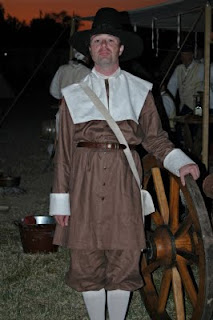

“I can’t stand this anymore,” I say, finishing up. “I must get a dance in!”

I dash off with the blessing of my dinner companions and find lines of young ladies and gentlemen finishing up a round of “Chase The Squirrel.” But they’re running out of dances they know, and so they look in my direction.

“Do you know any dances?”

“All the dances I know are mostly 18th Century,” I admit. “But if you’re willing to try, we can improvise, too.”

Someone suggests the Pineapple Dance—although it will have to be with an apple this time. I give my go-ahead for that, and volunteers quickly arrange three chairs as I explain the dance’s progression from three seated people. “One of you will take the apple and the other two will sashay off. Or you may give the apple to somebody in the line and all three go down the line. PLEASE BE DELICATE! The person who wins this apple has to eat it!”

The music starts and we’re off and sashaying. A lady ultimately ends up with the fruit. All end up out of breath. Now is the time for a waltz.

“Gentlemen, you are expected to do your duty!” I bellow. “I do not want to see any waiting lady deprived of a dance!”

Those who don’t know how to waltz learn from those who do, choosing either an easy two-step or a more-mannered box step. I am alone, unable to woo a lady from the sidelines who is trying to keep warm. Another one eventually steps up to me midway through the number, and I take her arms cheerfully, with much admiration.


I help call a Virginia Reel... and then a marathon reel to the tune of Jingle Bells. The Christmas season is officially underway in all of our hearts, something reinforced by the officers, who are merry from their evening together and parading through the camps with gifts and carols. They arrive as we’re attempting a polka.

We sing “O Come All Ye Faithful,” and “Feliz Navidad” in honor of our Spanish allies. Their commander returns the favor with a hilarious rendition of something I could only call “The Tortilla Song.” A gentleman dazzles us with a humorous reading, and a few ladies regale us in more carols and hymns.

General Washington, quite delighted with everything, remarks that with all the talents of those around us, we cannot let the evening go by without seeing “the talents of our prancing Puritan!”

White steam in the cool evening air pours from my mouth.

“Yes, take a breath.”

What, dear me, shall I do? The “Prancing” part is the hint.

“I am not much of a singer,” I begin. “But I think now we should turn to the dance! Someone suggested a jig.”

I call over two of the 1st Minnesota who were in the mood for one earlier. “I don’t know what John Playford would think of what we are about to do, but I know that there is a myth that Puritans abhor the dance!”

The three of us start slowly, but then we work up fervor as the music proceeds beyond the first few bars, jigging and prancing about as the crowd cheers us on -- “Yes, cheer us on!” -- with clapping. In short order, we pull in a few ladies.

I cavort all over the place, pulling a lady in and jigging to each other, rounding a circle in a mad promenade.

“Come on in! The water’s warm!” I cry.

A few more do. But most are just content to watch and admire. “This is exactly what they did in camp,” I overhear General Washington say, and I know my display is winning approval.

We had one last hymn, from our beloved Molly Pitcher, who chose a favorite hymn from the Church of England: “Tomorrow Shall Be My Dancing Day.”

“Tomorrow shall be my dancing day;
I would my true love did so chance
To see the legend of my play,
To call my true love to my dance.
Sing, oh! my love, oh! my love, my love, my love,
This have I done for my true love...”


As she is singing, General Washington whispers a suggestion to me: “Why don’t you dance as she is singing?”

Dance to a hymn? It does not seem proper, especially not for a Puritan. But her voice is so beautiful and the allegory so fitting, I accept the invitation.

Many a time I have danced an improvised solo minuet when I have found no available lady for a waltz. So that is my caper now, stepping gracefully in a circle around her as she sings, toes pointed every so often, turning occasionally in place, sometimes with a honorable glance. But we are giving GOD the ultimate honor. The original Puritans may have frowned. The colonists could have scoffed, but nothing in this moment invites any jeers or cries of irreverence.

“Then was I born of a virgin pure,
Of her I took fleshly substance
Thus was I knit to man’s nature
To call my true love to my dance.”


I worry about upstaging her, so I attempt no overtly fancy steps or flirtatious gestures save for a low and courtly bow at the end, where unfortunately I have ended up behind her. The audience gives enthusiastic approval while the warmth of it all continues to radiate through me.

“This is my favorite night,” General Washington tells me as we walk towards the next camp to honor with carols and pies.

I can feel it. “All is right with the world,” I tell him. “It doesn’t matter what’s going on in the rest of the world, all is right here.”

IN THE CONCLUSION: The final battles... and the ongoing mission!

Thursday, November 19, 2009

The Free And The Brave - Part 1: School Of The Soldiers

Memorable and miracle moments from the 2009 American Heritage Festival, as presented by We Make History

From the journal of Private Christopher Francis, soldier of the Continental Line, recruit of the The 1st Virginia Volunteer Infantry, and Prancing Puritan.

Pictures by M. Cynecki

“Are you willing to enlist in the cause of Liberty?” I ask.

Some of the first schoolchildren stand before me -- this Yankee Doodle Dandy soldier in the red, white and blue uniform -- puzzled.

“Do you think you can fire this musket?”

That they understand. Anything involving firearms tweaks their curiosity, and I can fill their cups many times over, starting with the priming and the loading, showing how I tear off the cartridge tip with my teeth and pour a little bit of powder in the pan before dumping the rest down the barrel.

“I pull the trigger and that sets off the charge in the pan, and some of that explosion goes through the touch hole -- I don’t know if you can see it there -- and sets off the powder in the barrel, pushing the musket ball out and hopefully into one of those redcoats.”

I motion to the open field in back of the line of canvas tents, where the British are practicing their drill and march. They have a precision that inspires the lackluster regimental. One or two occasionally collapse into the grass in deference to the children opposite them with the wooden toy rifles.


“They do a good job of falling down,” I note to a fellow Continental soldier during a spare moment when the young ones are enthralled with a leg-stock punishment device.

“For a shilling, we can hold them in place for you,” a Colonist offers the parents.

“For a little extra, we can also hang a sign around them that says ‘Insubordinate,'” I add.

The others on this School Day are milling about the Colonial camp, watching someone melt lead into musket balls or watching the ladies cook breakfast. The more adventurous are trying their skill at the game of Graces, tossing hoops back and forth to catch them with sticks. Across the way, the French Tent is up, and Le Comte and La Comtesse -- dressed in their lacy full court beauty -- are explaining to the wee ones why they are involved in this fray.


“Can we take your picture?” one visitor asks.

“Of course, My Lady!”

Whatever we say or do, the groups lap it up. I explain the musket spiel at least a dozen times to the kids who pass on through in their official polo shirts and name tags, more interested in the weapon than anything else they see before them.

“What rank are you?” a child inquires.

“I am just a private. But he,” I say to a redcoat who has just sauntered up to a fellow Patriot and myself, “is an officer.”

Lt. Radcliffe is casually drinking from a tin cup and thinking he’ll be the one to drop us in battle. He has that confident swagger about him, the product of somebody who has not tasted defeat, not even sipped it. A few moments later, we are all summoned to muster.

“This isn’t quite the Battle of Cowpens,” General Washington informs us. Cowpens, after all, didn’t involve our Spanish allies -- those proud and honorable men in the blue and yellow uniforms -- gladly adding to our numbers.

“Battle of Fountain Pens,” I jest.

“Or Pig Pens,” remarks the British commander, eager for a smidgen of levity amid his predetermined loss.

The gray skies let loose a shower, and children shriek and dive under tent flies. The outpouring does not last long.

“It’s a great day,” His Excellency observes. It reminds us all of Virginia and its sudden shifting skies.


The shrieks and screams in our favor multiply as my fellow Continentals and I take the field. Young ones are eager for us to get out there, as the British are already pushing back our militia. The Catalonians have some artillery fire for support.

We advance on the British, greeting them with more cannon blasts and musket volleys. I worry about the light sprinkle in the air and what it can do to a flint. Even as something as innocent as a gentle November breeze can snuff out my sparks and leave me unarmed.

“Load and come to the ready!” General Washington orders.

My 69-caliber smoothbore’s hammer gives me as much fight as the redcoats, even after a good oiling. It resists the pull-back. But even with the battle-within-the-battle, I can still stuff a load down the muzzle in 20 seconds or less, which is the goal.

“Fire!”

The orange flame of the pan stands out amid the morning grey. I don’t know if the load in the muzzle followed, but I don’t have time to worry about it. The redcoats are still advancing, all half-dozen of them plus their militia and musicians, and another load has to go down the gun.

“Aaaaagh!” screams a fellow Continental as he drops by my feet. I’ll make those bloody scoundrels regret it.

Three more volleys from us, and we’ve got them on the run. Even their artillery is no help now. We’ve got them running —- “CHARGE!” I am screaming. The children are hollering along with me.

Their general is left abandoned with three Patriot soldiers running him down. He offers his sword. “Disarm him!” I cry. But I wait for General Washington to handle the matter diplomatically.

“Your men fired at one of our ladies,” he points out, indicating the extinguished British officer on the ground: Lt. Radcliffe. So much for that confident swagger.

“It is fitting that his wig is unkempt.”

“Resurrect?”

“Resurrect!”

Later, I learn the full story. That swaggering Radcliffe felled a Molly Pitcher, to the horror of the Patriot cause and the boos of the children. But what that redcoat and the kids didn’t know was that Molly took the hit on cue, leaving her aggressor officer with a reputation that would add to his persona and probably elicit a few more playful boos and hisses long after the battle.

For the victors, though, it’s nothing but cheers. I march past the crowds of children, giving high-fives to anybody who can show me their hands. “Huzzah! Huzzah!” I shout as I slap palms. They come from everywhere in the crowd, running up to the safety line.
Everybody wants to be a part of a winning team, and no doubt some of the kids will be picking up a Charleville of their own one day and marching into the battle with visions of jet-smoke rifle fire and falling redcoats cavorting about their minds.

* * *

Advancing forward 100 years, it’s time to let the Yanks hand out a whupping to the Rebels in front of the children. My 1st Virginia compatriots and I think we’re beating the bluebellies back, but a detachment of their forces flank us and mow us down in good fun.

It’s a different perspective for one officer, now a private, right next to me in formation, not minding any of it.

“Did you lose your rank?” someone asks.

“No, just trying something different.”

He’s talking about more than just himself. Young men in the 1st Virginia Volunteer Infantry and our fighting friends the 1st Minnesota are stepping up to try out the ranks of NCO’s and officers. They are taking on more responsibility and a new learning curve for a position that our superior cautions isn’t as much fun. But the reward is a sharper edge in leadership, one that will seep over to everything else in life.

We’re reorganizing our Civil War soldiers into a battalion structure, in preparation for bigger things ahead. Multiple layers of leadership on the battlefield mean multiple companies and multiple commands repeated multiple times.

“Battalion!”

“Battalion!”

“Company!”

“Forward!”

“Forward!”

“Forward!”

“March!”

“March!”

“March!”

It’s easy to discern what’s coming when it’s said three times, but the challenge for the officers is making sure they’re in the right position to move: out in front of the troops, which means they scurry like squirrels into position out of their respective companies, or back from behind if we’re moving after firing.

The logistics of a simple advance can be head-scratching at times: the flag-bearers have to be in the center and the Captains have to be in front of their respective companies. They have assigned positions for everything—no walking about to survey the troops during a battle like some prize-fight referee. It’s an adjustment for everybody, even the privates who are learning new ways of falling into columns of twos and fours. It will all be worth it though, when we journey to Virginia once more.

* * *

My friends in time gather for a potluck Thanksgiving dinner after the children have departed. It’s the closest I will come to the real meal two weeks later, which isn’t real at all given I’m working between bites. I prefer it this way: breaking bread among the people whom I love and give Thanks for every day.

Several of those people express their thoughts out loud at the invitation of our commander, who thanks us once again for inspiring the hundreds of young ones we met today.

“I am thankful for our freedom,” a young girl says, “that I can do what I want.”
Several others share. I am silent. Part of me wants to speak out, but I don’t want to make a long speech. Something inside of me is telling me to hold my tongue, that people have heard enough of me, that I should instead hear from others.

But later, I open up to our leader in soft confidence. “This is my favorite of the three days. I am so thankful to be here for it.”

IN PART TWO: Flint follies! High drama among felled men! Getting jiggy!