Friday, March 31, 2006

Feed Your Head -- Rest Your Feet

To the high school students of Tucson demonstrating against harsh immigration reform: Enough marching. It's time to get back to class.

One day of demonstrations, I understand. Two looks suspicious. Three, and I know you're just ditching pre-calc.

I know about the First Amendment, and I know immigrants built this nation. But I also know you all need an education. And a few of you could use some schooling on what you're marching about.

Here's an actual soundbite from an actual student that actually aired at the start of KOLD News 13 at Ten on March 30, 2006:
"I came to protest I guess. I'm just with the Mexican people. A lot of my friends are Mexican."

(Reporter asks a question)

"I don't exactly know what it's for."
"Si se puede!" Yes, we can! Can... uh... what?

Many of you aren't marching in protest. You're wandering in the wilderness, adrift on the waves of others' passion. You know not your purpose nor your politics. Your aim is hanging out with the crowd.

Did you know there's more than one immigration reform bill before Congress? Do you know that not all of them involve making illegal immigration a felony? Did you hear about the guest worker program the president backs -- at substantial risk to his standing among conservative Republicans?

Do your homework. Understand the issues. Understand your position.

Your teachers and principals are trying to help you. They are mercifully -- I say too mercifully -- sparing you from truancy citations and detentions to let you take a hike. They know a teaching moment is before them, and they are offering you classroom time to talk this out. I suggest you take their offer.

From KOLD News 13's report by Teresa Jun:
"We used the approach that we're not going to physically confront kids leaving school," said TUSD Superintendent Roger Pfeuffer. "Given the emotionality of the issue, I think we dealt with it appropriately."
What are you administrators afraid of? Do you have nightmares of the 60's? Are images of Kent State pervading your thoughts when you see the cast of fourth-period Physics parading live on KGUN 9?

"Appropriately," my foot. It's time you put yours down.

A truancy citation is not a death sentence. It is not racist. Asking students to stay in class and march after school is more than reasonable. It's polite, if nothing else. Offer to help rally after the final bell.

Don't let parents get under your skin. They will holler and whine if you lock the school down, but do it anyway. You're paid to educate, not commiserate. Sensible parents will support you.

I cannot deny the satisfaction and emotional rush of publicly expressing your beliefs. But true satisfaction comes from understanding the framework of your convictions and forming your opinions from fact. All this is possible if you don't skip out on History and Civics classes. You can't learn it from the street.

Thursday, March 30, 2006

And The Network Goes To...

My hunch back in January was wrong. KWBA in Tucson is getting the CW network.

It makes sense. KWBA has nabbed higher ratings than KTTU and holds a higher profile. But KTTU will hook up with Fox's new creation: MyNetwork TV.

Let's go deep here. The whole point of merging UPN and WB was to create one strong network out of two weaker ones. Looking at the season-to-date Nielsen averages, WB and UPN are each drawing less than half of Fox's audience (6.0 for Fox, 2.1 each for WB and UPN). Provided CW takes the best of the best, they could stand to close the gap to perhaps 50-75 percent of Fox's number -- say a 4 rating. But that sounds awfully optimistic.

MyNetwork TV is going to get a strong push from Fox, which owns several MyNetwork affiliates. The main offering is English versions of telenovelas, those steamy Mexican soaps. But Why not just call it "Fox 2," as Inside Tucson Business' David Hatfield alluded to? You capitalize on the strong Fox brand. Maybe you also offer a second run of Fox shows a day or two after they run on Fox. Forget to Tivo American Idol? Catch an encore the next night on MyNetwork! As CBS is showing us on Saturday nights, you can make money off repeats of popular shows like CSI.

I also won't be surprised to see a repeat of the present situation: two low-rated nets still in Fox's long shadow. Names may change, affiliates may shift, but you end up with the same problems.

But with my last hunch disproven, what do I know?

Saturday, March 25, 2006

"You Look A Little Too Happy To Be Here."

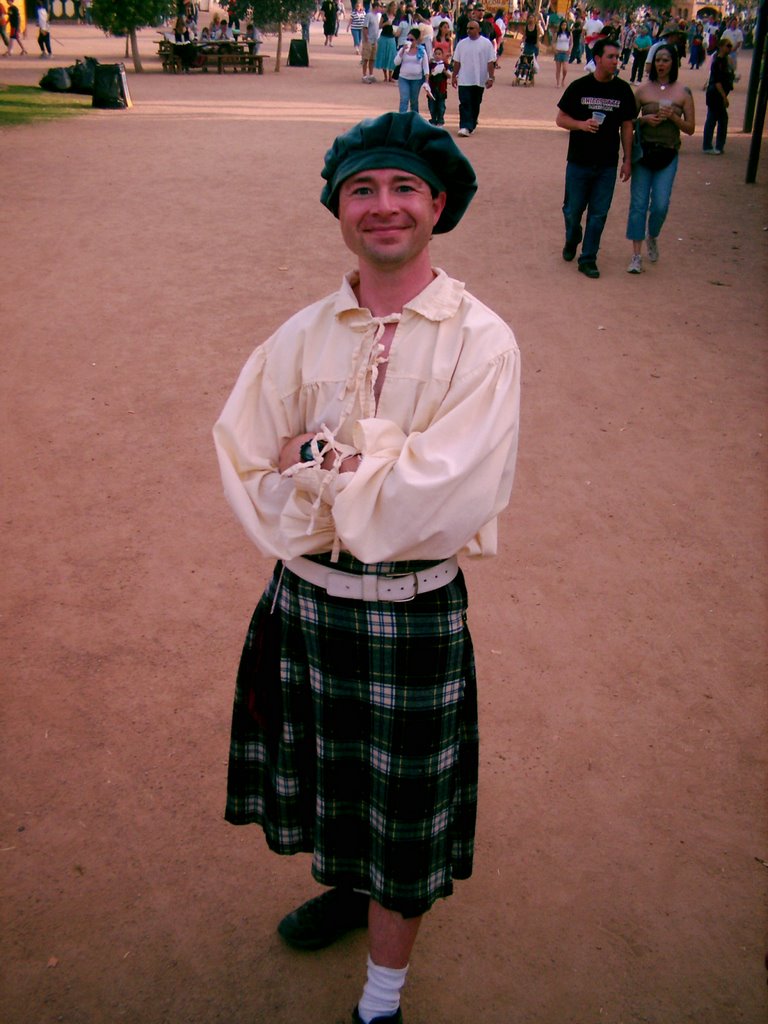
That's yours truly at the Arizona Renaissance Festival, kilted to the hilt and loving every second of it. The title quote comes from the ticket taker at the gate, himself costumed, when he saw the smile on my face as I passed by.

For the uninitiated, you can rent costumes right outside the gate. The fee is not outrageous -- about $30 for me. Yes, it's a little long. And yes, if you have to ask, I was wearing undies. I thought about keeping my dress shorts on in the changing room.

"Take off your shorts," the attendant said.

I thought about it some more. But since the kilt fell below my knee, I decided to risk potential embarassment.

Walking around in a kilt is quite comfortable. I just wish I wore actual kilt hose instead of those socks! Calm wind helps too. Sometimes you have to sit like a girl. I don't care. I have a "brave heart."

I could tell you more about the day, with its shows and jousting and chivalrous revelry. I enjoyed it. But after a few recent timeline travels which involved much more interaction, simply dressing the part isn't cutting it any more. I feel like I have to go further, which in this case probably meant dancing the Highland Fling... something which I didn't have the opportunity to do.

What does this mean? For me, living history means living it. But a time will come, I promise you. Keep your kilts on.

Tuesday, March 21, 2006

Send In The Lions

I thought we got rid of the Taliban in the Afghan government. I guess not:

Christian Charged For Switch From Islam

My favorite contradictory quote:
"We are not against any particular religion in the world. But in Afghanistan, this sort of thing is against the law," the judge said.
And from the prosecutor:
"He would have been forgiven if he changed back. But he said he was a Christian and would always remain one," [Abdul] Wasi said. "We are Muslims, and becoming a Christian is against our laws. He must get the death penalty."
It's getting much harder for me to believe Islam is a religion of peace with characters like these around. I'll say it again: moderate Muslims need to start taking their faith back.

Monday, March 20, 2006

Reel To Reel: V For Vendetta

How It Rates: ***1/2
Starring: Natalie Portman, Hugo Weaving
Rated: R
Red Flags: Intense Graphic Violence and Swordplay, Mild Language

I saw V For Vendetta late in the evening in the middle of a Las Vegas getaway. Out of all the shows in Vegas I could've picked, I picked this one. I emerged from the theater spellbound. This is a film that I watched for two hours and mused upon for many hours afterward. I was still thinking about it when I drifted off to sleep in my hotel room.

V For Vendetta has a complicated Francis Movie Equation: 1984 + Phantom Of The Opera + The Zorro Pictures / The Matrix + the psychology and mindsets surrounding the Third Reich and the War On Terror. The film from the directors of the Matrix triology could be a warning picture -- a prediction of what will happen if we do not guard our liberties, trade freedom for security, and surrender to fear.

The picture takes place in 2020 Great Britain, now a facist state. The motto of the government conjures up images of Nazi Germany and The Wave: "Strength Through Unity. Unity Through Faith." A nationwide curfew is strictly enforced. Works of art and music deemed offensive by the government are confiscated. Television is merely the puppet of the government, censored and bloated with propaganda as news. Vans with listening devices cruise up and down the streets monitoring for dissent. And the public, comfortably numb in their homes and pubs, doesn't care.

One person does: a mysterious vigilante named V (Weaving), who wears the mask of Guy Fawkes, a man who tried to blow up Parliament in the 1600's. V is out to reawaken the public to what they have lost and make them rise up against tyranny. This involves a pirate broadcast, a few big explosions, and lots of killing -- mainly targeted at government officials. He meets and befriends Evey (Portman), a worker for that puppet TV network, who comes to find within herself another person, one with purpose and courage.

That's all you need to know about the plot, which is building up to a big day when something big is supposed to happen. A curiosity: the USA in this film doesn't exist any more as a sovereign nation, although it's not clear why. We hear a couple of references suggesting that somehow, the British took back the former colonies. Lousy redcoats. What is clear is this: the War on Terror has grown and spread, along with a climate of fear. In this climate, a repressive regime rose to power, much the same way the Nazis rose to power in the disillusionment, poverty and hopelessness of post WWI Germany. The film also throws in some other thought-provoking twists, which are better left for you to discover and find the parallels in real life.

In The Matrix, the Wachowski brothers laid some deep questions about our dependence on technology and our perception of reality into a world of CGI. V For Vendetta goes even deeper, though with less action and more political intrigue, all of which works, except for one scene of Weaving's character slicing through people with a pair of swords.

For a vigilante, V speaks with the tongue of a learned man, not some psychopath. He is a voice of reason, even if you do not approve of his methods. "People should not be afraid of their governments," he says. Governments should be afraid of their people." Still, you can call him a terrorist. His actions are violent and designed to incite fear. He kills a lot of people. And even if the ultimate end is eliminating the government's own campaign of repression, he is not a role model for your kids. But as we see all the time, one person's terrorist is another's freedom fighter. And if we suddenly realize one day the freedoms we love have been confiscated, a lot of us are going to want V out there fighting for us.

It's no spoiler to tell you that Parliament is blown up, just as Fawkes intended. This may disturb you. But in the context of the picture, it might not. It is all perception, and the Wachowskis push that question: is terrorism ever justified?

At one point, V lectures the British public on what has happened to their rights and says the blame for it lies with themselves. Twenty years from now, I hope like heck somebody isn't making the same lecture to us in America.

Saturday, March 18, 2006

Drawing The Curtain On Freedom Of Speech

What should have been a teaching moment, an opportunity for a discussion of free speech and what offends us fell victim to a scared administrator in Fulton, Missouri, my home state.

High-school drama teacher Wendy DeVore is resigning after the school superintendent cancelled TWO student plays amid complaints about content.

From the AP report:
But after a handful of Callaway Christian Church members complained about scenes in the fall musical "Grease" that showed teens smoking, drinking and kissing, Superintendent Mark Enderle told DeVore to find a more family-friendly substitute.
Teens smoking. GASP! Drinking. GASP! And kissing. GAAAAAASSSSP! The teenage high-school experience isn't suitable for high-school teenagers anymore. And this is after the script had already been sanitized for high school audiences. The New York Times points out DeVore rated the production PG-13. That should've been enough.

The irony surrounding what was to be the next play speaks for itself:
DeVore's students were to perform Arthur Miller's "The Crucible," a drama set during the 17th Century Salem witch trials.
Note that this play was chosen before the cancellation of Grease.

The irony deepens when you see what play went on instead:
DeVore chose Shakespeare's "A Midsummer Night's Dream," a classic romantic comedy with its own dicey subject matter, including suicide, rape and losing one's virginity.
But I guess because it's written in Old English, nobody will understand it anyway.

According to the Times, Dr. Enderle seems more concerned about tough questions than standing tough for his faculty and students:
Dr. Enderle said he did not base his decision to cancel "The Crucible," which was first reported by The Fulton Sun, a daily, just on the three complaints and the video [of a dress rehearsal]. He also asked 10 people he knew whether the play crossed a line. All but one, he recalled, said yes.

"To me, it's entirely a preventative maintenance issue," Dr. Enderle explained. "I can't do anything about what's already happened, but do I want to spend the spring saying, 'Yeah, we crossed the line again'?"
"Preventative maintenance." Call Roget's. Censorship has a new synonym.
Nevertheless, the superintendent said he was "not 100 percent comfortable" with having canceled "The Crucible."
Not only is he devoid of backbone, he's also wishy-washy. Do you want this person leading a school district?

This could've been an excellent topic for a town-hall meeting with parents. Hopefully, somebody would have stood up for the kids and their teacher.

From AP:
"We have become a laughingstock," teacher Paula Fessler told The Fulton Sun.
Make a ridiculous decision, and you deserve the ridicule. Unfortunately, the ridicule here is obtuse, hitting the citizens of Fulton, Missouri instead of their school superintendent. Fulton is not a backwater bastion of intolerance. You will recall it's where Winston Churchill made his famous "Iron Curtain" speech.

Now, we have the Velvet Curtain. On one side, we have the First Amendment. On the other, we have those who say it doesn't apply to kids, doesn't apply to indecency, doesn't apply to anything we don't "like." They have mentally added another amendment to the Bill Of Rights: The Right Not To Be Offended.

That right does not exist. If something offends you, then use the one that does to state your beliefs as a counterpoint. But also choose to turn away, close your ears and your eyes. The arts and the media feed off of your patronage. Refusing to patronize offensive content will send a much more powerful message than taking a pre-emptive strike. As we have seen time and time again, controversy drives publicity, which drives curiosity.

The student actors at the center of this are concentrating on putting on a fantastic show, Shakespeare or otherwise. Huzzah to them! Unlike their high chancellor in the faculty, they know where they stand.

Saturday, March 11, 2006

Tears Of A Stranger

The following took place a few weeks prior to the date of this entry. I have withheld this story until now to avoid upstaging the mourning of the young woman who lost her life. But I feel ready to tell it, especially after seeing the movie Capote, so that you may know journalists -- including TV news producers -- are not without feeling for the people they encounter, even as others criticize us for having no soul, no shame, no honor in our profession.

I felt powerless. A story didn't roll correctly. A soundbite had no audio. And all I could do was kneel beside a monitor, one earpiece listening to the unfolding program, and keep people in front of the camera from looking silly by warning them when they were on. So much for field producing live shots at the Chrysler Classic of Tucson. Everybody was fine on my end. But gremlins were popping up back at the station during the Sunday 5:30 newscast.

I'd volunteered for the job hoping to help the sports crew avoid a repeat of last year, when the golf tournament went into extra holes. It led to a mad understaffed scramble to get the footage on the air. If anything, I could run tape back and forth should we bump up against a tight deadline, easing the tension. This year, it all ended on time, with plenty of minutes to catch our breaths, edit our tape, and set up our live shots. We were overstaffed.

But then I heard Andrew, one of our photographers, was on his way to another assignment. The family of an 18-year-old girl killed in a car accident just two days ago was going to talk to us. Andrew was to get the soundbites alone, without a reporter accompanying him. I didn't want him to do it by himself, so I dusted off my TV reporting expertise from long ago and hopped in the live truck with him.

We made a call to the assignment desk to get directions and some background. I dug through the back of the van for a pen. My hands waded through camera bags, empty pop bottles, discarded paper, trash, mystery wires, wrappers and filth, but located not a single pen. At work one hangs around my neck. All I had around my neck now was my press credentials. I desperately needed that pen to transcribe the details that were either going to keep me out of trouble or get me into more of it: Who was this girl? How did she live? How did she die? No way was I going into an interview with a grieving mother ignorant of the facts and bereft of a way to take them down in front of me.

Andrew stopped at a 99-cent store while I leaped out and ran for a cheap writing utensil. I snatched a pair of Scriptos and dashed for the checkout.

"Are you in a hurry?" a clerk asked in the middle of an order. She was rolling what looked like two dozen pop cans across the scanner, one at a time.

"Is there an Express Lane?" I queried.

"It's $1.07," she said, seizing the advantage of working at a fixed-price store: an ingrained knowledge of prices plus tax.

She generously took my money in the middle of the other order, and I was back in the truck in a flash, on the phone, and on my way to an interview that would wring my heart like a sponge.

All I knew about Elisa before I met her family was that she was an aspiring mariachi musician, one who had placed fifth in a national contest. I knew she had died in a head-on collision. And that was all.

Our live truck rolled into the dark cul-de-sac around 7:30, delayed by heavy traffic. Rows of parked cars lined the curb outside the family's home, occupying as much space as possible without blocking the center of the road. I worried how we would get our battleship of a vehicle out. The approaching deadline for the 10:00 newscast was working against us. We were to get enough material -- interviews and pictures -- for a "natsound" package, one where the interviewees do all the talking in the finished piece and the reporter does none.

Here I was, the reporter, wearing neither a suit nor tie but the aftermath of a day in the field assisting with golf coverage. A button-down brown-striped shirt hung loose around my waist, with brown shorts as base. Pulling cables left the pant legs marked with black streaks. My press badge with the four-year-old picture still hung around my neck, and a Chrysler Classic media access pin dangled from a pocket.

A relative serving as a liaison for the family met us shortly after we rolled up and graciously thanked us for coming. She led us inside.

Relatives filled the garage and every room of the home's lower floors, some hugging, some eating or sipping beverages, and nearly everyone talking. We made our way to the living room, where a crew from another station was wrapping up amongst the crowds. Their camera sat dismounted, tripod ready for folding. Andrew and I searched out a space for an interview.

"Wherever you want to do it," I said to him and the family. We decided on Elisa's room.

The door swung open and I stepped into a shrine. Pictures of the girl dotted the blue walls: her and her friends, her and her family, her as a mariachi singer, the feature article about her in the paper, all smiles. Ticket stubs for Spanish concerts protruded from the frames. My eyes scanned the room several times as Andrew set up the equipment.

I caught a quote on her bulletin board: "Wait for what you want and you'll get run over."

As the photographer took video of the photos, my eyes fixed on a silver microphone without a wire. It lay on her dresser like a hairbrush, and I asked about it.

Her father laughed. "She used that to practice her stage technique," he said. He didn't think that old mic, dented on the top, worked.

I saw the mirrored closet doors in front of me and knew it did. Every day, Elisa would stand in front of those doors, practicing to become a star, perfecting her voice and her rhythm. My mind flashed back to my high school days when I practiced for speech and debate competitions in front of my mirror-less closet door.

Elisa's mother and I sat down on the girl's bed. I asked her to face the camera and not me as the interview began.

"Tell me about her," I said, keeping my question vague and open-ended so she could proceed with the most striking thought that came to her mind.

"Elisa was a charismatic young lady," her mother said. "She just brought so much joy and happiness to everyone. Everyone she met, she touched in a positive way."

The mother painted me a picture of the daughter she had lost: a loving person, one driven by a love of music, one who brought joy to many others while determined to be the best.

She talked of Elisa placing second -- not fifth as I had been told previously -- at the national mariachi contest last December, second out of 500 contestants.

"She did so well. We were so proud of her, and yet at the same time she was so disappointed that she didn't get first place because she thought she had let us down. And we said, oh no, you never let us down."

She talked of Elisa learning Spanish from scratch to master her craft.

"She had wisdom. She had a lot of wisdom in her age. And I don't know, maybe that's why the Lord took her from us at a young age."

And then came the night Elisa died.

Elisa was on her way to a party, one with traditional Mexican music, and she was to pick up a couple of friends on the way.

"She said, 'I'm on my way, I'll be there in a few minutes,' and then quickly she says, 'Oh no.' She hung up. And and at that time, they didn't hear from her again."

Nobody knew what caused her to veer into oncoming traffic. But her death was instantaneous.

The walls full of pictures, the memories, and the presence of her loving family seeped into me. My insides ached and my eyes watered.

"Excuse me, Chris, this battery's almost dead," my cameraman said. "I need to go get another one."

I needed the moment. I rubbed my eyes nonchalantly, as if my contact lenses were bothering me, composed myself and sat up. While Andrew fetched the battery, I made small talk with a comparison to the late pop star Selena, who also had to learn Spanish on her way to stardom.

I talked to her father, who admitted being hard on his daughter when it came to singing right. But she also made him proud, when she was on stage, performing for millions of people on the Univision TV network.

"I'm sure she's singing right now," I said.

"Yeah," her father smiled. "I guess the Good Lord wanted her in His choir of angels. Maybe they were all sopranos and they needed a mezzo soprano or something."

We needed video of her singing. A family member found the DVD, but it wouldn't play correctly on the DVD player in her room. Someone suggested bringing the DVD player from the living room up to the bedroom.

"It may be easier for us to just go downstairs," I said as Andrew grew nervous about the time slipping away from us.

We returned to the crowds below and Andrew set up the camera in front of the living-room TV while relatives fidgeted with the DVD player. What we were about to get wasn't going to look the best it could. We didn't have the proper equipment and cables to take the video straight from the disc. And worse, Andrew thought he only had 30 seconds of battery power left. But we had to make it work.

The family searched out the moment that brought pride to them. I held the microphone up to the stereo speaker.

Elisa stepped onto the stage, her off-white mariachi outfit glowing in the lights, earrings dangling in front of her tightly-ponytailed dark brown hair. She began to sing, and the passion of the music poured from her corazon as if she had been singing all her life. She missed not a note, flubbed not a phrase. Her beauty penetrated the screen. Again, my eyes watered.

"Muchos gracias!" Elisa called to the audience, taking her bows as the crowd on the disc cheered her.

A few people behind me applauded. I turned around and saw every face in the room staring silently at the screen, the pain evident in their eyes, their hearts longing for another song.

"Thank you," I said softly. "Thank you for talking to us."

Andrew loaded up the gear and I slipped into the front passenger seat of the live truck.

"This is killing me," I said to my colleague, my voice quivering. "I can't listen to somebody talk about this wonderful person who's gone and not be affected by it."

Tears flowed silently now in the privacy of the live truck. I tried to regain my composure, some modicum of professionalism, but my body shook with the chill of grief.

I felt so awkward and out of place. I had entered the home of a family in mourning for their daughter as a stranger, and yet the two people closest to her willingly shared the story of her life with me as they would to a friend, in her own room. Some might call it grief therapy, telling the story over and over again to keep her spirit alive within them.

The rule is you don't let yourself get emotionally involved with a story. You're a journalist, not a grief counselor. And I'd been down this road before, having run the camera a decade ago in college while a fellow reporter talked with the mother of a son who had just been murdered.

I cannot sit in front of somebody, eye to eye, and hear the story of someone like Elisa without it touching my heart, without it making me shed a tear. Perhaps it is because this person is so worthy of my respect, so worthy of honor in a time when many young adults do not make the right decisions. Elisa did not deserve to die. She deserved to live, using her love of music to bring joy and pride to all around her.

We arrived back at the station at 8:30 and quickly pieced together the story. I cut the basic soundbites in the computerized editor and Andrew hurriedly laid down the music and pictures from Elisa's performance to round it out. I was under double the pressure because Andrew had to edit another story and wouldn't be available to help until that task was done.

The finished product deserved five minutes. But we only had time for a minute and a half.

We saw Elisa singing, her mother talking about the "charismatic young lady." Her father talked about his proudest moment, "watching her sing at this competition she was in."

We heard about the night of her death, the "oh no" phone call. But we heard more about the life.

"We're going to miss her dearly," her father said in the final words of the piece, just before Elisa finished her song and said "Muchas Gracias."

I'm glad the piece contained only the words of Elisa's parents. Any words I would've added would have been tainted by emotion. This way, viewers heard the story I heard, although in a lot fewer sentences.

A wonderful young woman, one who had enriched the world around her was gone. The photographs in her room bore abundant proof of the many lives she touched. She was on her way to stardom. She was living a dream. But so many others were taking that journey with her. And now we'll never know how far she would have gone.

To deny my emotion is to deny my own humanity. And I feel no guilt in weeping for this person. She has earned every tear.

Reel To Reel: Capote

How It Rates: ****
Starring: Philip Seymour Hoffman
Rated: R
Red Flags: Brief Graphic Violence, Smattering Of Language

In Cold Blood is on my list of Books I Need To Read Before I Die. But in a way, I already have. Truman Capote's nonfiction novel sparked a new genre and forever changed the way true-crime accounts were written. One of my favorites in the genre, Harry N. MacLean's In Broad Daylight, is one of Blood's many great grandchildren.

But Capote is not the story of a book. It is the story of a man consumed with humanizing the story of a family murdered in 1950's Kansas. Capote's probing of the two killers' lives brings out parallels in his own scattershot life and reveals currents of deep tragedy and longing. Watching Capote unravel the truth is like watching a sand castle blown away by the wind, leaving a foundation in ruins.

Hoffman, who just won an Oscar for his performance, is absolutely mesmerizing as the famed author. His high-pitched effeminate voice leaves no question about his orientation. But at the same time it projects childlike innocence, a harmless disposition that hides deeper scars. Several scenes show us how Capote could be the life of the party as a quirky storyteller. Hoffman embodies the role completely, flawlessly integrating Capote's tics and speech patterns.

The movie focuses on Capote's various journeys to Kansas to gather the raw material that would make him famous. He is aided by fellow author Harper Lee (Catherine Keener), who grew up in Capote's neighborhood and has just penned her own groundbreaking novel, To Kill A Mockingbird. Capote is not one to use a notebook and pen when he's talking to people. He will step into a room and start to absorb his surroundings, as he does in one memorable scene where he meets one of the killers being held in "the women's cell" -- a cage in the Sheriff's kitchen. Capote can recall conversations with amazing accuracy, as he himself boasts, which he will later jot down in notebooks.

The author realizes he can't tell the story without fleshing out the two killers, condemned to death. He bribes a warden to give him unlimited access. He finds another lawyer for them so they will not be executed before he's finished gathering facts. And in the process, a friendship develops -- but maybe it's more of a dependency. The killers want to live. Capote wants to finish his book. The author resorts to small deceptions to keep them talking, saying the book is less finished than it is. But Capote's legal aid works too well, putting the case in front of the Supreme Court, and further denying the author an end to the story which is tearing him up. All through this, he sees his friend Lee rise to fame. Her book is a success. It becomes a movie. Capote knows he has his own success, but it is delayed as long as the killers are alive. Still, he feels for them, he is bonded to them.

Capote reveals why the author never finished another book, just as In Cold Blood revealed what led two men to kill. Both Capote and the killers become victims of their own actions. And as the two criminals lost their lives, Capote loses his own in the contradictions of friendship and his work. He says to Lee, "I couldn't have done anything to save them." Lee replies, "Maybe not, Truman, but the truth is, you didn't want to."

Journalists are not supposed to become emotionally attached to the stories they cover, but Truman Capote was not a journalist. He was a novelist. The attention to detail, the need to create compelling characters, the crafting of a plot all drove him to dig into territory and emotional minefields many reporters don't wander into. Capote became the victim of a job too well done.

Monday, March 6, 2006

And The Oscars Go To...

A few comments on Hollywood's Big Night:

Best Picture: Crash -- You can read this one of two ways. Some of you will say Brokeback Mountain got snubbed because it was about gay cowboys. Nikki Finke of L.A. Weekly says it's because straight Academy members didn't want to see a gay movie. I read it this way: Brokeback had a strong message about love, but Crash had a stronger one about race relations.

Best Director: Ang Lee for Brokeback Mountain -- No gripe here. Lee took charge of a film that could've ended up as porn or laughable love story and steered around the mines. That's what a good director should do.

Best Actor: Philip Seymour Hoffman for Capote -- I haven't seen the picture. But I've seen enough of Hoffman's performance to want to. And now I want to even more.

Best Actress: Reese Witherspoon for Walk The Line -- Hooray! (That only approximates the cheer that went up in the newsroom when she won.) Joaquin Phoenix was great as Johnny Cash. But Witherspoon was even better as his second wife. She dissolved into the role so effectively, doing her own singing, I had to ask myself, "Is this the same person who starred in Legally Blonde?"

Best Supporting Actor: George Clooney for Syriana -- Oh heck, another performance I haven't seen in a film I haven't seen.

Best Supporting Actress: Rachel Weisz in The Constant Gardener -- Ditto.

Best Song: Three 6 Mafia with "It's Hard Out There For A Pimp" from Hustle & Flow -- The lyrics were disinfected for TV, I'm told, but I swear I heard the phrase "talkin' s#!t" instead of "jumpin' ship." Shocking, yes. Surprising, no. Remember, Eminem won for "Lose Yourself" in 2003.

Best Documentary: March Of The Penguins -- A pic about cute flightless waterfowl does more than $100 million in worldwide box office. If that isn't worthy of an award, then the Academy's documentary voters deserve all the scorn they've absorbed over the years.

And about Jon Stewart -- He behaved himself a little too much. Maybe he feared becoming red-state flamebait or becoming the worst host since Dave Letterman. But as the night went on, the jokes got better: "Do you think that if we all got together and pulled this [giant Oscar statue] down that democracy would flourish in Hollywood?" "We're out of clips!" If you tuned in expecting The Daily Oscars, you tuned out disappointed.

In all, we'll probably remember (or forget) this year's Oscars for what wasn't there: no runaway winners, no political barbs. Call it boring, but that's showbiz.

Sunday, March 5, 2006

Reel To Reel: 16 Blocks

How It Rates: ***
Starring: Bruce Willis, Mos Def
Rated: PG-13
Red Flags: Language (medium), Violence (medium)

What saves 16 Blocks from becoming a forgettable police procedural is a barrage of surprises -- not necessarily major plot twists, and not all of them on the level. And all right, Mos Def does steal several scenes as Eddie, a motormouth con with a nasal, Mike Tyson-esque voice. But aside from those two features, it's just another TV cop show.

Bruce Willis stars as Jack Mosley, a run-down alcoholic NYPD detective given a simple chore. Take Eddie from jail to the courthouse for a grand jury appearance. Sixteen blocks -- piece of cake. It's like dropping some shirts off at the cleaners. Eddie, however, is about to testify against some crooked cops who would rather see him dead. When Jack stops off for some booze to stay comfortably soaked, a hit squad moves in on Eddie, who's still in the car. But things go sideways, and Jack and Eddie are on the run, with Eddie's mouth running as fast as his legs.

Willis' character is not drawn for us any deeper than necessary. Maybe it's because Def's Eddie is hogging so much characterization he's not leaving anything on the plate. We know Eddie has a dream of opening a birthday cake bakery, and he's trying to clean up his act. But what do we really know about Jack? Nothing really more so than he's been on the force long enough to have some deep roots and probably a few skeletons, but we don't know the facts, ma'am.

16 Blocks makes good use of several foot chases, dodging the car-chase cliche as much as possible. While that's refreshing, I found a couple of plot twists at the end a little far-fetched. Still, they seemed to work, and the picture has a capable handler under director Richard Donner (Lethal Weapon). The picture is a good run for the money, but it won't leave you breathless.

Saturday, February 25, 2006

Reel To Reel: The World's Fastest Indian

How It Rates: ****
Starring: Anthony Hopkins
Rated: PG-13
Red Flags: Mild Brief Language, Intense Depiction Of Urinary & Heart Troubles

Somebody like Burt Munro is probably living in your neighborhood. You know him -- he's the guy who's always tweaking and tinkering. Maybe it's the lawn, his car, his stereo system, his spare room. You ask him a question about what he's doing and you unlock a spot in his heart. Out pours his devotion and his inside knowledge of fertilizer, grass seed, transmissions, motor oil, timing belts, signal-to-noise ratio, acoustics, Dolby Digital, drywall... etc, etc.

Anthony Hopkins gives his most memorable performance since Hannibal Lechter as Munro, a lovable, elderly New Zealander transfixed with building a very fast motorcycle in the 1960's. The real Munro set several land speed records, one of which still holds to this day. He is a precocious, overgrown kid, and a motorhead with a heart of gold. Building a fast bike consumes nearly all of his time and his living space -- a rickety shed surrounded by a weedy lawn. Be careful when you ask him to cut the grass.

The "Indian" in the title refers to Munro's labor of love: a 1920's-era Indian bike he has tuned and tinkered with for years in hopes of one day taking it to the salt flats of Utah to see how fast she'll go. When confronted with heart trouble, he decides he can't wait much longer to fulfill his dream.

Allow me to borrow a sentiment from fellow critic Phil Villarreal of the Arizona Daily Star, who saw Munro as Hannibal with all his evil turned inside out. Munro constantly exhibits an infectious, easygoing Kiwi friendliness bordering on naivete -- but not crossing the line. Seeing him hit it off with a parade of characters on his way to Utah is the film's engine. We watch Munro talk his way through dilemmas and predicaments like it's no skin off his nose. We watch him brush off the danger of bodily harm. When someone suggests he might lose a leg making his record-breaking run through the flats, he replies, "I've got a spare."

Munro's verbal mechanics are more satisfying to watch than any tricked-out motorcycle, and that's what makes the film work. You know what's going to happen. You know Munro will succeed. You want the old bloke to succeed. And then you'd like to take him out for a drink afterward... as long as it's tea, mind you.

The World's Fastest Indian is heartfelt without a Hollywood sugar coating. Sadly, it's playing mainly in art-house cinemas, so see it where you can while you can. As Bill might say, "lets take 'er out fora run."

Friday, February 24, 2006

Whoa There... I said WHOA!

We prefer to report the news, not make it.

My station, KOLD, broadcast this year's Tucson Rodeo Parade live. And we also became the lead story when a horse pulling the KOLD parade wagon got spooked and bugged out.

Picture this: a wagon full of reporters and anchors -- along with a few of their children -- careening down the street at what was probably 30 miles per hour... and smashing into the back of the wagon pulling Mayor Bob Walkup and the First Lady. This could've been a disaster. Thankfully, all hizzoner and his wife sustained were a couple of bruises.

And did I mention this was all caught on tape?

Read the story and watch the coverage here.

You have to give an A+ to the drivers handling the buggy. In less experienced hands, that buggy could've gone right into the crowds. I'm still amazed it didn't.

Horses will spook for a lot of reasons. We still don't know why ours did. Perhaps somebody said, "Frau Blucher?"

Wednesday, February 22, 2006

From Fire To Ashes

A new masters thesis from Texas Christian University suggests about one-fifth of TV news producers are either burned out or getting there. It's no surprise. I was warned in college the industry eats producers for breakfast, laps them up for lunch, and dines on them for dinner. But the key to survival seems to be finding a life outside the business, as one producer told researchers:
"I feel strongly that producers need connections away from work. Even if you think you are only going to be in a place a couple of years, join a church, a community group, volunteer at the humane society, do local theatre, something to be with "real" people. Newsroom culture, in general, is not "real" - we are more sensitive to certain ideas and points of view and don't have much experience with others because most news people are "alike." We need to "get out" and see what "real" people are like."
Amen. If you are a regular reader of FrancisPage, you can tell I've been finding escapes... even if that means rolling the clock back 200 years or so!

I have come close to quitting the business. That was in 1999, at a previous station in Texas. I had just been promoted off of weekends to a weekday job producing the 6 and 10pm newscasts. What I didn't realize at the time was that I was about to inherit a whole new set of headaches. They came in the form of an uptight anchor, a moody news director, several staffers who were mailing it in, and another producer who was slacking and sliding. It just got worse as the weeks rolled by. I dealt with it by going out to the movies on my newly liberated weekends... sometimes two features a day.

I never will forget the meeting I had with a consultant in August of that year. It came a few weeks after I had worked a very long weekend producing coverage of Hurricane Bret, which mercifully had spared most of populated Texas its full wrath. The first words out of his mouth were not encouraging.

"So, I hear your hurricane coverage sucked."

Huh? What? I worked all weekend on this, with lots of help from my assistant news director. We were working with people who had never covered a hurricane before and were learning on the job. We had people who had never done live, sustaining coverage for the amount of time we did it. And capping this all off, when all hands were supposed to have been on deck, when all of us were working mad hours, that one slider producer managed to slip out of town with no consequences to her employment.

My response to that consultant was that of polite surprise. But maybe I shouldn't have pulled punches. I should've said something like this:

"Look, here's the honest truth. We hire high school people for editors. We hire the same for photographers and camera crews. We don't pay diddly. We put interns in where experienced people should go. We have a hot-headed news director. We have a nightbeat reporter with relationship issues that are spilling into the newsroom. We have too many newbies who can't write to save their lives. I'm getting hit from three sides between management, anchors and my own gut. And if this keeps up, I'm going to be chewing on the end of a gun barrel and leaving behind a bunch of people who don't understand it."

I don't know what he would've done. Maybe he would've run out of the room. I'll never know.

Three months later, I escaped to a new producing job -- a new station, a new city, a chance to renew myself. I wouldn't trade the staff I work with every night for anything. They have become a second family to me. I'm still seeing movies, but the pains of labor are not threatening to break me. And in finding another life outside the station I have found new perspective and new hope. My co-workers support me in these endeavors as I support them every day on the job. For that, I am grateful. And every day I am alive I feel blessed.

Sunday, February 19, 2006

Come, Let's Be Merry!

We Make History Presents An Evening In Honor Of The Original "George W."


The appointed hour approached and I switched back to my original plan: that lace jabot did indeed look better with the rented coat. I marveled at the comfort of my waistcoat and breeches, the finest handiwork of My Dearest Aunt Susan. She donated her services upon learning of my previous step back in the past. Those gold buttons at the knees -- how fitting and proper!

One hundred and fifty were expected for The George Washington Birthday Ball. His Excellency, hero to a nation, stood at the door greeting the crowds as they entered, including a few members of the Continental Army -- myself among them. Fortunately, my carriage was not delayed by any weather nor Phoen-- uh, Virginia-- traffic.

As generations would pay tribute, the timeline stretched to include them: a Union officer, a Confederate officer, a couple of World War II enlisted men, a 16th Century Englishman... but curiously, no redcoats. Were they plotting a sneak attack? In a setting where the Blue and the Grey danced together, surely a British Regular might fancy a turn or two. Even King George III came to respect His Excellency.

We posed for many pictures. I stood alone for a pair, but Mr. Washington was kind enough to escort a charming young lady over to pose with me. The shutter snapped, and then I bowed to her deeply, my three-cornered hat removed in the utmost respect.

"Wait, wait, that's the pose!" the general cried, and he summoned us back over to resume our honors as flashbulbs went off like rifle shots.

The ladies stood out in their finest ball gowns, accompanied by many young men in modern-day formal attire. They could have all resembled future presidents, a thought not lost on President Washington, who entertained them with many historical facts as they took on the roles of presidents past.

"Let's get this party started."

The Pledge Of Allegiance, The National Anthem, and now, the promenade. As "Hail To The Chief" and "Yankee Doodle" played, I thought I knew this dance. But new steps are always the rule. Picture the long line of couples linking and weaving out of the crowds, the line of partners splitting up and rejoining and joining again in configurations that would challenge the expert at the loom.

I still consider myself a novice to English country dancing, but I know what I like.

"Christ Church's Bells..."

Oh joy! The first set dance of the evening was my favorite of the previous ball. No complicated steps, no serpentine movements.

Then came "Come, Let's Be Merry" -- a three-couple set dance. This could be trouble. I sense some complicated figures ahead. But behold, this dance produced "the moment."

One part of the dance calls for the lead couple to waltz up the line. You can do it one of three ways, each more or less like ballroom dancing, but it's the man who decides. I chose the simplest means. So now I stepped to the three-quarter time with my partner, a beautiful lady in a floral gown, our inside hands joined as if we were performing a minuet. I would turn to face her on alternating beats, my eyes catching hers back and forth. My smile grew wide. Her eyes twinkled.

Ahhhhhh......

Many times it's not nice to tease, but in "Away To The Camp," another three-couple dance, the women and men take turns parading around each other. And it's quite all right, as Mr. Washington demonstrated, to tweak or tickle a lock of a fine lady's hair as you pass behind her. And likewise, they returned the favor!

Several breaks allowed us to cool down and seek refreshment. My costume breathed better this time and I needed little fanning. My feet were stronger. After the throbbing of the last night of dance and revelry, I had sought out the sole comforts of a doctor named Scholl. Already my calves were thanking me.

Eighteenth-century men, as the general pointed out at one point, would sometimes augment their stockinged calves with cork to provide a more attractive form to interest the opposite sex. I wonder though, if it did anything to ease pain.

You can't have a birthday party without cake. And First Lady Martha presented a fine one to her husband with the number 274 atop the white and blue frosting.

"I stopped counting at 200," President Washington quipped.

We also celebrated two other birthdays this night, singing and shouting a hearty "HUZZAH" to some young people. And two women were honored for their service to the community and the greater good: a woman with the staff of the Fitch Center, and an outstanding teacher. Their delight: cherry pies and an outpouring of appreciation.

"This is called 'All Haste To The Wedding.'"

Oh yes, that one I'd learned in Williamsburg and another close to my heart. At such times I skip about in the finest of cheer, my feet aching to do more than walk through the figures. Could I be loving this too much?

"Why is your right hand raised?" one lady asked, jesting at my joyfulness as we performed a "left-hand star."

I am all in the moment, I replied. I think.

Even soldiers were gentlemen, men who had learned to dance respectfully in their youth. Washington himself earned a reputation as a fine dancer. And I could think of no better way to honor that tradition than to add an extra touch of glee... for life, liberty, and the pursuit of happiness, always capped off at the end with a deep bow to my lady partners and a heartfelt sentiment: "Thank you for a most enjoyable dance!"

You know the cliche: careful what you wish for. I wondered if we might try a quadrille or the Virginia Reel. We did.

My little group of four couples agonized through the first few steps of the quadrille. Were we doing this right? Is that partner supposed to end up over there? Are we supposed to switch off or something? Turns out we were doing right all along, and relief washed over us.

Then came the reel, and my set ran into trouble. The reel sent myself and others, well, reeling as the head couple worked the way down the set, left hand turning our partner, right hand down the line, left turn... wait, that was supposed to be a right turn. Fall behind, even for a moment, and you fall out of synch.

"Reels are a lot of fun," I recall a Colonial Williamsburg interpreter saying, "but they can be absolutely painful."

No pain here. We messed up, we continued on and laughed it off. My nightmare scenario did not come to pass, one where a lady or gentleman would turn away in a huff, silently grumbling at the lack of a partner's grace if the other should trip all over the floor.

A slow waltz with "your favorite partner" closed the evening once again. Without a partner, I once again sought out another lady I had not danced with that evening, keeping true to my tradition of trying to dance with as many different women as possible. We stuck to simple steps, her not being that much of a waltzer, but I had to throw in a couple of twirls.

"Your friend dances much better than she knows," I said as I escorted her back to her friends.

Goodbye. Good night. God Bless You All.

* * *

Several people in the motel room parking lot spotted me making the walk back to my room, fully costumed, haversack over my shoulder.

"The British are coming! The British are coming!" shouted one, leaning outside his second-floor room with a buddy. I saluted them, and I gave another one to a woman talking on a cell phone who waved.

The stroke of midnight found me back in my car and re-clothed in my 21st Century attire. My mission was not to roust the militia to arms but find a late-night snack. Still, my three-cornered hat laid in the empty seat beside me.

Perhaps it was hunger, or a touch of fatigue, but a nattering question loosed itself from the back of my mind.

Francis, why do you do this?

Look at yourself. What compels you to dress in a style 200 years prior to your birth and perform dances seven times older than you? You're in your thirties and you're prancing around out there like an overgrown kid.

Maybe. But I'm not a juvenile delinquent, either.

But why?

Because it uplifts me.

Lord Scott, at one point in the evening, talked about "raising the bar" for our culture using the talents and gifts that we have. I am not sure how being a TV news producer in 2006 fits with stepping into the role and accoutrements of an 18th Century gentleman.

But this much I know: If I put on a tricorn and breeches in this day, it's with the intention of being a better person for it. If my joy on the dance floor rubs off on others, if it improves my disposition to life and my family, friends, co-workers and even a stranger or two, that counts as a victory.

So come, let us be merry!

See more pictures -- and more reflections -- from this celebration at this link!

Sunday, February 12, 2006

Drawing Upon Free Speech

Thursday night my station did a story on the controversial Muhammed cartoons which have raised many a riot around the globe. The piece contained three of the cartoons just as they appeared, including the "bomb turban" one. We did not fuzz anything, like CNN.

Here is what we told viewers before the story aired:
Media outlets across the country are debating whether to print the cartoons or broadcast them. Our media partner, the Tucson Citizen is conducting an online poll. And so far, 65 percent of respondents are saying they should run either in the paper or online.

Tonight we talk with an Israeli political cartoonist visiting Tucson and with a spokesman for Tucson's Islamic community. After much debate in our newsroom, we decided to show the cartoons, but only in the context in which they are discussed here. If you think you may be offended, please turn off your television. This is not to incite, but to give Tucsonans and southern Arizonans some insight into what this controversy is all about.
You can read Teresa Jun's excellent story at this link, which also has a video link to the story (and the disclaimer before it) as it aired.

Some honesty: I pitched this story. I believe in free speech. I couldn't honestly call myself a patriot if I didn't. At the same time, I believe rights come with responsibilities -- the old "yelling fire in a crowded theater" exception is one we can all recognize. I also believe it means being respectful of other religions. This story, again, was right on the mark.

But know this also: In Teresa's story, Muhammad As'ad urges the rioting Muslims overseas to "just cool it." I wish Al-Jazerra would broadcast that comment once for every time they've run an Al-Qaida tape. Islam is not a religion of violence. But unfortunately, the moderate, peaceful Muslims have allowed their religion to be co-opted by the radicals. Teresa's story might not have been necessary if more people understood the true nature of Islam.

You wouldn't think of Catholics as abortion-clinic bombers. You wouldn't see Jews as hook-nosed. But mention "Muslim," and I imagine a lot of you are going to have some vision of a person an explosive device. Your better judgment knows it's false, but that's not what you see when you turn on the news.

If we are going to fight a War On Terror against radical Muslims, the moderates cannot sit on the sidelines. It is high time that they started taking their religion back, changing the perception, and getting the truth out there. The Council on American-Islamic Relations (CAIR) is trying, but they have also taken heat for extremists in the ranks. One group is not going to get it done. It's going to take a lot of time, a lot of unity, and likely a lot of TV Public Service Announcements before the message gets out.

Saturday, February 11, 2006

Firewall

How It Rates: ***
Starring: Harrison Ford, Paul Bettany, Virginia Madsen
Rated: PG-13
Red Flags: Violence (high), Language (low)

Harrison Ford has every right to say he's getting too old for this. He's blasted his way out of Mos Eisley as Han Solo, cracked the whip as Indiana Jones, chased replicants in Blade Runner, thrown around some executive power in Air Force One, done the super-spook thing in Patriot Games and Clear And Present Danger, and run for his life in The Fugitive. When he caught a breath, he did the less pulse-pounding Sabrina, Regarding Henry and Working Girl. A lot of people would decide to mellow out. Then came Hollywood Homicide, and the lovable action hero was back, running around with a blaster and trying to ride a kid's bike. Another Indiana Jones picture is in the works.

So I watch Ford in Firewall and see an old friend sucked back into a genre I'm not sure he can handle after all these years. And yet he shows he can. Indiana Jones 4 will not break him in half.

Ford plays Jack Stanfield, a bank security manager who becomes the pawn of slick thief Bill Cox (Bettany), who comes from that large family of British-accented movie thieves. Cox has done his homework. You can spend a lot of time and bandwith breaking into a bank's iron-wall computer system, or you can kidnap the security manager's wife and two kids and force him to do it for you. So Cox and his gang of nerd henchmen strike, and they wire up Stanfield with a hidden camera and microphone to do their bidding. For that extra wrinkle, Jack's bank is in the middle of a merger, one rife with security concerns.

Firewall plays out like a standard hostage-thriller procedural, even though it baits us with possibilties -- an escape, reverse psychology on the henchmen, biological warfare involving a child allergic to peanuts. You'll have to find out for yourself how those scenarios play out, but when they do, they're at least a welcome diversion, if anything. As with all hostage-thrillers, the hostage(s) change(s) the game at some point, and somebody else ends up on the other end of the gun. The only thing to deduce is when this is going to happen, and will it happen in a way that makes sense. Here it seems to, but with some reservations.

Computer technology is at the core of Firewall, which is Silly Putty in the hands of a screenwriter. The means by which Stanfield enables the theft looks like a hardware hack from the pages of Make magazine. Like writing a computer program to solve a complex problem, screenwriters can fall back on a combination of homebrew software and hardware to fulfill their plot device needs. They willfully invent devices and keyboard commands that exist only in the PC landscape of Hollywood. And audiences don't mind any of this phoniness, including the pen camera than can somehow send a clear signal to a van sitting several stories below with not a hint of fuzz.

The Matrix taught us computer systems are designed around rules which can be bent or broken if need be. Morpheus was right, both in our world and his -- but mostly his.

Thursday, February 9, 2006

Hear Ye, And Ye Shall Be Heard

Oops. Comments should be working correctly now -- meaning visible without me having to approve every one of them. I accidentally had more anti-spam protection turned on than I needed. As always, practice your honors.

Wednesday, February 8, 2006

I Love You To Death

From the Speed Of Thought blog comes a new suggestion about how to root out Osama.

Sunday, February 5, 2006

Both Sides Then

Caught In The Middle Of The "Battle Of Winchester"

“We are going to be invaded,” said Miss Kay, putting a dark period on a sentence inside the one-room schoolhouse.

The warning seemed out of place amidst the teacher’s inviting nature. Wooden desks in front of her stood at attention, equipped with fountain pens and writing books stamped with the motto “try, try again.” In one corner lay pocket-sized schoolbooks on arithmetic and grammar. A chess set and marbles sat in another corner. Rays of light pierced holes in the roof, pricking the floor. Facing the blackboard at front, one saw the teacher’s name and a mild admonition: “Please, only kind words!”

“Come, come to school!” the teacher coaxed, and the children outside in the unseasonably warm February morning wandered in. They forgot it was Saturday, forgot it was Arizona, and forgot -- for the time -- the threat beyond their sight.

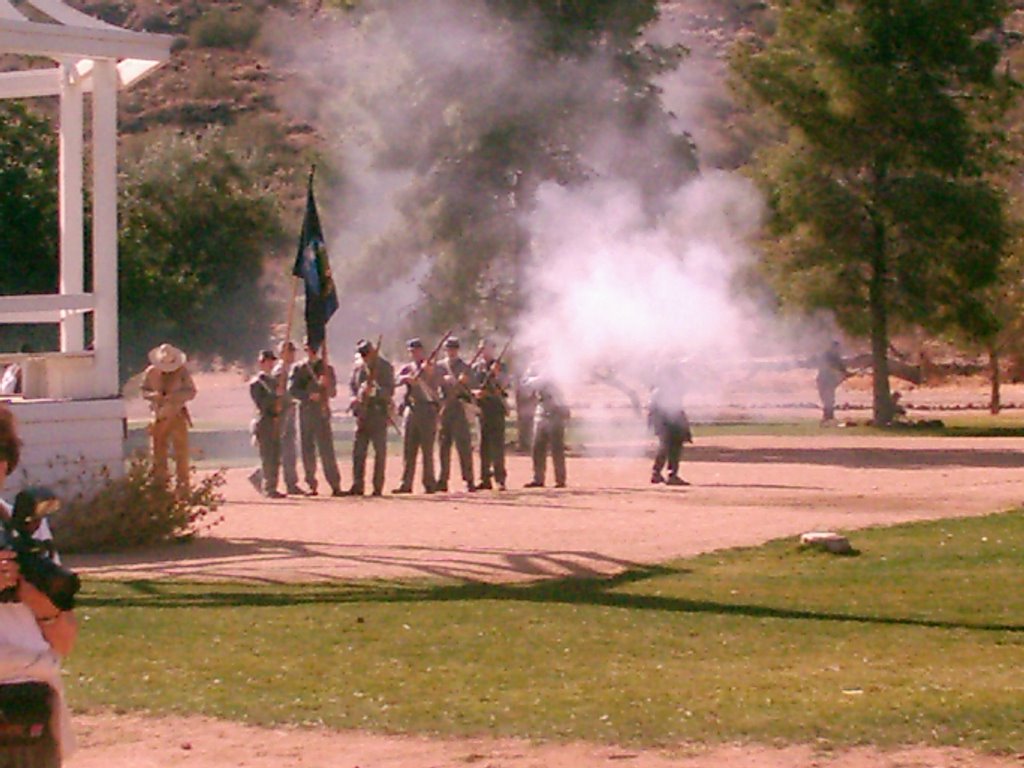
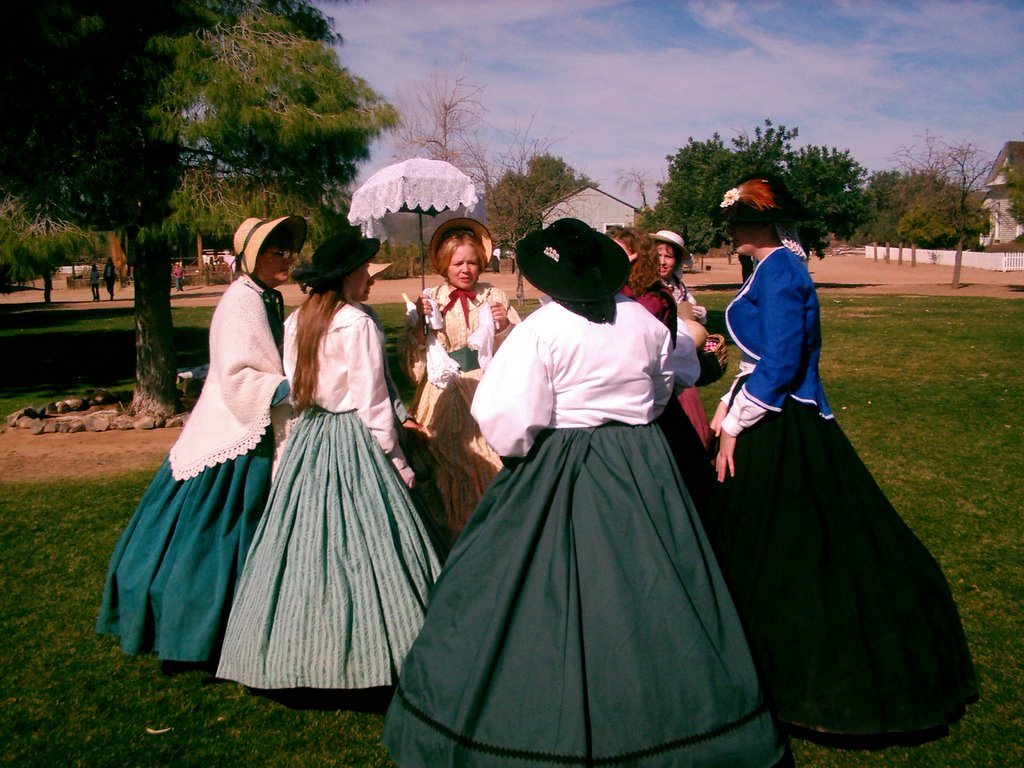
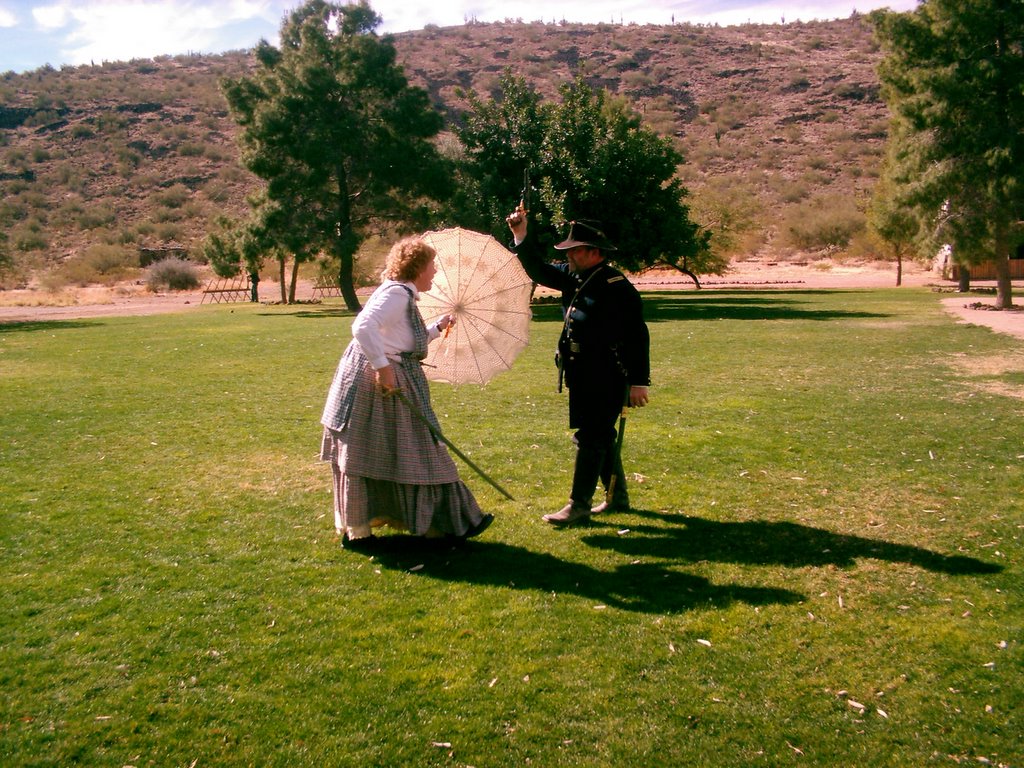
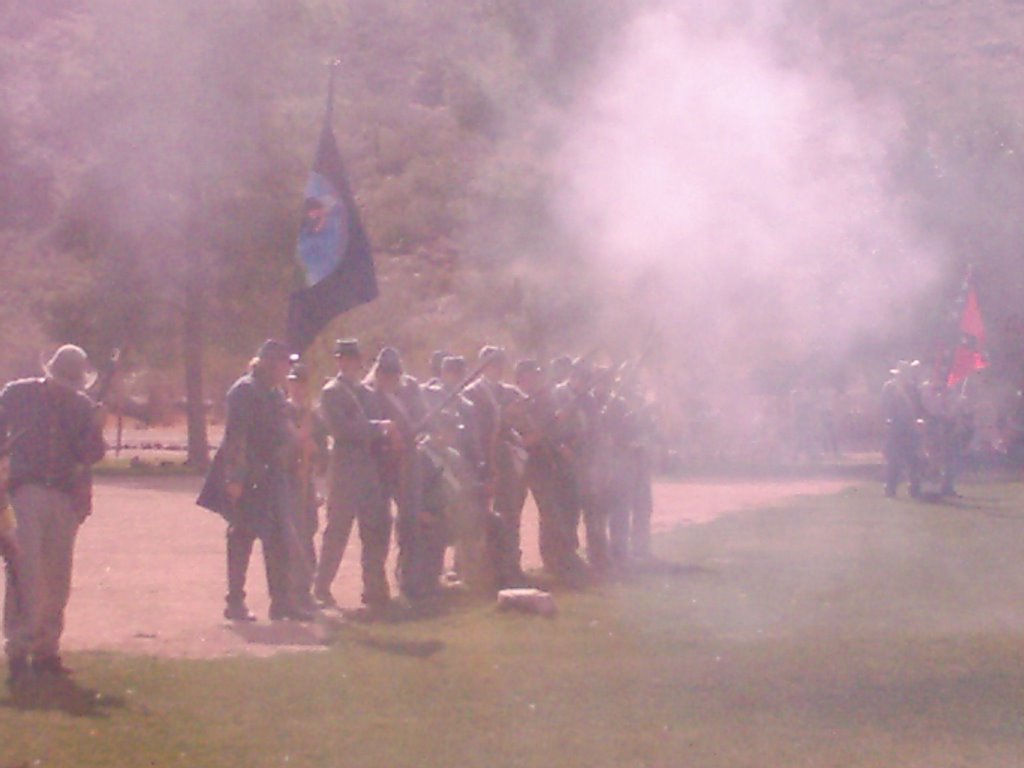
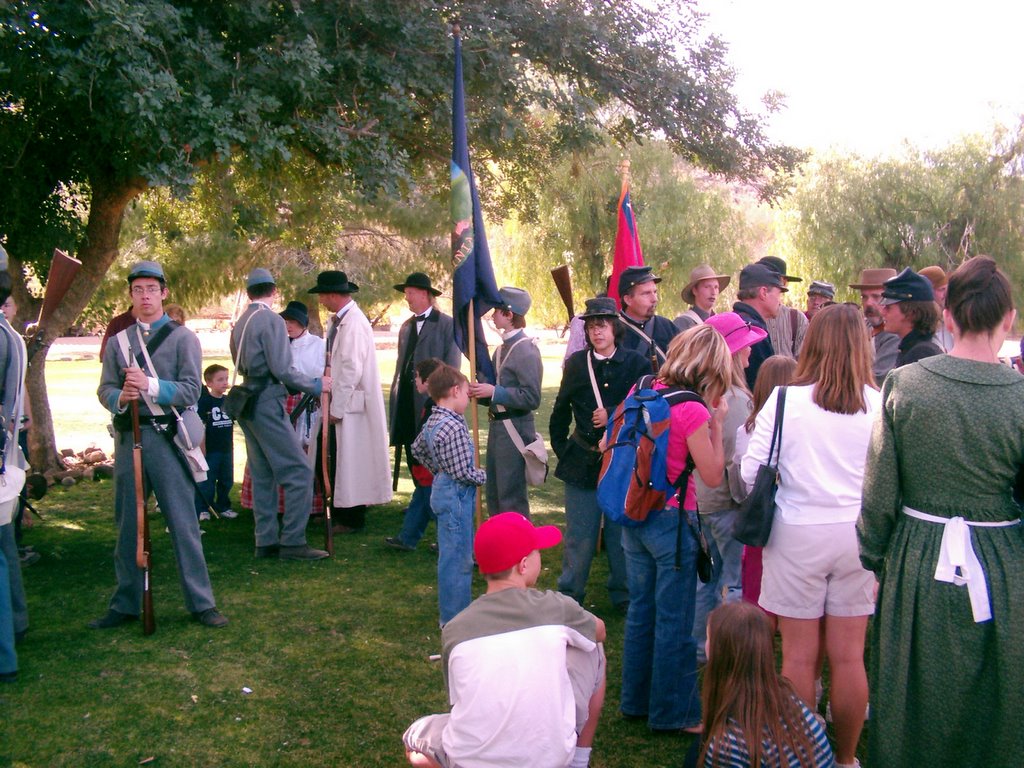
Pioneer Village, a living history museum north of Phoenix, had morphed into town of Winchester, Virginia during the Civil War. The town of loyal, Confederate Virginians was in the sights of Union soldiers. And numerous civilians, myself among them, were about to see a dramatic slice of life during wartime as portrayed by members of We Make History and various re-enactors and actors portraying the Blue and the Grey.

Morning drifted towards afternoon with uncertainty and a sense of trouble ahead. Confederate troops lined up early that morning to hear the yanks were on the move, headed in this direction.

I wandered about the various parts of the town: the Victorian house, the bank, the print shop, the church, the schoolhouse, soaking up history. During this time, the Confederate commander wandered over.

The person, I had met before at a certain ball. His character, I had not.

Yet he seemed to know me and I introduced myself again as before.

“Christopher Francis of Tucson,” I said.

We chatted for a bit, in character, as Captain Scott thanked me for making the journey and introduced me to a member of the 1st Virginia. Without much effort, my voice lapsed into a southern drawl.

“I hear there might be trouble,” I commented, still in something resembling character.

Yes, there was. Capt. Scott was well aware of the movement of the Union forces. “But I am confident we shall hold this town,” he said, unwavering in his convictions.

“Are you here buying or selling on Market Day?” the member of the battalion asked.

“Both,” I said. “Buy here, sell there. I go both ways.”

Our talk turned to the weather and I remarked how warm it was, with the temperature headed towards the 80’s and how winter seemed so unreasonably mild.

“I swear we haven’t even seen any snow on Mt. Lemmon,” I said.

“Mt. Lemmon?” Capt. Scott replied.

Ugggghhh. I’d blown it. That part of my brain still wired to Tucson had cracked out of turn and I’d thrown him for a loop. But a member of his battalion stepped in to make the save, suggesting I was talking about a mountain in Virginia.

“I’m a little geographically challenged right now,” I said sheepishly.

But Capt. Scott took it in stride, asking how the men at Virginia Military Institute were. I didn’t know the answer, but I made up the best one I could.

“They’re doin’ just fine. They’re off and out there,” I said, perhaps trying to draw a parallel in my mind to the reporting staff I supervise.

At eleven in the morning, the rumors proved true. A Confederate lookout ran back into town. “They’re coming!”

A nervous townswoman or two ran to the commander, begging them to hold off the Yankees. Consoled, all they could do was wait.

“Citizens of Winchester,” Capt. Scott announced, “there’s gonna be a fight. I’m sorry this is happening on Market Day, but we need everyone to get to the side of the building here.”

Minutes later, the Union soldiers moved in. Volleys of shots sprayed across the green of the town square, punctuated by cannon fire. When the gun smoke lifted, one Confederate soldier lay dead and two others wounded. The others had retreated. Those Yankees had won this round.


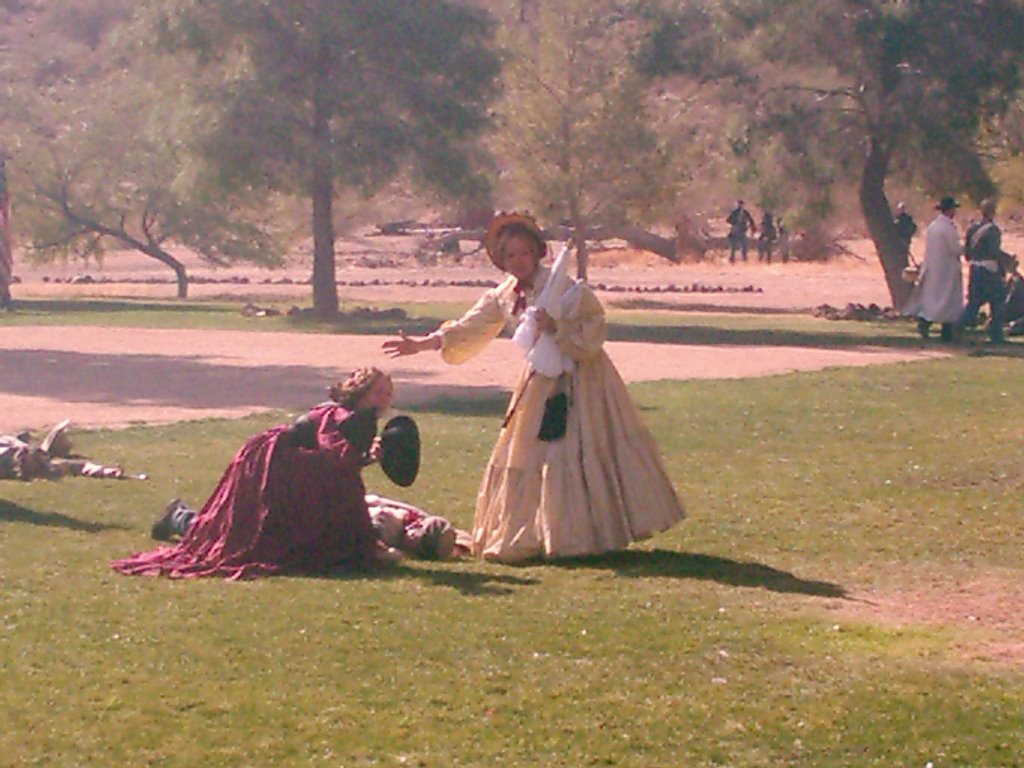
Women and girls in hoopskirts huddled over the casualties as a few stray shots rang out in the distance.


“We must remain strong! We are Virginia women!”

As medics carried the injured off to the medical triage, the ladies of Winchester took their outrage to the Union soldiers.

“Yankee scum!”

“How dare you invade our peaceful town!”

A particularly cunning lady snatched a Union officer’s sword and waved it at him, itching for a fight. He dispatched her with a pistol shot.


“You have no right to call yourself a gentleman!” a woman spat.

“I never called myself a gentleman,” the commander replied, seizing her and laying on a forced sloppy kiss.

The crowds of modern-day townsfolk were choosing a side now. No longer neutral, scattered children and adults took great pleasure in shouting “Yankee scum!” over and over.

“Who said that? Bring him here!” the Union commanders would shout, often in vain.

Back at the triage, more shots rang out. Someone had wounded a Union officer as he argued with a lady, injecting a ray of light into the mournful countenances of the Winchester women.


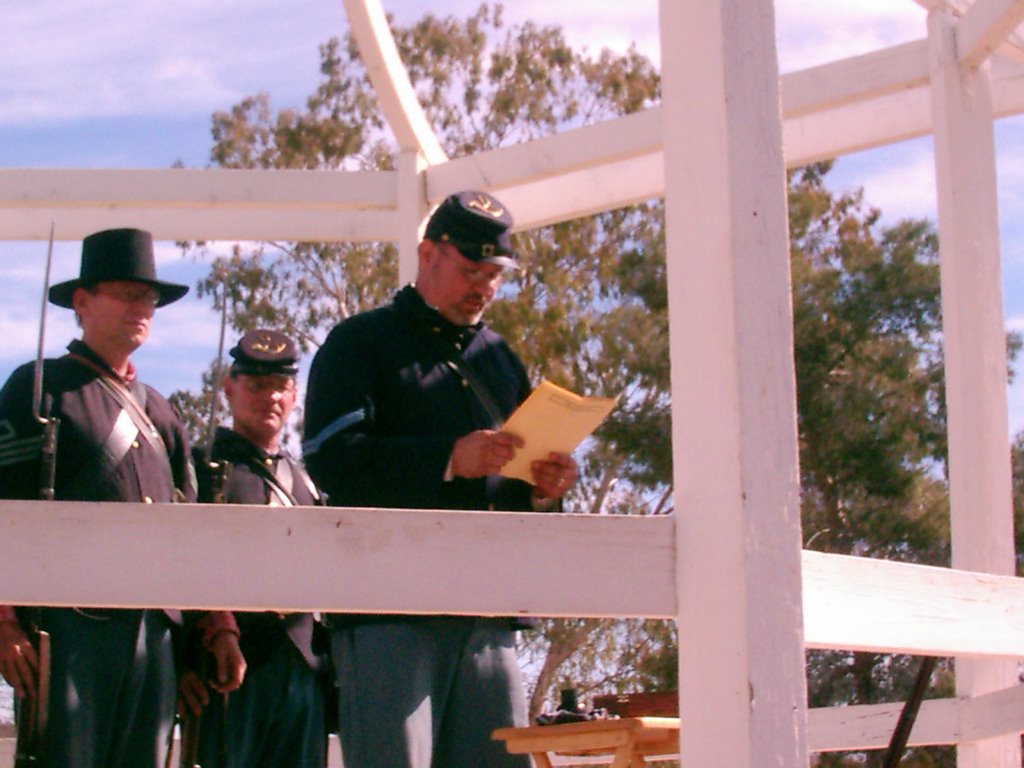
Half an hour later, a Union commander of Irish stock gathered the townsfolk around the veranda in the center of town.

“Martial law is now in effect!”

The crowd booed.

The Union troops would take money, livestock, and whatever else they needed under authority of President Abraham Lincoln.

Hearing his name left the newly-minted Confederate sympathizers in a quandary. Though hating the troops, they still loved the president. Nobody booed.

“We have our own president!” ladies protested.

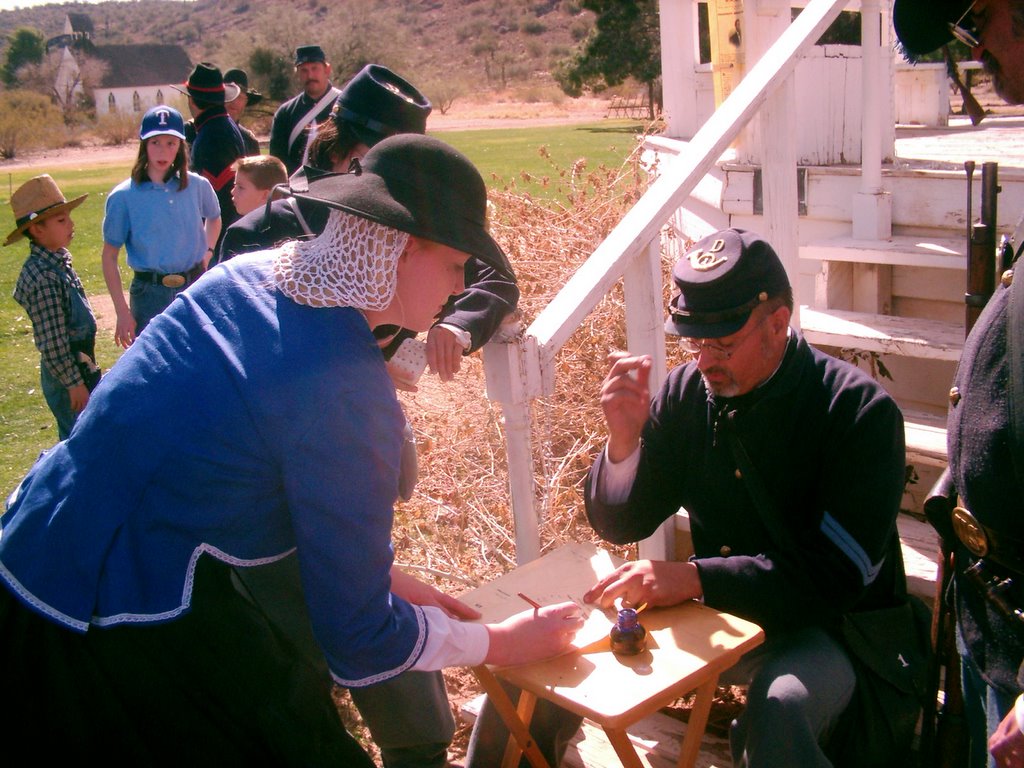
The next order of business: a census. All the townspeople -- mainly the ladies for the purpose of this historic exercise -- were to sign a roll. And sign they did, all stating the name of “Sarah Lee.”

The act of defiance frustrated the Union official, so much that he declared the next person to state that name would be taken around back and shot.

“But sir,” one soldier pointed out. “If we shoot these ladies we won’t have enough ammunition left.”

A battle of bullets had progressed into a war of wits. Those filthy, wretched Yankees could take the town, but not the hearts and minds.

The siege grew fiercer.

Union soldiers went door to door taking silverware and whatever else they wanted.

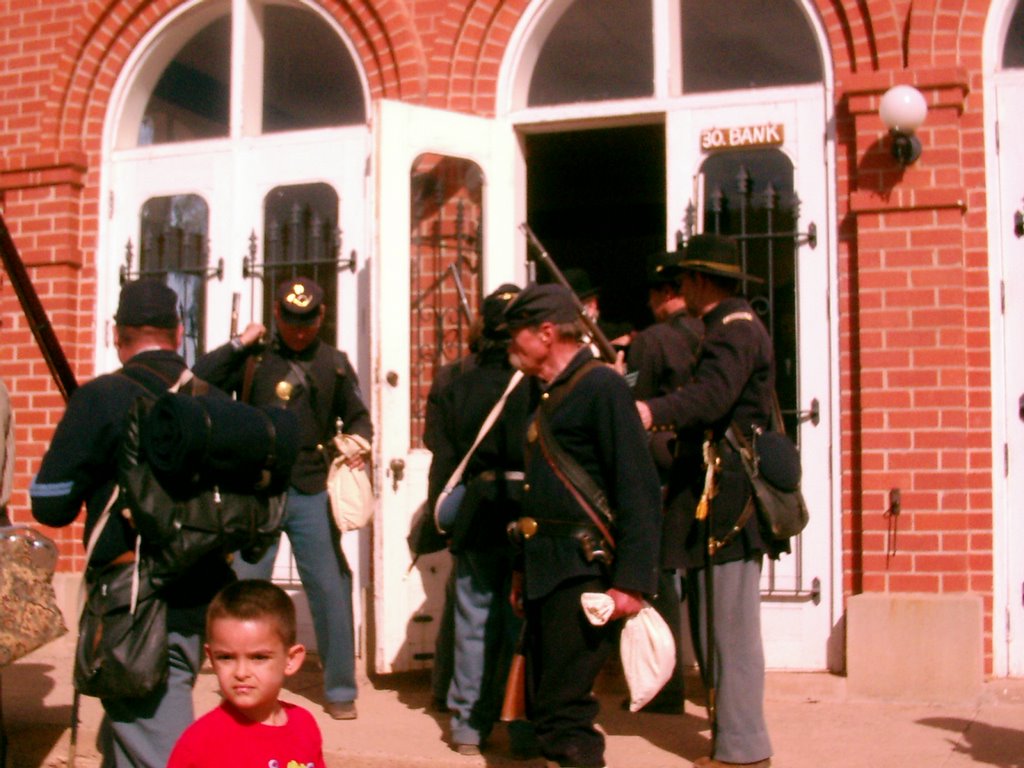
A raid on the bank made their payroll, as they sent the banker to jail with a loud skirmish reminiscent of the Wild West.


The mayor of Winchester narrowly prevented a hanging with his pleas for justice for an accused man.

I found myself confronted by a Union soldier demanding to see inside my backpack as I wandered in a direction he didn’t like. All I could focus on was the sharp point of his bayonet as I fumbled with the zipper.

And the taunting continued, as a group of ladies picnicking under a tree sang “The Bonny Blue Flag” within earshot of the enemy.

Three hours after the occupation had begun, help arrived. Stonewall Jackson’s men came in, and with more volleys, smoke and fire, the rebels reclaimed the town.


“Hip hip, huzzah! Hip hip, huzzah! Hip hip, huzzah!”

The spectacle wound down beneath the shade of a tree in the town square, as Capt. Scott called the spectators together with the Union and Confederate Armies filing back in.

“We have compressed about two months of history into a few hours,” he explained with an invitation to meet and ask questions of the various re-enactors. The kids went first, asking about gunpowder. But I still stood in admiration, at a loss for a question.

However, I had one for a lady of Winchester.

“That bit where you all signed in as Sarah Lee. I gather that was an act of defiance. Did it actually happen like that?”

Actually, it was improvised on the spot, she explained. And everybody went with it.

For all the planning, studying, and broad outlining, the magic had come through again. They had become their characters both in words and spirit.

“You do so well at what you do,” I said. “I just find it absolutely amazing.”

My comments heartened her. She was still learning and was glad to hear I enjoyed it so much.

And once again, I prepared for the long trip back across the Shenandoah… back to southern Virginia… southern Arizona… wherever Mt. Lemmon was, anyway.

Wednesday, February 1, 2006

Your Remote, Your Voice

I've been meaning to talk about the speech Aaron Brown gave a little while back on the decline of quality news. But Jeff Jarvis beat me to it, and he gives a better refutation of it than my humble words could muster. The Bottom Line: quality news isn't dying. Audiences are merely getting quality news elsewhere, and televison heavyweights are miffed because it isn't from them.