Tuesday, October 11, 2011

GOD Created Jobs

Steve Jobs was a Buddhist, not a Christan, but GOD made him. GOD uses people even if they don't know HE'S using them, and HE'LL use non-believers, too. HE used a lady of the night to help Joshua fight the Battle of Jerico (Joshua 2), so why not Steve Jobs to help us deal with technology?

In a commencement speech in 2005, Jobs reflected on mortality in a very secular, technological manner:
"No one wants to die, even people who want to go to Heaven don't want to die to get there, and yet, death is the destination we all share. No one has ever escaped it. And that is as it should be, because death is very likely the single best invention of life. It's life's change agent; it clears out the old to make way for the new. Right now, the new is you. But someday, not too long from now, you will gradually become the old and be cleared away. Sorry to be so dramatic, but it's quite true. Your time is limited, so don't waste it living someone else's life. Don't be trapped by dogma, which is living with the results of other people's thinking. Don't let the noise of others' opinions drown out your own inner voice, heart and intuition. They somehow already know what you truly want to become. Everything else is secondary."
To him, it's like a continuous computer upgrade cycle, one where everyone is going to be obsolete like the old Apple II's he co-created, replaced by something new. Jobs doesn't tells us the new will be better; it will just be new.

So he tells us to be ourselves and listen to ourselves, to that "inner voice, heart and intuition. They somehow already know what you truly want to become." I gather he wasn't thinking of the HOLY SPIRIT, but that's what he's getting at. GOD equips each of us with a purpose and compass. But so much depends on us listening to HIM and using HIS compass, rather than letting the rest of the world kick us around.

The "dogma" that Jobs talks about can come from the world, especially politics. It can also come from churches. Dogma isn't harmful by definition, but it becomes that way when we start believing it without understanding why we believe it, or become enslaved to it so that we're unwilling to ditch what's not working.

We have two major political parties that are enslaved to dogma right now. We also have, unfortunately, a number of churches that are doing the same thing by treating man-made extensions to GOD'S WORD as gospel. The Bible warns us several times not to do this:

Deuteronomy 4:2 (NIV) -- "Do not add to what I command you and do not subtract from it, but keep the commands of the LORD your GOD that I give you."

Proverbs 30:5-6 (NIV) -- "Every word of God is flawless; he is a shield to those who take refuge in him. Do not add to his words, or he will rebuke you and prove you a liar."

And my favorite, 2 Timothy 2:15 (NIV) -- "Do your best to present yourself to GOD as one approved, a worker who does not need to be ashamed and who correctly handles the word of truth."

But people still add to GOD'S WORD. Maybe it's because they want to be set themselves above other Christians. Maybe it's because they don't think they're Christian enough. Maybe they have a hard time believing in GOD'S grace, and they're trying to earn their way into Heaven, aided and abetted by some denominations' belief systems. The truth is, nobody's good enough. We still need JESUS.

I read on Ed Stezer's blog that Jobs was baptized as a Christian, and he later converted to Buddhism. Steve Jobs would've made a better Christian than a Buddhist. We don't know if Steve Jobs came back to GOD in his final hours, but I wonder if he ever thought about who was really guiding him. It wasn't Buddha.

Friday, September 23, 2011

No, You Won't Be Needing The Insecticide

A favourite of many English dancers who love Pride And Prejudice is this dance from the ball scene with Mr. Darcy: Mr. Beveridge's Maggot. It's a little too advanced for newcomers, which is why you won't see it at the Pride And Prejudice Ball, but it's beautiful to watch.

By the way, the term "maggot" refers to an idea, not a gross worm. Long long ago, people thought creativity came from creatures in the brain, and not just figments of our imagination.


HUZZAH to the lad in the kilt!

A variation of this dance was also popular during the Colonial period...


...as well as the Renaissance:


And here's a slightly slower version:


Finally, your humble servant gives it a try. I'm the lad in the blue outfit, dancing at the Jane Austen Evening last January in Pasadena:


Dance On!

Thursday, September 22, 2011

Miss Austen Would Love It

Every year in Bath, England, a recreation of a Regency-era ball takes place, in full period costume and merriment. Of course, you don't have to go all the way to England -- just come to the Pride And Prejudice Ball this Saturday!

Wednesday, September 21, 2011

Your Mother Should Know (If She Lived During The Regency)

"Let's all get up and dance to a song
That was a hit before your mother was born."

--The Beatles

As I pointed out earlier, many dances popular in the Regency era go back at least 100 years earlier, although I've seen one dancing expert argue to the contrary. Why would people want to groove to their grandmother's tunes? Isn't that like doing the twist at the disco? Well, even disco came back. Why not old English Dances?

So let's set the WABAC machine for the 1600's and watch the Newcastle Country Dancers perform their namesake dance: "Newcastle."


Now, here's how it would have looked like during Jane Austen's time:


By the way, the Newcastle dancers also perform a lively version of "Argeers."

Tuesday, September 20, 2011

You Can't Dance If Your Nose Is Up In The Air

I offer you another Regency-era dance in celebration and anticipation of the Pride And Prejudice Ball. This one is called "The Physical Snob." I have no idea how it got that name, but what makes it interesting is all the weaving the dancers do amongst themselves:

Monday, September 19, 2011

But It's Almost Fall!

My Most Honourable Dancing Friends, never mind what the calendar says. It's almost time for the Pride & Prejudice Ball, which means your humble servant shall be offering a week-long sample of period dances for your diversion and enjoyment.

Here's a dance from the Leicestershire Victorian Dancers' Regency ball, "Upon A Summer's Day," which happens to feature some fine period military attire:


You might be surprised to know many Regency dances were also popular during the Renaissance. Here's the same dance performed a little earlier in time:


Set, turn single, and join us again tomorrow...

Sunday, September 4, 2011

Reel To Reel: The Debt

Payback is a... well, you know what.

Going Rate: Worth matinee price
Starring: Helen Mirren, Tom Wilkinson
Rated: R
Red Flags: Bloody violence, sexual situations, a throwaway sex scene in a newspaper office

The Debt is an espionage-action film that drags more than thrills and nearly forgets its marquee star. It spends too much time leading up to something we likely will figure out before the end of the first two reels and wastes too much time waddling around details of a mission that's either marginally successful or stuck in neutral.

Mirren plays Rachel Singer, a retired Israeli Mossad agent who has been glorified with her two colleagues for capturing and killing a Nazi war criminal working as a doctor in 1960's East Berlin. That has been the official line for three decades, and it's also the one coming out in a book written by her daughter. We know right away that's not really the truth, but it takes about an hour or so for our suspicious to be confirmed. The film flashes back to Singer's younger self as a rookie agent teamed up with Stephan (Marton Csokas) and David (Sam Worthington) in a ratty apartment. They practice their martial arts training and occasionally some piano, eating rotten food while awaiting orders from Tel Aviv.

The agents get the green light, capture the notorious Dr. Vogel (Jesper Christensen), and pack him up for shipment back to Israel only to see the plan go sideways. They are left with a cantankerous old Nazi in their apartment and no way to get rid of him, except by killing him. However, killing is off the table because the idea of Israeli justice for Nazis is to make them stand trial, not hunt them down and exterminate them as Hitler's gang did to six million Jews.

Moral dilemmas really mess up good covert work, and the film has no problem demonstrating this as it transitions from action thriller to psychological thriller. But this is where the film drags. This is where I wanted to get to Helen Mirren's wrinkled, scarred self and see how the woman who played Queen Elizabeth II a few years ago cleans things up. She does, sort of, in a way that's more exploitative and shocking than satisfying. I heard one woman say on her way out of the theater, "Just another carefree romp on a Saturday afternoon." Of course she was exaggerating, but not by much.

The Debt is a remake of a 1997 Israeli film which I have not seen, so I can't tell you whether Hollywood jiggered with the pieces. I can tell you it would have benefited from some more cuts here and there, and not to Helen Mirren's face.

Monday, August 29, 2011

And Now, The Next Windstorm...

Coming home from work this evening, I heard Jeffrey Kuhner of The Washington Times -- filling in for Michael Savage -- rip into "the media" for its Hurricane Irene coverage, griping about how it turned out to be tropical storm instead of a hurricane. And it gets better: he then accuses "the media" of overhyping the storm to "prop up" President Obama. Somehow, I knew the president was going to get blamed here.

And, no surprise, Rush Limbaugh gets his word in, calling it a "national embarrassment:"
It was a rainstorm and there was a lot of flooding and there were deaths associated with it, but the hype, folks, I'll tell you what this was. It was a lesson, if you pay any attention to this, the hype, the desire for chaos, I mean literally, the media desire for chaos was a great learning tool, this was a great illustration of how all of the rest of the media in news, in sports, has templates and narratives and exaggerates beyond reality, creating fear so as to create interest.
And yes, you guessed it, he finds a way to chide the president:
The media, the government are out there peddling fear when facts and calm would make for much better investments and would result in much more credibility for these people reporting this stuff. I'm gonna tell you something, Hurricane Obama -- whatever Irene's gonna cost us, it pales in comparison to the hurricane of the Obama administration.
As Nikki Finke would say, "Oh barf."

Elected officials, emergency workers and evacuees will tell you the same thing when a hurricane is barreling down on their communities. You hope and pray for the best, but you prepare for the worst. As I write this, cities in Vermont, Massachusetts, and New Jersey are all dealing with massive flooding. More than 30 people have lost their lives, and that number could go higher. Imagine the death toll had the media listened to talk radio and told us to shrug off the storm.

Meteorology is not an exact science, even though our forecasting and computer models are better than they were three decades ago. The people at the National Hurricane Center freely admit this. That's why the "forecast cone," as it's called, stretches for hundreds of miles on either side of a hurricane's predicted path. All weekend long, the NHC repeatedly warned us not to take this storm lightly. A Category 1 Hurricane and a strong tropical storm aren't that much different, and they're both destructive. Let us also remember these kinds of systems rarely hit so far north. A lot of folks aren't used to preparing for them. They need to know what's coming.

People also confuse the concept of "Continuing Coverage" with hype. Media outlets provide this kind of coverage on major events simply because a large number of people want to know just what in tarnation is going on now, not at the top and bottom of the hour. If your network doesn't provide it, somebody else will, or viewers will go to the Internet and get it there. Even in national emergencies, news is still competitive.

Consider this: Would you rather be in a relief shelter or a pine box? Would you rather be griping about your loused-up weekend at the beach or swept away by the tide? In life-or-death situations, I would rather be over-warned than under-prepared. I would be grateful that my house was still standing than shocked because nobody told me it could be blown away.

Talk radio show hosts never miss a chance to blame the media for everything they can because that is what brings in the ears and the ad dollars. Far be it from them to ever be thankful that the storm wasn't as bad as feared... or thank GOD that it wasn't. Irene weakening from a major hurricane to a tropical storm before it hit New York City isn't the fault of forecasters or media or hype. I prefer to see it as proof that GOD answers prayers and is watching over us in the middle of a spiritual battle. My words to the media haters out there ironically echo the words of Darth Vader: "I find your lack of faith disturbing."

How about this: let's just give all the talk show hosts and partisan gawkers their own conservative weather channel. They can gab for hours about how the media and the NHC is getting it wrong and how every major tropical system is overhyped by "the media" and the forecasters -- who all believe in bogus global climate change anyway -- and how we shouldn't change our plans or evacuate because it's just gonna be a really long rainstorm.

And oh yeah, it's all President Obama's fault.

Sunday, August 28, 2011

Snapshots From The Highlands

Featuring the photos of Mr. M. Cynecki

And now, some photographic memories from this year's Highland Ball, presented as always by We Make History. I've written so many words on so many balls that I think I'll just let the pictures do most of the talking.

Madame Noire with her Highland bodyguard... and dancing partner.

A duel? No, just two gentlemen united in the Cause.

Escorting Madame in the Grand Promenade. We could march all the way to London, even if the Bonnie Prince couldn't.

This is what it looks like when I approach a lass and ask for a dance.

The start of the jigging contest, or in my case, the Highland Fling contest. We started in a circle...


...and then broke free.


I have to have stamina to survive, even though my spirit is limitless.

Oh how I flung. But the prize belonged to the lasses this night...

...in a showdown between neighboring clans.


Careful with those high kicks, most honourable lass! I speak from experience.


For more recollections of the evening, see the official Highland Ball page.

Friday, August 19, 2011

Fling It!

I can't finish this weeklong Highland Ball tribute without paying homage to that most famous of Scottish dances, the Highland Fling.

Here is the traditional caper from the Dunedin Dancers:


Now, a modern interpretation from some creative Lasses who mashed it up with Queen and Survivor:


And here's some children trying it:


That's probably the closest to my version of the fling, which I shall attempt once more -- and preferably more than once -- tomorrow night!

Dance On, Lads and and Lasses!

Thursday, August 18, 2011

Those Eastern Scots Are An Especially Happy Lot, Aye?

Somewhere in Eastern Europe, here you see some Scots and not-so-Scots enjoying one of my favourite Scottish dances, the "Gay Gordons."


Here's another version of it from a wedding:


Some of you know it better as the "Carolina Twirl" after it got to the states and got changed a bit:


Naturally, I'm hoping to dance this at the Highland Ball.

Wednesday, August 17, 2011

It's All Fun And Games Until Somebody Steps On The Sword

As I continue our dance countdown to the Highland Ball, the legend of the Sword Dance is that you can show off as much as you want, but if you step on the sword, you will die on the battlefield.

This young Highlander has no problem with facing death:


That's hard enough when you're doing it solo, but imagine having dancing with three other brave Scots, like the Gordon Highlanders in this clip from the movie Waterloo:

Tuesday, August 16, 2011

Dancing In The Streets

The Highland Ball is one of my favourite balls, not just because of the colourful kilts, but also because we dance it in a beautiful ballroom on the Northern Arizona University campus.

But you don't always need a ballroom, or even lights, as this group demonstrates.

According to the YouTube description:
Aurora Scottish Dance and Music hold an impromptu late night ceilidh on the main road through the village of Imbsheim in the Alsace region of France after the formal part of the International Folk Dance Festival had finished on 24th August 2011. In addition to audience and performers from the festival, the Mayor of Imbsheim also joined in with the dancing.

Monday, August 15, 2011

You Don't Need To Light Anything

The Fourth of July is so last month, but the Scots have a dance for it: the Firecracker Reel.

I'm not sure how it got that name, and Google doesn't provide any answers. Maybe you can?

In the meantime, enjoy it from Plateau Scottish Dancers:


Sunday, August 14, 2011

Chase That Goose

Dearest Dancing Friends, can it be true? The Highland Ball is nearly here! And as is tradition, your humble dancing servant is devoting a week to Scottish capering.

First up, a lively dance from the Dunedin Dancers of Edinburgh (which is pronounced "Ed-in-burro," not "Ed-in-burg," like the city in the Rio Grande Valley of Texas). While I'm used to chasing squirrels in my dancing days, these folks are on a "Wild Goose Chase."


Next, the "Diamond Jublilee:"


And finally, a popular one, the "Reel of the 51st:"


You have to love that great circle at the end -- keeping in time on a slipping step is not easy. Been there. Danced that.

Monday, August 8, 2011

Reel To Reel: Rise Of The Planet Of The Apes

Monkey see, monkey do.

Going Rate: Worth full price admission
Starring: Andy Serkis (motion-capture), James Franco, John Lithgow
Rated: PG-13
Red Flags: Intense action sequences, mild profanity

No apes were harmed in the making of this picture. In fact, no apes were used in the making of this picture, which alone makes Rise Of The Planet Of The Apes a landmark achievement. You will hear this film compared to Avatar, and that is not a stretch. Motion-capture CGI is now at the level where human actors can be seamlessly replaced by monkeys in an ironic form of reverse evolution theory.

But actors still gotta act, and that's where Rise rises. Its primate stars are nuanced, sympathetic characters, not one-dimensional dirty apes, and nowhere is that more clear than in the performance of Andy Sirkis as Ceasar, a chimp saved from death who grows into the leader of a revolution. As Gollum in the Lord Of The Rings trilogy, he's already familiar with seeing other faces pasted over his own, but it's still his expressions and characterization that comes through.

Ceasar is the house pet and test subject of scientist Will Rodman (Franco), who's working on a cure for Alzheimer's Disease. Rodman has developed a virus that not only halts the illness but also regenerates brain tissue. His research nearly collapses when a test chimp gets out of control, but Rodman is relentless because he has another objective: saving the life of his Alzheimer's-afflicted father (Lithgow).

Rodman watches Cesar develop into super-chimp, smart and getting smarter, and it encourages him to try the experimental drug on his father. Dad comes out of his disease like he's awakened from a nightmare, and Ceasar happily swings through the trees. All would be well if it weren't for nature taking its course and both the chimp and the treatment getting out of hand.

Rise is unmistakeably a parable about tampering with the workings of the brain, but its real target is our heart as we watch Ceasar struggle with his feelings. Is he a pet or a really hairy person? Is he a normal chimp or something else? Ceasar can communicate with signs, but it's his eyes that do most of the talking. If Andy Serkis doesn't get some kind of award nomination for his mastery of expressions, I'll be tempted to beat my chest like King Kong. Oh yes, there's a gorilla in this picture, along with a circus orangutan, and Cesar talks to the latter like Tarzan when it's subtitled for us. I wonder if the filmmakers intended that allusion or if it's just a nifty coincidence.

Rise Of The Planet Of The Apes deserves a sequel not just because it's a good picture. It's a good picture that actually left me wanting more, instead of being just another shallow summer blockbuster. Right now this film is exceeding expectations at the cash register, and that's always a promising sign, not that Hollywood needs one to sequelize anything.

Hearts Of Heroes

My only desire for the evening was that I might honor a lady with a dance, but GOD had other plans.

“Every time I come here I'm wearing a tricorn,” I tell my other Sons of the American Revolution compatriots as we approached the entrance to the Desert Diamond Casino. I was referring to previous judging stints on Lucky Break, an anachronistic and offbeat but appreciated touch.

Tonight nobody will question of our Continental Army uniforms as we gather for the annual Purple Heart Ball. Our usual color-guard duties are assigned to a military unit, but our hosts want us to add historic color to the event. General George Washington, after all, created the honor.

The event sold out well in advance, so I know we'll have a great turnout. A military band plays smooth jazz to a front room filling up with people mingling and seeking the bar. The commander in charge summons us over for a run-through of what we're supposed to do during the presentation of the colors.

Every event is unique in its layout and staging. We have no one set way to carry in the flags and post them, so the standard for the standards morphs to the needs of the occasion. When we carry no flags at all, the process takes on a new wrinkle. This evening's plan calls for us to march in after the flags for the various armed forces and post ourselves on either side of the stage. Three of us will stand on one side of the stage without guns. Another compatriot and your humble servant will stand on the other side, with guns, ready to salute with our arms – a “present arms” – at the proper time when the color guard marches in with the national and state flags. The National Anthem will follow, then an invocation, and then we march out in reverse of the way we entered the room.

“Salute with your flat hands?” a compatriot asks.

“Yes.”

The palm is facing outward, European style, instead of perpendicular to the forehead. That is certain.

The rest of plan is clouded in uncertainty as I hear it, especially in the din of the music. I'd like to walk through it at least once to visualize where I should stand, where I should look, what I should do. At least a hundred pairs of eyes are going to be on us, and I have only one shot at it. The real Continental Soldier would know what to do. My re-enacted persona can only get as close as possible and try not to blow it.

Another detail has yet to be determined: do we take our tricorns off during the Invocation?

“They're leaving their hats on,” someone says, referring to the color guard.

“Then we leave them on.”

I'm not comfortable with it. I put GOD first, and that means uncovering during prayer in respect. If some people uncover and others don't, it's not a uniform standard, and any ceremonial maneuver requires uniformity. I think of everybody else who will be uncovering, though, and that should include us. We need a definite answer, and our fearless leader sets out to get one.

For now, we'll go on with the other part of our mission: greeting the guests and interacting with them, the Purple Heart honorees. They flow in wearing suits or dress uniforms, or suits with their VFW-style hats. I spot a Marine decorated with three rows of medals. Sailors in pressed whites help escort a few old soldiers to their tables. Ladies in their cocktail dresses amass and chatter. I offer more than a few courtly bows to them as they pass by, and my compatriots soon imitate the gesture.

“They always like it, even if you don't do it exactly right,” one fellow Continental notes.

Cell-phone cameras emerge from purses and shoot off photos of us standing at attention with our muskets shouldered next to admiring guests, images soon to work their way onto Facebook. I spot a lady in a ball gown tantalizingly close to an 18th Century polonaise, and for three seconds I am back in 1776.

I approach a couple admiring the silent auction table. “Good evening, Good Sir!” I greet with a slight British accent. I bow to his wife. “Good evening, My Lady! So glad to see you here tonight.”

“I love your uniform!” the wife returns.

“You are well-dressed yourselves,” I return.

“Are you here to protect us?”

“Against a few redcoats or rogue Hessians.”

“Hello, Christopher,” sounds a voice behind me.

I turn to see Mike, Coach Mike, one of the guys I sit across from every Friday morning at Prayer Breakfast. He's wearing a Purple Heart ribbon. Neither of us knew the other would be here.

“Hello!” I greet, stunned. “I bet you've never seen me like this!”

“I've seen the hat,” he replied.

I quickly run into a few other guys from the Friday morning breakfast club, people I knew but didn't know like this, not in connection to the military – and their wives, whom I bow to.

We still don't know if we're supposed to uncover or not for the Invocation. Another compatriot goes to get an answer from somebody else. Meanwhile, it becomes clear we're not going to get a walk-through. I'm nervous.

“We'll make this work,” I say to the others and to myself.

Minutes before the start of the event, we finally get our answer: yes, we'll uncover.

The first members of the military march in and we follow. A fellow compatriot softly coaches me on how to shoulder the musket for consistency. I follow the others to the center of the room, where we're supposed to split and take the sides of the stage, only I won't know where to split until the others split first, so I must be ready to turn on a dime. Ceremonial marching requires both precision and style. Turning a corner means halting and snapping to a new direction instead of turning while walking. I snap-turn at least three times until I reach the desired position. It looks good. All is well.

The color guard from Davis-Monthan Air Force Base marches in with tight precision.
“Present arms,” my fellow compatriot whispers. I'm glad somebody's calling orders, because nobody else is. I'm trained to take commands, not anticipate or give them.

The National Anthem brings all to their feet and my musket out in front of me, held high and parallel, dividing my face in half.

Another whisper from my compatriot, and he nudges me to the steps of the stage, where we take our positions for the Invocation. There's no set-up before the prayer, so I hastily uncover and give Thanks. The march-out proceeds according to plan, and relief washes over me. It's time to eat.

Our hosts are spreading us out so we can mingle with as many tables as possible. I end up at Table 8, a sparsely-populated location in a corner of the banquet hall. A gentleman and a couple are already there sipping iced tea. I bow and greet and take my place, removing my tricorn as per protocol. Moments later, a group of four sailors joins us. Another sailor at a table next to us sees us, and I displace myself to make room for all of them to sit together.

I find out that sailor is a naturalized American citizen from Panama.

“I studied your history for my tests,” he says in his accented English. “It is very interesting, the battles.”

I wager he knows more military history than I can get my hands around.

“You've probably heard of the Battle of Cowpens,” I say. “It's the one where the militia draws the British in, and the Continentals are over the hill waiting for them. It's in the movie The Patriot.”

He probably knows – he just can't remember it.

On my right side is a woman with a soldier son. She wears a button with his picture, and I know what it could mean.

“Where is he serving?” I ask.

“Afghanistan,” she replies. She tells me his journey from student to combat duty, passing up a baseball scholarship for the sandbox before his death at the hands of a makeshift bomb, or “IED” as they call it officially.

“We were invited here,” she says, telling how she has been trying to honor his memory.

“We honor by doing,” I reassure her.

Salads come and go, followed by the steaks and regulation rubber chicken. It's good for banquet food, but that's not the point. An empty table for sits in the center of the room, in memory of those soldiers still missing. Remember, we're told.
As the feasting winds down, the emcee introduces a 14-minute clip from an upcoming documentary on Purple Heart veterans. The rest will come soon on television somewhere in Arizona. The segment begins with a mine worker who went to war and came home to fight another one for equality. But its second subject stops me cold.

Before me are photos of Coach Mike, as he goes off to Vietnam as a sharpshooter... and then comes home to an ungrateful nation. An interview clip shows him recalling the time, and the pain is all over his face. Either he doesn't need to say any more, or he doesn't want to. Instead, the narration advances to his present life on the basketball court and his feelings about a current generation who have never known the full brunt of war. To his admiration, they are still able to commit to serving in Iraq and Afghanistan, without a draft.

I never knew any of this. All I knew was a man who coached basketball and shared his struggles at the Friday morning breakfast table. I knew he hunted “the bird of peace,” as he joked. I didn't know where that aim came from. He had told me not to be afraid of reporting what really went on in the world as part of my job, as much as it might get under peoples' skins. Now I knew where the attitude came from.

I had just shared with the soldier mom how I never knew that much about Grandfather Francis' role in World War II, how he worked with the team that monitored the Enigma machine, and how much he took to the grave with him. I never really saw him as a serviceman until the day we laid him to rest with a 21-gun salute. Now, here I was learning another soldier's story – only this time, the soldier was still alive, and sitting one table next to me.

Our emcee made more presentations, going through a list of families who had lost a loved one to war. The mother next to me was on that list, receiving a purple heart memento in trible to her fallen son...

...whose first name I heard for the first time...

...and it happened to be Christopher.

Now, everything was clear. GOD wanted me at this banquet and ball, not merely for appearance or to honor others but to see and hear what I heard. GOD had two messages for me this evening. HE wanted me to remember why I put on Revolutionary War outfit, if I ever had any doubt. And HE wanted me to continue doing it. Sometimes GOD warns us, but all the time HE guides us, and if we are willing to see it, HE encourages us.

The big band Memories burst out the Glenn Miller standard “In The Mood,” and the ball portion of the evening commenced. It seemed almost out of place after such an emotionally draining prelude, but our hosts reassured us our fallen soldiers would want it that way.

“We're leaving you without adult supervision,” a fellow compatriot called to me as he left for the evening.

For the next two hours I went in search of a lady who might afford me a dance. I found no unattached fair ones, or anybody with that longing look. But that wasn't the point.

Sunday, July 31, 2011

Just A Reminder -- You Voted For These People!

Well, maybe you didn't, and it's likely you're just as disappointed and angry as I am at Congress right now. I am not about to blame you, the voters, for the debt debacle currently occupying this nation, but you get what you vote for.

What you voted for was partisanship, because you voted for people who belong to them. You voted for Democrats, Republicans and Tea Partiers. Sensible people are part of these political organizations, but rational, well-behaved statesmen and women don't hold power anymore. They're fortunate to get elected in the first place.

The priority should be country first, party second. But as I have said before, partisanship has become a false religion, one that covets power above everything and values ideological street cred above what's best for the country. I honestly believe some those creatures in Washington desire some form of a default as a nuclear option, thinking if they play their hand right, their opposition will curl up and die. It doesn't matter if the rest of us go down for the count. That's not leadership, that's arrogance, and all parties do it. Let me repeat that: all parties do it.

So once again, I say we should've listened to George Washington, who said in his farewell address:
"However [political parties] may now and then answer popular ends, they are likely in the course of time and things, to become potent engines, by which cunning, ambitious, and unprincipled men will be enabled to subvert the power of the people and to usurp for themselves the reins of government, destroying afterwards the very engines which have lifted them to unjust dominion."
What's the solution? Stop voting for anybody who's associated with a political party. Don't vote for Republicans, Democrats, Tea Partiers or Libertarians. Given how that eliminates just about everybody, I would rather write in a non-partisan candidate than vote for any partisan, at least for Congress. I would encourage you to do the same, if you're as fed up as I am. Remember, you're still voting. Do not let anybody tell you that a vote for somebody outside the two-party majority is a wasted vote.

I wish we had some better system to get more independents to run for office. Unfortunately, campaigning costs money, and the parties are tremendous fundraising machines, if nothing else. Arizona's Clean Elections system is no panacea, either, even though the state is registering a growing number of independents. A single open primary would help clean up the mess, but I don't expect it to happen.

You can do something besides vote independently, however. You can pray independently. GOD, thankfully, is not a Republican or a Democrat... or a Tea Party member. GOD is GOD. Pray that our partisans start asking for GOD's wisdom, or using what GOD already gave them (James 1:5). GOD doesn't play politics, and it's about time our politicians took the hint.

Reel To Reel: Cowboys & Aliens

Riders in the sky.

Going Rate: Worth matinee price
Starring: Daniel Craig, Harrison Ford
Rated: PG-13
Red Flags: Western violence, mild profanity, one partially naked lady

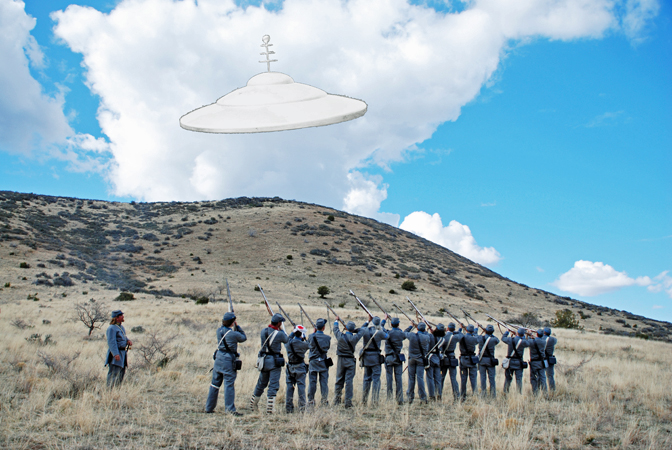
Until now, the closest mashup I've seen between the wild west and a wild visitor from outer space was that time the 1st Virginia shot down that flying saucer in Poland Junction. We should've called it Confederates And Aliens. But now the war's over, or is it? An invasion force is taking over the range in this hybrid of Alien, Independence Day, Super 8 and Unforgiven.

Lone wolf Jake Lonergan (Craig) wakes up in the middle of the New Mexico desert with a nasty wound, a mysterious bracelet on his wrist, and no memory of how either got there. He heads for the nearby town of Absolution, a dying gold-rush town run by Colonel Dolarhyde (Ford). The colonel's son is a habitual troublemaker, but he goes too far after an encounter with Lonegran. The son ends up in jail, and eventually Lonergan joins him after we find out he's a fugitive who's been robbing coaches for gold. Just when Colonel Dolarhyde comes to bust his son out of jail, Cowboys And Aliens ceases to be a conventional western. Alien spaceships fly in, blowing things up and lassoing earthlings like in that old video game Defender. Now it's up to Lonegran and Dolarhyde to find out what's happening to the town and to their people.

Craig's Lonergan will no doubt remind a lot of people of Clint Eastwood in one of Sergio Leone's movies -- the mysterious stranger with almost no name, but who can handle a gun like nobody else on the planet. So I guess it's understandable when we see how quickly he learns how to use the bracelet stuck to his wrist. Cowboys And Aliens doesn't waste time meditating on its own surrealism; it deals with trouble in the best way possible for people with saddles and six-guns. We know an armed posse poses little chance against space invaders with blasters, but the characters don't know that. To borrow from another western, they have true grit.

When I first saw the trailer for this movie, the premise looked silly, one of those awful studio ideas that make it onto film because it provides a vehicle for effects. However, Cowboys And Aliens is a well-acted adventure that straddles two genres without parodying either one. I can lay a lot of that at the feet of Ford and Craig, and director John Favreau (Iron Man) deserves some props.

Some people will roll their eyes at this film, thinking aliens have no business in 1870's America simply because science fiction or aliens as we know them hadn't been invented yet. That's two-dimensional thinking in a four-dimensional universe for a movie that's not in three-dimensions.

Sunday, July 24, 2011

It's On!

After a hot, sweaty, opening skirmish, the 2nd Virginia gets an invitation to take the lead role, and this time, your humble servant is along for the fight.

Darkness envelops the camps, pierced by a stray headlight from a vehicle delivering supplies to the moonlit tent cities. Police and security buzz the perimeter of the camp, situating themselves for a long day of crowd control. Not even a stray snore cuts through the soupy morning air.

I enter our camp, jacket in hand. I am the first to arrive. I thought at least a few officers would already be here, even before the morning bugle. A few soldiers sleep in the tents. The rest of us have spent the night at a nearby hotel. Re-enacting lets you pick and choose your level of submersion into the military way of life. A cool bed and a cold shower are well-accepted amenities.

The wake-up trumpet sounds across the camps just minutes after three of our officers arrive. "That's a good bugler," one notes as he sits in the darkness.

"I need to visit the sutlers," I say to them. "I lost my kepi on the way in."

"We found one," another replies. "It was lying in the road." I'm not 100 percent sure it's mine, but it fits.


The others stroll in as morning rises to meet us. It's going to be another tough one: high humidity. High heat. However, there's a 40 percent chance of showers. Ordinarily, this would be something we would root for, but not with the tents. Rain means mold. Mold means hours of scrubbing down stained canvas.

This time, I'm rested and ready. My hydration is at a level that will let me function through the sticky Virginia day. I'm ready to come to Stonewall Jackson's aid.

"Officer in the camp!" a voice calls. All of us stop what we're doing, rise up out of our chairs and snap to a salute to the commander who has just walked inside our perimeter.

He calls over our Colonel for a discussion. The two converse outside our hearing as we go about our morning business, sitting and drinking water and making sure we have our supplies in order for the day's battle. Before long, we learn those battle plans are changing.

Most of the 33rd Virginia is gone this morning, deciding not to battle another day of humidity along with the Federals. What's more, one of their commanders has had a medical emergency. A few remain, but some other battalion has to step into their lead role and absorb the holdouts.

Our Colonel huddles us up for a morning meeting. We are more than happy to fill the spot, but the commander giving us the invitation has a request for us: we need to shed our grey wool shell coats. The 33rd Virginia didn't wear them; we actually need blue shirts on instead. The officer making the request, however, understands we may not have the time or cash to invest a spur-of-the moment wardrobe change. Our white shirts will do nicely.

The lead role in the battle will bring other advantages besides less wool to sweat in: we will get an earlier starting time, meaning we will finish earlier and be able to start packing up sooner. We will have less time standing around waiting to be sent in as reinforcements. We'll fire more shots. Everybody will see more action.

"You're in my company," one of the captains says, noticing my pacing as I itch for battle. "And I'm ordering you to sit down and don't overheat."

I remove my old reliable 1861 Springfield musket from its sack. It has rusted a bit on the outside after the trip from Arizona, but it looks all right. During inspection, though, it fails to cock properly, meaning it's no good for battle. I figure rust may have invaded the lock, meaning the hammer won't hold where it's supposed to. If we had more time, I could take it apart and clean it out with some help from one of several gun experts in the camp. But we have to form up and march out. I swap my Springfield for a loaner Enfield from the regimental armory. I could learn to like this weapon: it's lighter and easier to carry on a long march.

"Yeah," the recruit in the file right of me agrees. "It's that's thinner barrel."

We are among the first Confederates to take the battlefield. No standing around waiting for something to happen.

"Prone!" barks a commander. At least, that's what it sounded like. I have never heard the command before. I don't know if he called "Prone!" or "Prime!" or something else, but it means get down on the ground, out of sight, out of range.

For the next 15 minutes, we lay in the grass, sneaking a glance at the Yankee standards hundreds of yards away, peaking out over the tall grass that is rife with spiders, ticks, grasshoppers and hornets. A monster stinging insect nearly buzzes my face. I'm glad the horses haven't trotted through this area before us.

A lady walks between our laid-out ranks delivering ice to anybody who holds out their kepi. I stretch it back to her, and the cubes she deliver go down my shirt and into my mouth, the rest melting into the cap for a cooldown.

Any moment now, we're going to get the order to advance.

When we do, the next 15 minutes rushes by in a stew of shooting, moving and firing. We gain major ground quickly, taking the Yankee artillery. But then we head towards stalemate, hyphenated by my own frustration as I pinch musket caps to get them to fit on the Enfield's smaller nipple. Across from us stand a persistent line of Federals in red shirts, and they just aren't going down.

It takes twice as long for me to fire, but commanders are prodding us: "Load, boys, load!" My Captain sees me rushing to get loaded and slows me down. "Take your time," he says in a low voice. "Don't rush it." Maybe he sees me turning red again like yesterday. The only thing heating up is the gun barrel. The Springfield disperses heat very well. The Enfield is holding it in.

We push on. We fall back. The ranks grow ragged as we rush to form up.

"Dress this line!" I call, trying to help my brothers in arms keep in line.

"Somebody needs to take a hit!"

Comrades to the right and left of me go down on volleys, and we pull them back up again as we advance, recycling them back into the unit. Nobody wants to lie around and play dead in a battle this large and exciting. Do it right, and the crowds don't even know it. Still, about a dozen mock casualties litter the space between us and them. At least one whips out a pocket camera and covertly squeezes off a few frames around himself. A couple of men in period attire dart between the lines, huddled over small video cameras. Official souvenir DVD's will be out in a few weeks.


Pressing on after shooting off some 30 or so rounds, we drive the Federals back behind the tree line -- and they've left us some booty.

"Plunder that water supply!" our Colonel barks.

Cases of Nestle water bottles sit in the open, waiting to be devoured. We break ranks, grabbing and drinking as much as we can before falling back into line for the next order to advance.

In front of us, the cavalry units are charging and putting on a show, one barely visible to people in the bleachers. A few more lines advance, and then just as suddenly as it began, it's all over.

"That's it, boys, the Yankees are leaving," a commander says.

And so are the crowds. Whether it's the heat, or the mistaken feeling that most of the action has ended, the stands are emptying out quickly. But appreciation is everywhere. Journeying back to camp, and throughout the day, spectators stop us and thank us, asking groups of us to pose for a picture or two.

I am chilled out and walking in the clouds. At last, I got to be a part of the battle, and oh what a battle. We agree universally this was the better battle of the two, whereas yesterday the unit did a lot of standing around and waiting to move in on cue. Nobody cares that this skirmish didn't last as long. Every moment counted.

As soon as most visitors are gone, we start taking the camp apart. The sun emerges from behind the clouds, and we're glad it held off so long. Tents come down and go into the trailer as we sort through all our personal effects. Soldiers trade the wool pants and linen shirts for tees and shorts.

By 4:00, we're loaded up and moving out, exhausted and happy and planning a pizza party back at the hotel with a dip in the pool afterwards. Our Confederate ancestors never had it so good, which is humbling. We brought smiles to a lot of faces today, which is uplifting. We fulfilled our mission, which is inspiring.

"Officer in the camp!"

People jump to attention and salute as one of the lead generals stops by the breakfast area of the hotel, where we're wolfing down Costco's best Italian pies. He smiles and laughs at us in joyous admiration, praising us for stepping up to fill an urgent need.

"I would have liked to visit with you more," he says. "But as they say where I'm from, I was busier than a one-armed pickpocket at a county fair!"

We invite him to stay and break crust, but he and his wife are off to find the best authentic Southern food they can get, collared greens and all. Still, he has to proclaim his love for his Arizona gunslingers, who come so far and do so much.

In war, the history books teach one thing, but the soldiers remember another. It is hardly cinematic or comprehensive. Each battle is personal, focused not on the whole but on the instant. When it's all over, I don't remember the big picture -- the lines on the map with the arrows and circles pointing the direction of the troops and where they marched or retreated. I remember the lone Yankee who charged from the line in desperation to be picked off with one of our shots. I remember that solid walls of Federals in front of me that weren't moving anywhere. Memories of the rote and struggle of firing at will fix in my head. A taste of fear is in there somewhere, fear not of getting killed but of not keeping up, not looking good on the field. It's not nearly comparable to its mortal cousin, but it's still fear.

Unlike my younger compatriots, this news producer's body isn't in the best shape for battle. I gather one could say that about a few old Confederates. But the heart will compensate for many things and drive forward just like the lines pushing those Federals back.